

 We typically respond the same day

.png?width=630&name=Untitled%20design%20(6).png)
Getting cited in Google AI Overviews means having your page named as a source inside the AI-generated summary that sits at the top of many search results. Google's system reads across pages, drafts an answer, and links out to a handful of sources it drew from. To be one of them, your content has to answer the query directly, be easy for the system to parse, and carry enough trust signals that Google is willing to attach your name to its answer.
The stakes are concrete. As stated in the Spark Toro Case Study, in the first four months of 2026, a whopping 68.01% of Google searches ended without a click. When an AI Overview answers the question on the page, the citation is often the only visibility you get. This guide lays out a framework for earning those citations, built on how the system selects sources and what you can control.
TL;DR
- AI Overviews cite pages that answer the query in the first sentence, use clear question-style headings, and state facts as self-contained, checkable claims.
- Citation favors structure over raw ranking. A page that is easy to extract can be cited even when it is not the top blue link.
- Being cited and ranking are related but separate. Overviews often pull from pages on page one, but the citation goes to the passage that best answers the sub-question.
- Trust signals decide ties: named authors with credentials, original data, and consistent facts across sources.
- The open web now gets a minority of clicks (374 per 1,000 US searches, SparkToro and Datos, 2024), so the citation itself is the prize, not just the click.
What are Google AI Overviews, and how do they choose sources?
Google AI Overviews are AI-generated summaries that appear above the traditional search results for many queries, drawing on multiple web pages and citing a few of them as sources. The system breaks the query into sub-questions, retrieves passages that answer each one, drafts a synthesized answer, and attaches links to the pages those passages came from.
Source selection leans on three things you can influence. The page has to be retrievable and rankable enough to enter the candidate pool, so classic relevance and crawlability still matter. The passage has to answer a specific sub-question cleanly, which is where structure and directness win. And the source has to be trustworthy enough for Google to cite by name, which is where authorship, accuracy, and cross-source consensus come in. Google's own advice for AI features points at this same combination of quality, accessibility, and trust, laid out in its AI optimization guide.
Is getting cited the same as ranking number one?
No. Ranking measures where your page sits in the list of links; citation measures whether your passage is used as a source in the AI answer. The two overlap because Overviews frequently pull from pages that already rank on page one, but they are not the same target. A page ranking third can be cited while the top result is not, if the third page answers the specific sub-question more cleanly.
This distinction changes where you spend effort. Ranking work still gets you into the candidate pool. Citation work, structuring passages so they answer sub-questions directly, is what gets you named once you are there. You need both, and the second is where most sites are underinvested.
How do you get cited in Google AI Overviews?
To get cited, structure each section so it answers one specific question in the opening sentence, then supply the trust and accuracy signals that make Google willing to name you. The framework below moves from passage structure to page trust to measurement.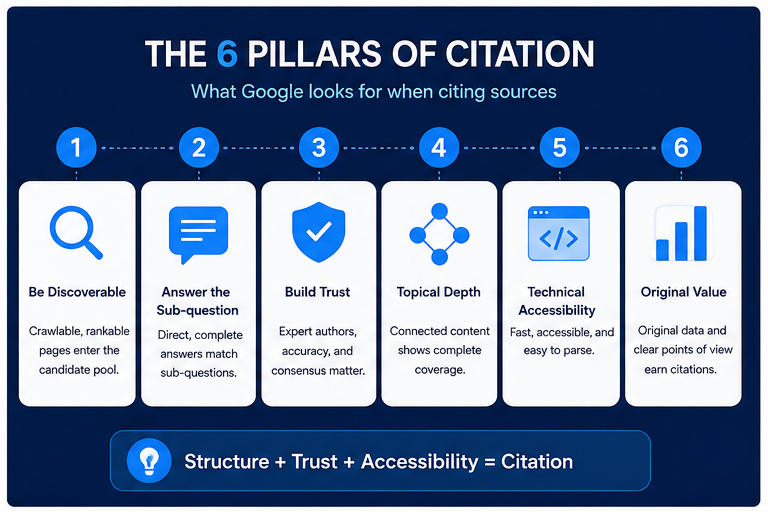
Answer the sub-question in the first sentence
Lead every section with the direct answer, then explain. AI systems weight the opening sentences of a passage most heavily when deciding what to extract, so a section that opens with background buries the answer the system is hunting for. If the heading asks "how much does HubSpot cost," sentence one states the price, not the history of the product.
This is the habit that moves the needle most, and it costs nothing. It also serves human readers, who scan for the same direct answer.
Use question-based headings that mirror real queries
Phrase your H2 and H3 headings the way people phrase queries, because Overviews are built by matching sub-questions to passages. A heading like "Pricing overview" gives the system little to match against, while "how much does it cost" maps directly onto a query someone actually types. Match the wording of real searches and People Also Ask questions rather than internal marketing labels.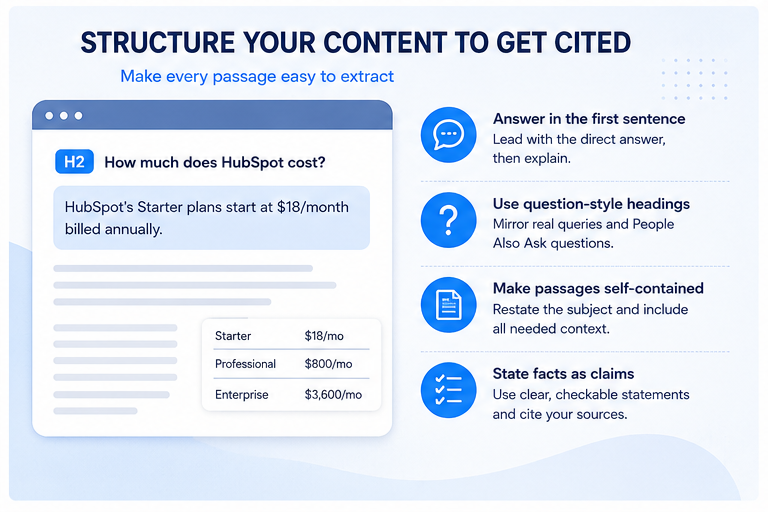
Keep most headings as questions, leaving a few structural ones like "Key takeaways" where a question would feel forced.
Make every passage self-contained
Write each section so it stands on its own, with no reliance on the paragraph before it. Overviews extract passages, not whole articles, so a section that says "as covered above" or leans on an earlier definition loses meaning the instant it is lifted out. Restate the subject by name and include the context the reader needs inside the section.
State facts as clear, checkable claims
Write facts as plain subject-verb-object statements a system can extract and verify. "AI Overviews appear above organic results for informational queries" is easy to quote and check. "The feature changes how things work for users" is not, because there is no clear subject and nothing to verify. Name the entity, use an active verb, attach a concrete object, and attribute any statistic to a named source at the point of claim.
Build topical depth, not just a single page
Cover the topic across a connected cluster of pages rather than one isolated post. When your site answers the main question and its neighbors, and those pages link to each other, Google sees consistent coverage and is more likely to treat you as a reliable source on the subject. A cluster on AI search, for instance, might connect a definition page, a platform-specific guide, and a technical checklist. We cover the foundation of the discipline in our guide on what AEO is, and the platform-specific angle in how to rank your website on ChatGPT in 2026.
Keep the page technically accessible
Make sure the pages you want cited can be crawled and rendered. Content that depends on JavaScript that never renders server-side, sits behind blocked robots rules, or hides under interstitials may never enter the candidate pool, no matter how good the answer is. This is the same technical hygiene that supports every Google search feature, and we maintain a full technical SEO checklist for AI Overviews that applies here.
Add author credentials and structured data
Attach a named author with a real bio and mark up your content with schema. A qualified author signals that a person stands behind the claims, and Article and FAQ schema help Google parse what the page is and which questions it answers. Both reduce the ambiguity Google faces when deciding whether to trust and cite a source.
Publish original data and a clear position
Give Google something it cannot find on ten other pages. Original research, first-party benchmarks, specific named examples, and a clear stated position all add net-new value over generic advice. When you draft with AI assistance, edit with human judgment and add real data so the result stays original and accurate, following Google's guidance on using generative AI content.
Can you track whether you are cited in AI Overviews?
Yes, though it takes more manual work than classic rank tracking. Run your target queries in Google and record whether an AI Overview appears, whether your page is cited, and which competitors are cited instead. Do this on a schedule so you see the trend, since Overviews vary by query and change over time.
Pair that manual check with analytics. In Search Console, watch for the gap between impressions and clicks, which widens as Overviews answer more queries on the page. Some SEO platforms now flag AI Overview presence for tracked keywords, which speeds up the manual sweep. As Google continues expanding AI features across search, described in its ongoing AI Mode updates, tracking citation presence becomes a standing part of reporting rather than a one-off audit.
Key takeaways
- Getting cited is a separate target from ranking first. Ranking gets you into the pool; clean passage structure gets you named.
- Lead every section with the answer, use query-style question headings, and keep passages self-contained so the system can extract them.
- State facts as checkable subject-verb-object claims, and attribute every statistic to a named source.
- Build a connected topic cluster and keep pages crawlable so you enter and stay in the candidate pool.
- Add author credentials, schema, and original data so Google trusts you enough to cite by name, then track citation presence on a schedule.
Want your pages to become the source Google cites? Webdew builds AEO and technical SEO programs that position B2B brands inside AI search. Talk to our team about where to start.
Dive Into our
Client Testimonials
Listen to business owners like you share how we’ve helped them grow. Your story could be next!





.svg)
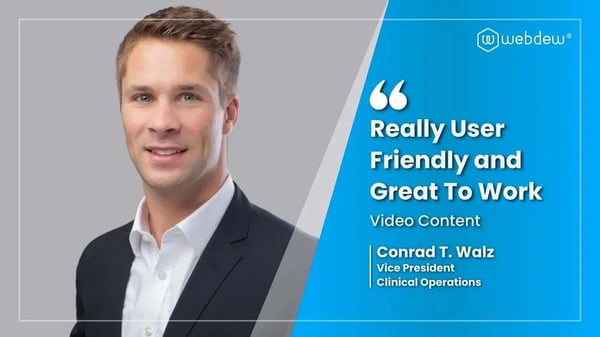
“Recently we reached out to Webdew for a website inside of HubSpot and they also did some mocking automation for us.”
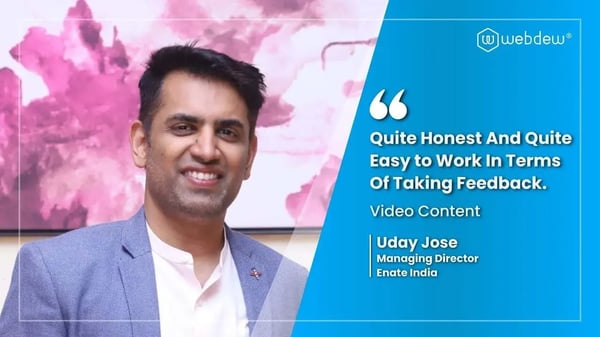
“Webdew team was quite honest and quite easy to work with in terms of taking feedback implementing it, showing that it doesn’t happen again and things like making sure that it meets our expectations.”
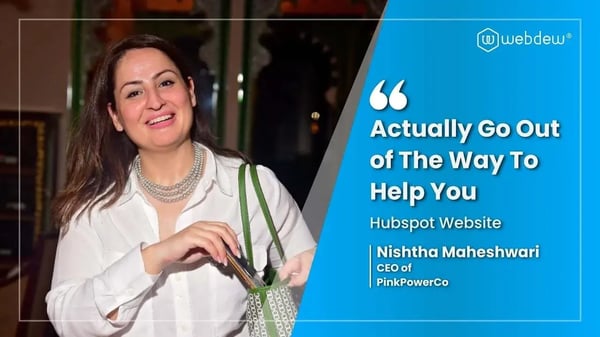
“We worked with webdew to help us build our HubSpot website and they did an amazing job with it. They were very quick.”
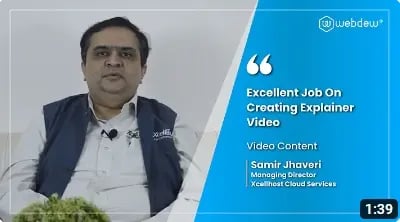
“webdew has helped us optimize the sales and marketing processes, and this is automating a lot of processes.”
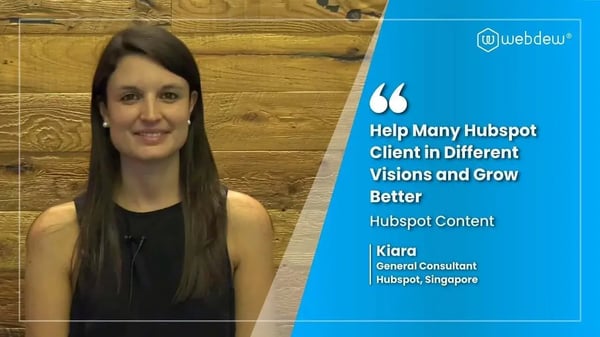
“Hi everyone my name is Kara and I work as a channel consultant at HubSpot Singapore. I’ve been working closely with webdew agency”
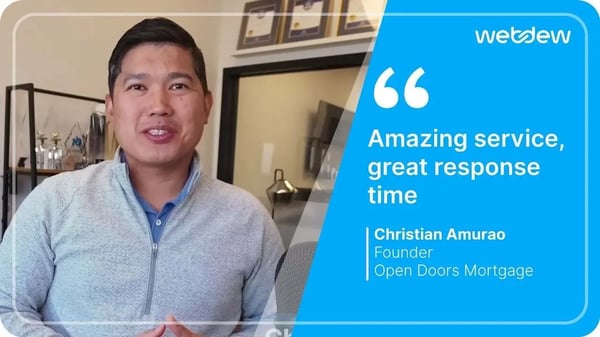
“Hi my name is Christian from OpenDoors Mortgage team and I’m in the mortgage business and just trying to work on new projects and kind of incorporating HubSpot for my operations”
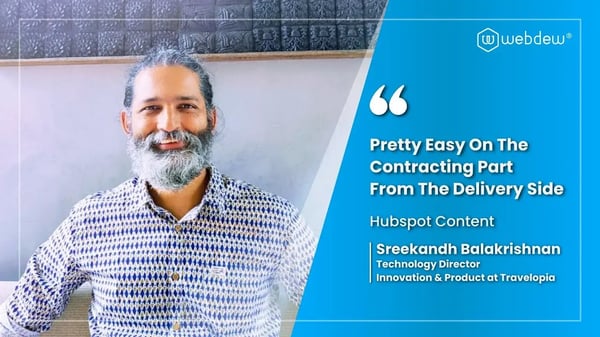
“I’m one of the technology directors for Travelopia. We are the largest experiential travel company in the world. We’ve engaged webdew recently, not recently, it’s been about a couple of quarters now.”
“We worked with Chehak over the past several months to create a series of animated videos for an academic planner that we produce. And from the very beginning, she was absolutely professional and a pleasure to work with.”


6x
We helped clients multiply their website conversion rates through strategic design and UX optimization.
20%
Our marketing campaigns led to a 20% uplift in customer engagement across digital channels.
2K+
Delivered over 2,000 qualified leads through targeted funnels and smart automation.
120+
Our video content has earned 120,000+ views, driving brand awareness and audience retention.
“I recently had the pleasure of working with Chehak on a video demo project, and I was thoroughly impressed with her services.”
.svg)

Additional Resources
Access expert tips, trends, and strategies designed for small businesses. Stay ahead of the curve and make informed decisions with our comprehensive resources!