


 We typically respond the same day

AI search engines pick their sources through a two-stage process: retrieval, where the system gathers a pool of candidate passages that might answer the query, and selection, where it decides which of those passages to use and which to cite by name. Ranking gets a page into the pool. Extractability and trust decide what comes out of it.
That split explains a pattern that confuses a lot of marketing teams. A page can rank well and never get cited, while a lower-ranked page gets named as the source. The two systems reward different things. At Webdew, this is the distinction we spend the most time explaining to B2B teams whose rankings look healthy while their AI visibility does not. This guide walks through how the selection process actually works across the major engines, what signals carry weight at each stage, and where the engines differ from one another.
TL;DR
- Source selection has two stages. Retrieval builds a candidate pool from the index; selection picks which passages answer the query and which sources get named.
- Engines retrieve passages, not pages. A section that only makes sense in context of the whole article extracts badly.
- Google decomposes complex queries into sub-questions and answers each from different sources, a technique it calls query fan-out.
- Trust signals break ties: named authorship, factual consistency across independent sources, and accuracy.
- The engines differ. Some cite live retrieved pages with links, others answer from training data with no citation at all, and they need different work.
What are the two stages of AI source selection?
The two stages are retrieval and selection, and they run in sequence. Retrieval assembles a set of candidate passages from an index using semantic matching, meaning the system compares the meaning of the query against the meaning of stored text rather than matching keywords literally. Selection then evaluates those candidates and decides which ones to synthesize into an answer and which to attribute.
The mechanics of retrieval are documented publicly by the model providers. OpenAI's own retrieval documentation describes the standard pattern: documents are split into chunks, converted into vector embeddings, and searched by semantic similarity to the query. This is the same architecture behind most retrieval-augmented systems, and it has a direct consequence for anyone publishing content. The unit of competition is the chunk, not the URL.
Why do AI engines retrieve passages instead of whole pages?
AI engines retrieve passages because they are assembling an answer to a specific question, not recommending a destination to visit. A 2,000-word article usually answers a dozen different questions. The system only needs the 80 words that address the one being asked, so it indexes and retrieves at roughly that granularity.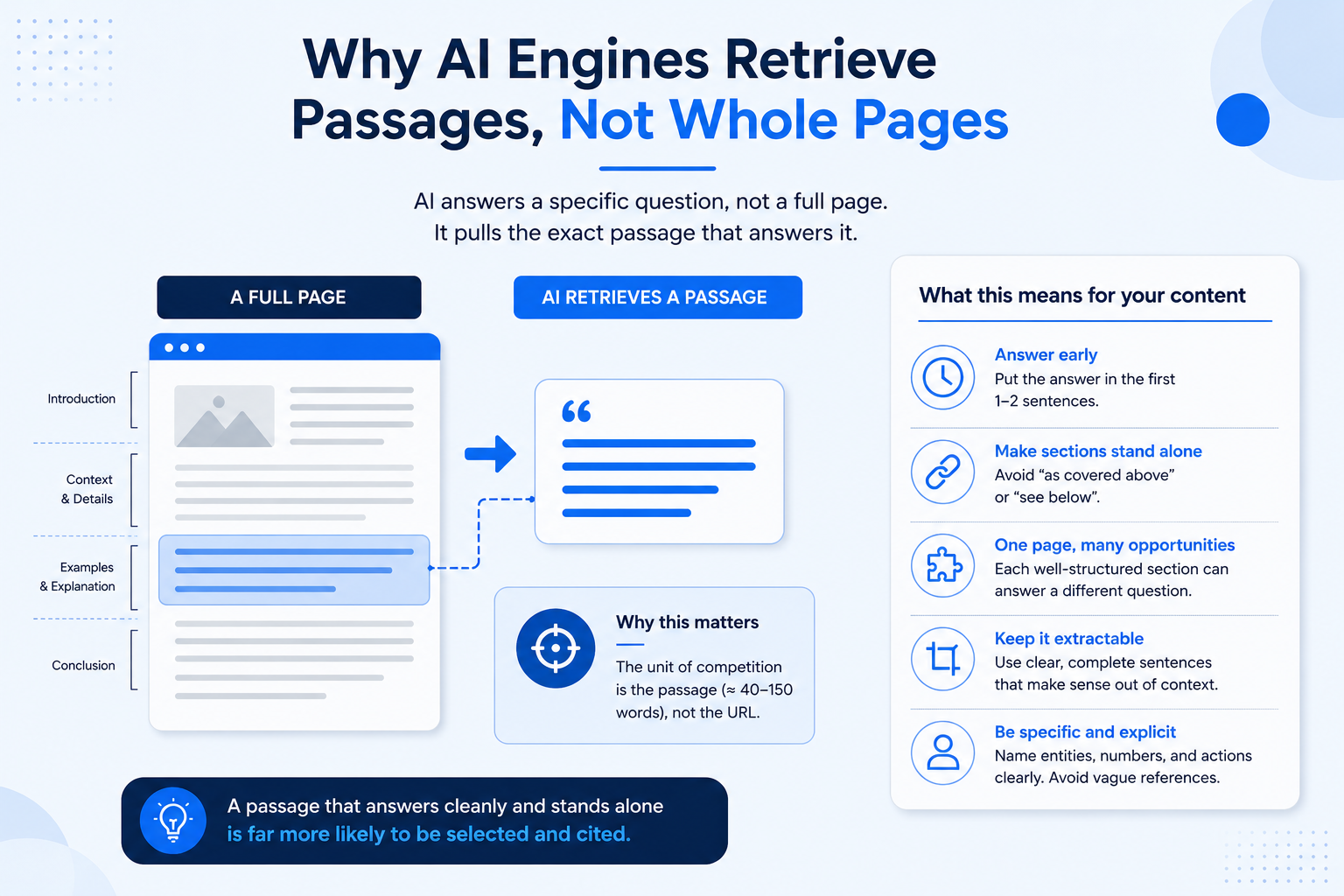
This is the single most important mechanical fact for content teams to internalize. It means a section that opens with context and buries its answer in the fourth sentence competes badly against a section that answers in the first. It means passages that say "as covered above" lose their meaning the moment they are lifted out of the article. And it means one strong page can be cited for several different queries if each of its sections answers a distinct question cleanly.
How does Google select sources for AI Overviews and AI Mode?
Google selects sources by breaking a query into related sub-questions, running searches for each, and drawing on different pages to answer different parts. Google describes this as a query fan-out technique in its AI Mode announcements, where a single complex prompt triggers multiple underlying searches across subtopics
.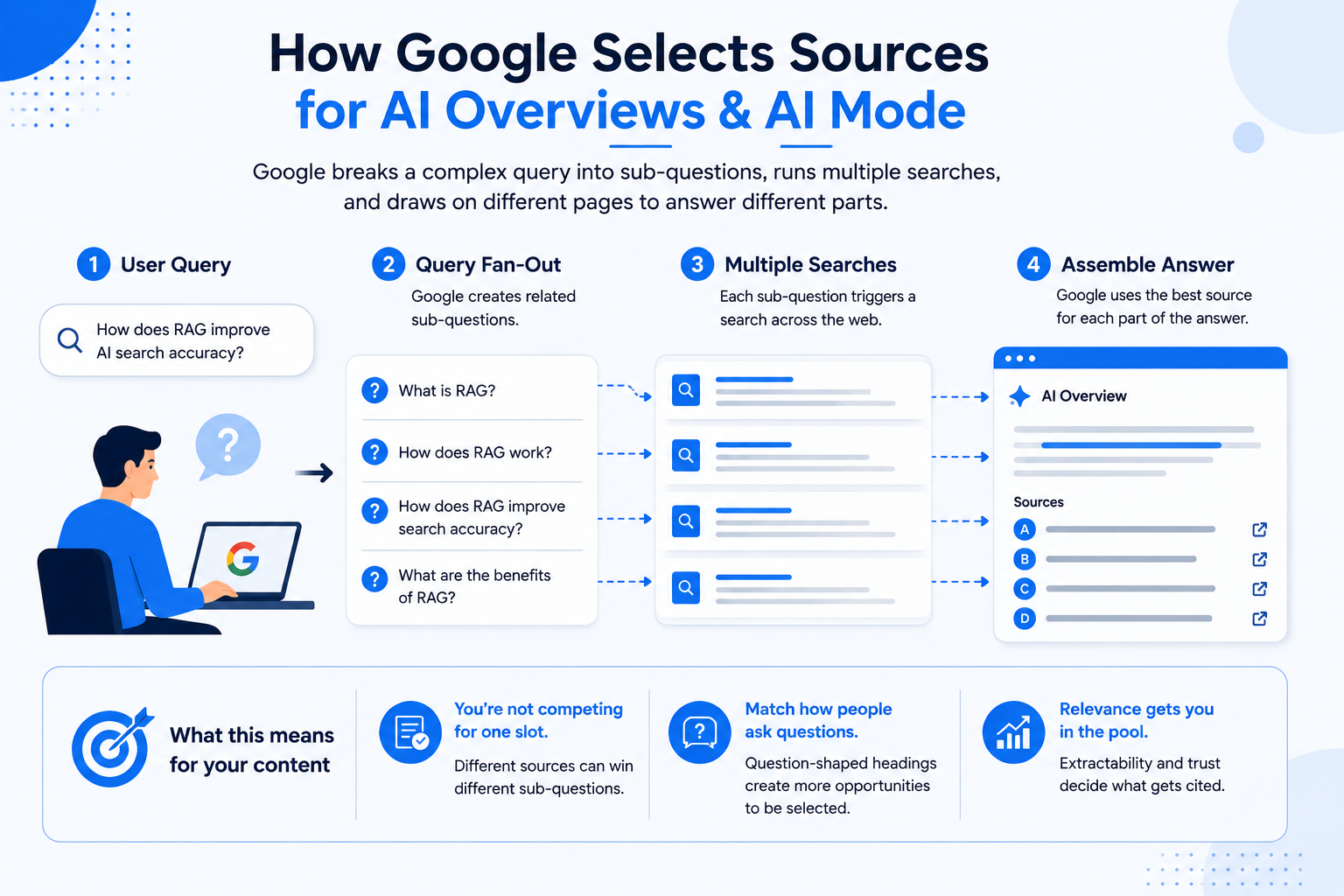
Two practical implications follow. First, a single answer can cite several sources because each one won a different sub-question, so you are not competing for one slot. Second, the sub-questions Google generates often will not match your headings unless your headings are phrased the way people phrase questions. A page organized around internal marketing labels has fewer surfaces that match a generated sub-question than a page organized around real queries.
Google's search index still supplies the candidate pool, so conventional relevance and crawlability remain the entry ticket. Webdew maintains a working technical SEO checklist for AI Overviews covering the crawl and render fundamentals that determine whether a page can be retrieved at all.
How do the major AI engines differ in picking sources?
They differ mainly in whether they answer from a live web fetch or from what the model already learned during training, and that difference changes what you can influence.
Live retrieval engines, including Google AI Overviews and AI Mode, ChatGPT search, and Perplexity, fetch current pages at query time and typically attach citations with links. These reward the things you can change this quarter: accessible pages, direct answers, question-shaped headings, and clear extractable claims.
Training-data answers work differently. When an assistant answers from memory without searching, there is no retrieval step and often no citation. What surfaces instead is whatever the model absorbed during training, which tends to be facts and brand names repeated consistently across many independent sources. You influence that slowly, through the kind of coverage that shows up in industry publications, comparison content, and third-party roundups over months rather than weeks.
Most teams need both tracks running. Our platform-specific guide on how to rank your website on ChatGPT in 2026 covers the split in more detail.
What signals decide which sources get cited?
Once several candidate passages could answer the query, the system falls back on signals of reliability and clarity. Four carry the most weight.
Answer directness
Whether the passage states the answer plainly and early. A passage that leads with the answer can be quoted almost verbatim, while one that circles the topic requires the model to infer, which makes it a weaker candidate for attribution.
Factual consistency across sources
Whether the claim matches what other credible sources say. Systems tend to favor claims corroborated elsewhere, because agreement across independent sources is a usable proxy for accuracy. A figure that appears only on your site and nowhere else is harder to trust than one echoed by several publishers.
Entity clarity
Whether the passage names its subject explicitly. "HubSpot workflows trigger email sequences from form submissions" identifies the actor and the action. "The system handles that automatically" does not, and a passage with unresolved pronouns is a poor extraction candidate because the meaning depends on text the system may not carry along.
Author and source credibility
Whether a qualified, named person stands behind the content and whether the site has a track record on the topic. Google's guidance on using generative AI content reinforces that human oversight and demonstrable expertise matter regardless of how content was drafted.
Does ranking still matter if engines pick passages?
Yes, because ranking largely determines whether your page enters the candidate pool in the first place. Retrieval draws from an index, and for Google that index and its relevance signals are the same ones behind conventional results. A page nobody can crawl, or one that ranks nowhere for the topic, rarely becomes a candidate.
What ranking no longer does is decide the outcome on its own. Being first gets you considered. Whether you get cited depends on how cleanly your passage answers the specific sub-question the system generated. Ranking and citation are sequential filters, not the same filter, which is why the practical playbooks for each are described separately in our guides on what AEO is and how to get cited in Google AI Overviews.
Key takeaways
- Source selection runs in two stages. Retrieval builds the candidate pool from the index; selection decides which passages get used and named.
- Engines compete at the passage level, so structure each section to answer one question in its opening sentence and to stand alone without earlier context.
- Google fans a complex query out into sub-questions, which is why question-shaped headings matched to real queries create more surfaces to win.
- Live retrieval and training-data recall are separate pathways. One rewards accessible, extractable pages now; the other rewards consistent cross-source coverage over time.
- Trust breaks ties. Named authors, explicit entities, and claims corroborated by independent sources beat unverifiable assertions.
Understanding how engines pick sources is the starting point. Webdew builds AEO and technical SEO programs that make B2B pages the ones AI systems retrieve and cite. Talk to our team about where to start.
Dive Into our
Client Testimonials
Listen to business owners like you share how we’ve helped them grow. Your story could be next!





.svg)
“Recently we reached out to Webdew for a website inside of HubSpot and they also did some mocking automation for us.”
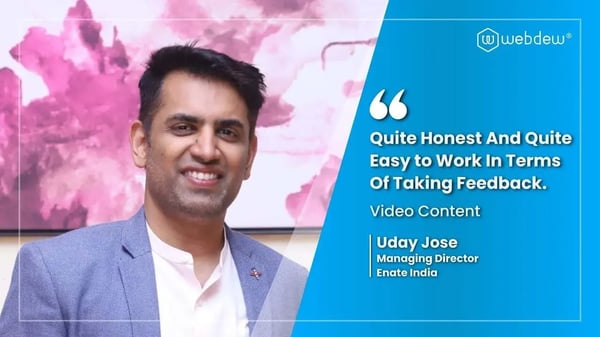
“Webdew team was quite honest and quite easy to work with in terms of taking feedback implementing it, showing that it doesn’t happen again and things like making sure that it meets our expectations.”
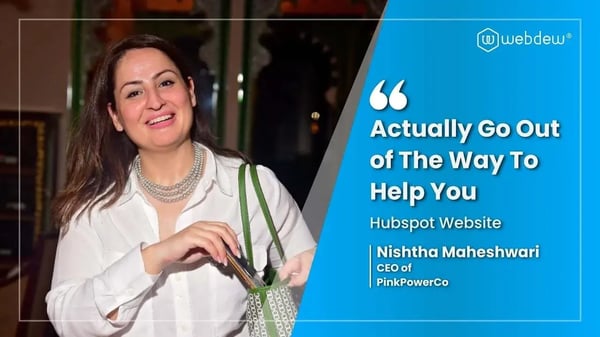
“We worked with webdew to help us build our HubSpot website and they did an amazing job with it. They were very quick.”
“webdew has helped us optimize the sales and marketing processes, and this is automating a lot of processes.”
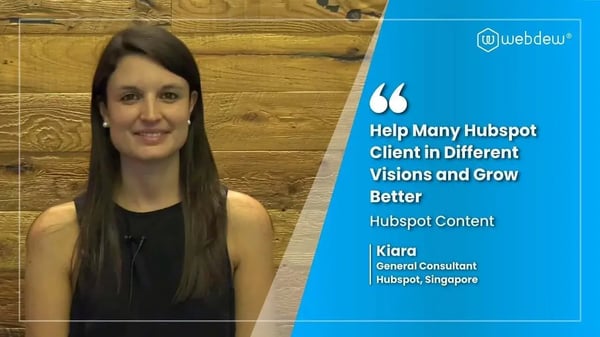
“Hi everyone my name is Kara and I work as a channel consultant at HubSpot Singapore. I’ve been working closely with webdew agency”
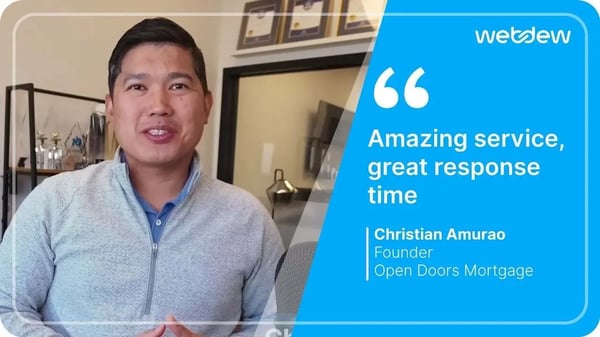
“Hi my name is Christian from OpenDoors Mortgage team and I’m in the mortgage business and just trying to work on new projects and kind of incorporating HubSpot for my operations”
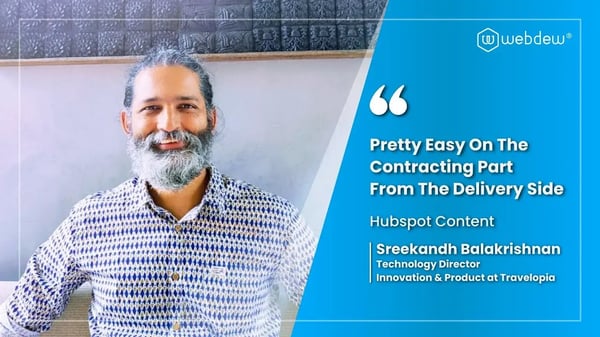
“I’m one of the technology directors for Travelopia. We are the largest experiential travel company in the world. We’ve engaged webdew recently, not recently, it’s been about a couple of quarters now.”
“We worked with Chehak over the past several months to create a series of animated videos for an academic planner that we produce. And from the very beginning, she was absolutely professional and a pleasure to work with.”


6x
We helped clients multiply their website conversion rates through strategic design and UX optimization.
20%
Our marketing campaigns led to a 20% uplift in customer engagement across digital channels.
2K+
Delivered over 2,000 qualified leads through targeted funnels and smart automation.
120+
Our video content has earned 120,000+ views, driving brand awareness and audience retention.
“I recently had the pleasure of working with Chehak on a video demo project, and I was thoroughly impressed with her services.”
.svg)

Additional Resources
Access expert tips, trends, and strategies designed for small businesses. Stay ahead of the curve and make informed decisions with our comprehensive resources!

.png)