


 We typically respond the same day

TL;DR
- B2B SaaS SEO services divide into nine functions: technical foundation, buying-stage keyword mapping, site architecture, topical authority content, product-led content, comparison pages, answer engine optimization, authority building, and measurement.
- Complex product lines change the priority order. Architecture and keyword mapping matter more for a multi-product company than for a single-product startup.
- Evaluate every service by revenue impact, not output volume. Each entry below includes the question that separates the two.
- Two functions are newly non-optional in 2026: answer engine optimization and measurement built for long sales cycles.
- Buy the services that fix your current constraint. Paying for content production when the constraint is architecture wastes both.
What are B2B SaaS SEO services?
B2B SaaS SEO services are the specialized functions that grow organic pipeline for software companies with long sales cycles, buying committees, and often multiple product lines. They differ from general SEO work in what they optimize for: influencing a committee over months rather than converting a single visitor in one session.
That difference matters when you buy. Generalist SEO work for SaaS tends to produce traffic that leadership cannot connect to pipeline, because the program was built around volume metrics rather than buying-stage coverage. The nine functions below are the ones that reliably move SaaS pipeline growth, each with a test for whether you are getting value.
Which 9 SEO services matter most for B2B SaaS?
1. Technical SEO foundation
Technical work makes everything else findable, and for SaaS sites it concentrates in specific places: documentation, security pages, integration listings, and app subdomains. These are validation-stage pages, and they are the ones most often thin, blocked, or unstructured.
Covers crawlability and indexation, Core Web Vitals, JavaScript rendering for app-adjacent pages, and redirect hygiene across accumulated subdomains. Teams new to this layer can ground themselves in SEO basics for website optimization before scoping the work.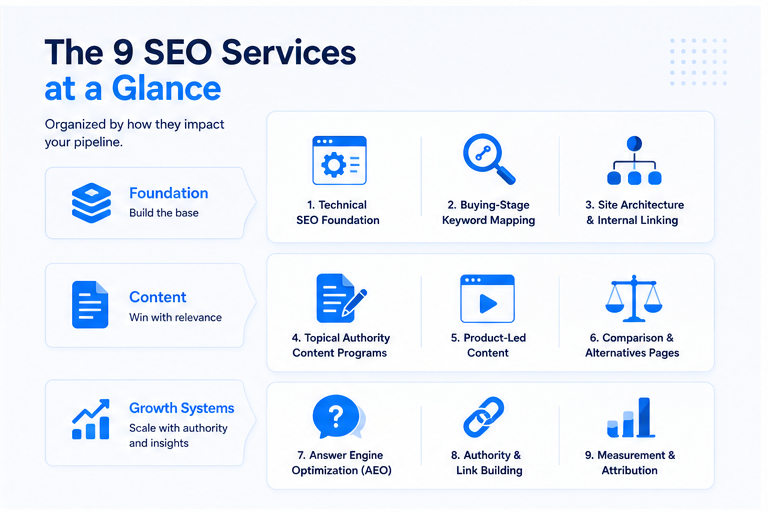
Revenue test: ask whether the pages a buying committee checks during evaluation are indexed and fast, not whether the site scores well on a generic audit tool.
2. Buying-stage keyword mapping
Keyword work for SaaS means mapping queries to committee roles and deal stages, not sorting a list by volume. The champion, the technical evaluator, the security reviewer, and finance each search differently about the same purchase.
Covers query research segmented by stage, intent classification, and a coverage map showing which stages you own and which you are absent from.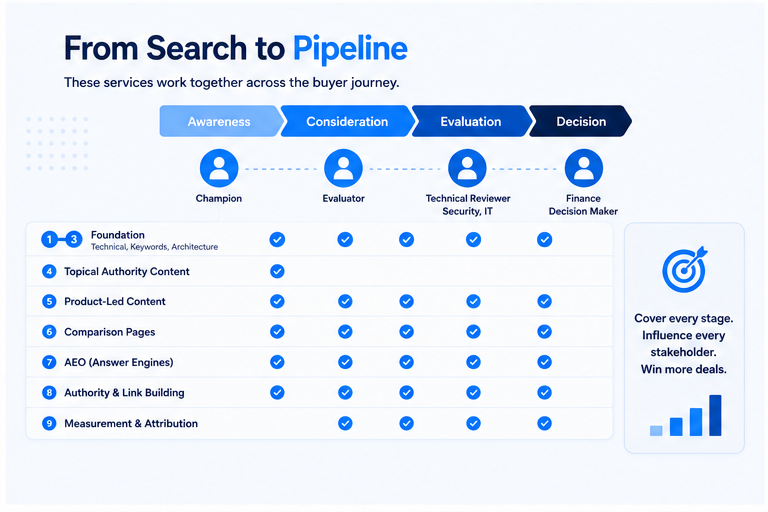
Revenue test: can the deliverable tell you which buying stage you are weakest in? A volume-sorted spreadsheet cannot.
3. Site architecture and internal linking
For companies with several product lines, architecture is often the highest-return service on this list and the least requested. Products launched at different times accumulate as disconnected page sets that compete with each other and split authority.
Covers URL taxonomy, hub-and-spoke clustering per product line, navigation structure, and an internal link plan with anchor text distribution.
Revenue test: does each product line have a clear hub, and can you name the three pages linking to your most commercially important page? If not, this is your constraint.
4. Topical authority content programs
Authority compounds when content stays tightly scoped to the categories you want to be known for. Programs that chase trending topics outside the niche dilute the signal they are trying to build.
Covers cluster planning, editorial calendars tied to a defined topic scope, and refresh cycles for decaying pages.
Revenue test: ask whether the plan says no to anything. A calendar that accepts every topic is not a strategy.
5. Product-led content
Product-led content shows the software solving the problem the query describes, which is what separates SaaS content that converts from content that only ranks. It requires writers who can operate the product, which is why it is the hardest service to buy well.
Covers use-case pages, workflow walkthroughs, integration content, and feature-to-outcome writing that names real mechanisms rather than benefits.
Revenue test: read one sample and check whether it could have been written without access to the product. If yes, it will not convert.
6. Comparison and alternatives pages
Shortlist-stage queries are where deals get shaped, and absence from them removes you from consideration before a conversation starts. These pages also attract the highest-intent traffic on most SaaS sites.
Covers versus pages, alternatives pages, category comparison tables, and honest fit statements that route poor-fit buyers elsewhere. The groundwork here is knowing the field, which starts with SEO competitive research.
Revenue test: do the pages state where a competitor is the better choice? Comparison content that never concedes anything reads as marketing and converts poorly.
7. Answer engine optimization
A growing share of committee research now happens inside AI answers rather than search results, which changes what content needs to look like structurally. AEO is the newest function on this list and the one most SaaS teams have not staffed; if the discipline is new to your team, start with what AEO is and how it differs from traditional search work.
Covers question-based structure with direct answers up front, schema markup, entity clarity, and citation monitoring across AI engines.
Revenue test: ask the partner to show you where your brand currently appears in AI answers for your category, before they propose anything. If they cannot measure the baseline, they cannot improve it.
8. Authority and link building
Authority signals still gate competitive rankings, and for SaaS the durable version looks like earned coverage and original data rather than placement volume. This service carries the most risk of buying something harmful.
Covers digital PR, original research and data studies, partner and integration listings, and cleanup of any toxic profile inherited from previous vendors.
Revenue test: ask for the last ten placements and check whether a target buyer would plausibly read those publications. Volume without relevance does nothing.
9. Measurement and attribution
For a nine-month sales cycle, last-click reporting will always undervalue organic search, and programs get cut on that bad math. Measurement built for the real cycle is what keeps good SEO funded.
Covers stage-coverage tracking, presence of organic pages in closed-won account journeys, target-account engagement on validation pages, and branded search trend reporting.
Revenue test: can the reporting show whether organic content appeared anywhere in your last ten closed-won deals? If the answer is only "sessions and rankings," you cannot defend the budget.
How should you evaluate these services by revenue impact?
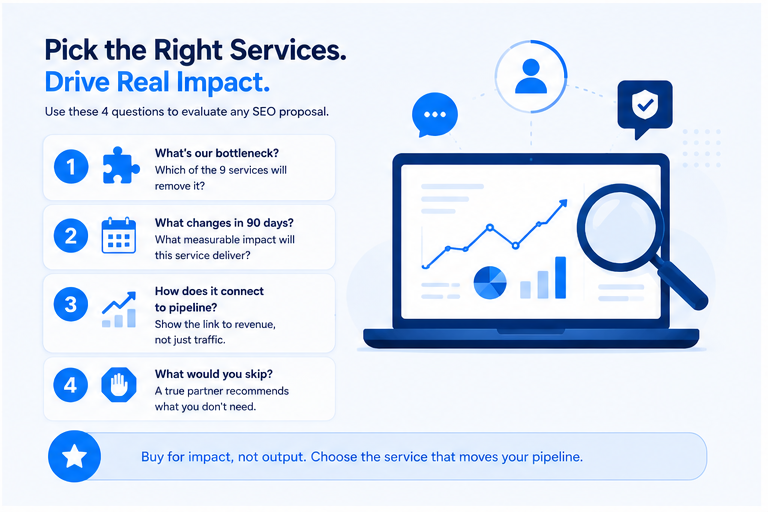
Buy against your current constraint, and use a consistent test for every proposal. Four questions cut through most sales conversations:
- Which of the nine functions is our bottleneck right now? Traffic problems, conversion problems, and absence problems have different answers.
- What would this service change in ninety days, stated as a measurable? Vague deliverables produce vague outcomes.
- How does it connect to pipeline, not sessions? Every function above has a revenue test; ask for it explicitly.
- What does the partner recommend we skip? A proposal covering all nine equally is a scope document, not a diagnosis.
Most SaaS teams do not need all nine at once. They need two done properly, sequenced against the constraint, with the measurement function running underneath so the results are provable.
Key takeaways
- The nine functions cluster into three groups: foundation (technical, keyword mapping, architecture), content (topical authority, product-led, comparison), and growth systems (AEO, authority, measurement).
- Multi-product companies should weight architecture and keyword mapping first; single-product teams usually start with comparison pages and product-led content.
- Answer engine optimization and long-cycle measurement are the two functions that moved from optional to necessary most recently.
- Apply each function's revenue test before buying, and treat a proposal that recommends nothing be skipped as a warning sign.
If you are unsure which function is your constraint, the stage-coverage question is the fastest diagnostic: list your target queries by buying stage and see where you are absent. Webdew works with B2B SaaS marketing teams on exactly this sequencing, from technical and architecture work through content programs and AEO. Explore Webdew's SEO services or talk to the team about a stage-coverage audit scoped to your product lines.
Dive Into our
Client Testimonials
Listen to business owners like you share how we’ve helped them grow. Your story could be next!




.svg)
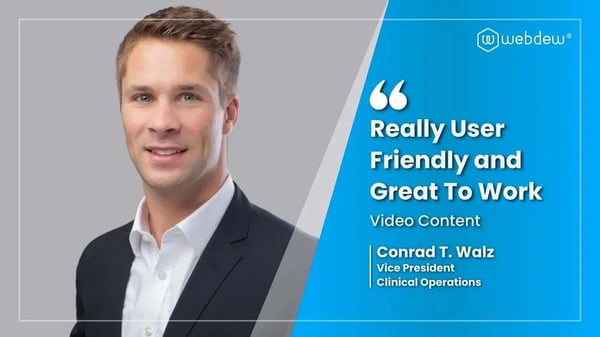
“Recently we reached out to Webdew for a website inside of HubSpot and they also did some mocking automation for us.”
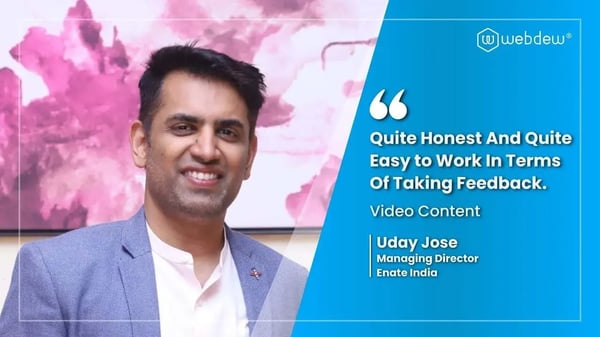
“Webdew team was quite honest and quite easy to work with in terms of taking feedback implementing it, showing that it doesn’t happen again and things like making sure that it meets our expectations.”
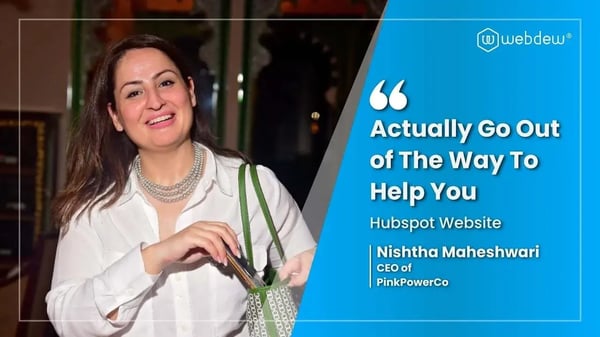
“We worked with webdew to help us build our HubSpot website and they did an amazing job with it. They were very quick.”
“webdew has helped us optimize the sales and marketing processes, and this is automating a lot of processes.”
“Hi everyone my name is Kara and I work as a channel consultant at HubSpot Singapore. I’ve been working closely with webdew agency”
“Hi my name is Christian from OpenDoors Mortgage team and I’m in the mortgage business and just trying to work on new projects and kind of incorporating HubSpot for my operations”
“I’m one of the technology directors for Travelopia. We are the largest experiential travel company in the world. We’ve engaged webdew recently, not recently, it’s been about a couple of quarters now.”
“We worked with Chehak over the past several months to create a series of animated videos for an academic planner that we produce. And from the very beginning, she was absolutely professional and a pleasure to work with.”


6x
We helped clients multiply their website conversion rates through strategic design and UX optimization.
20%
Our marketing campaigns led to a 20% uplift in customer engagement across digital channels.
2K+
Delivered over 2,000 qualified leads through targeted funnels and smart automation.
120+
Our video content has earned 120,000+ views, driving brand awareness and audience retention.
“I recently had the pleasure of working with Chehak on a video demo project, and I was thoroughly impressed with her services.”
.svg)

Additional Resources
Access expert tips, trends, and strategies designed for small businesses. Stay ahead of the curve and make informed decisions with our comprehensive resources!

.png)