

 We typically respond the same day

The nature of how people find brands, compare products and services and make purchasing decisions online is being altered by the use of AI search. Google’s AI Overviews, ChatGPT Search, Perplexity, and AI Mode are no longer simply experimental features. They are becoming a normal part of the typical search journey.
For marketers and SEO professionals, this raises an essential question:
How can you improve your chances of being cited in AI-generated answers?
A recent Semrush study analyzed 5 million URLs cited by ChatGPT Search and Google AI Mode to understand which technical SEO factors correlate with AI visibility. The study provides one definitive insight: technical SEO still plays a role, however, not always directly as a ranking variable. Rather than having a solid technical background, strong technical foundations enable AI systems to access, understand, and trust your content.
In this blog, we will examine the results from this study and translate them into a checklist for you to utilize in optimizing your website for AI-Related Overviews and Search Visibility.
What does AI visibility mean?
AI visibility refers to how often your brand, website, or content appears in AI-generated responses.
This can include:
- Being cited as a source in Google AI Overviews
- Getting mentioned in ChatGPT Search or Perplexity answers
- Appearing as a recommended brand in AI-generated comparisons
- Having your content referenced for definitions, steps, statistics, or product explanations
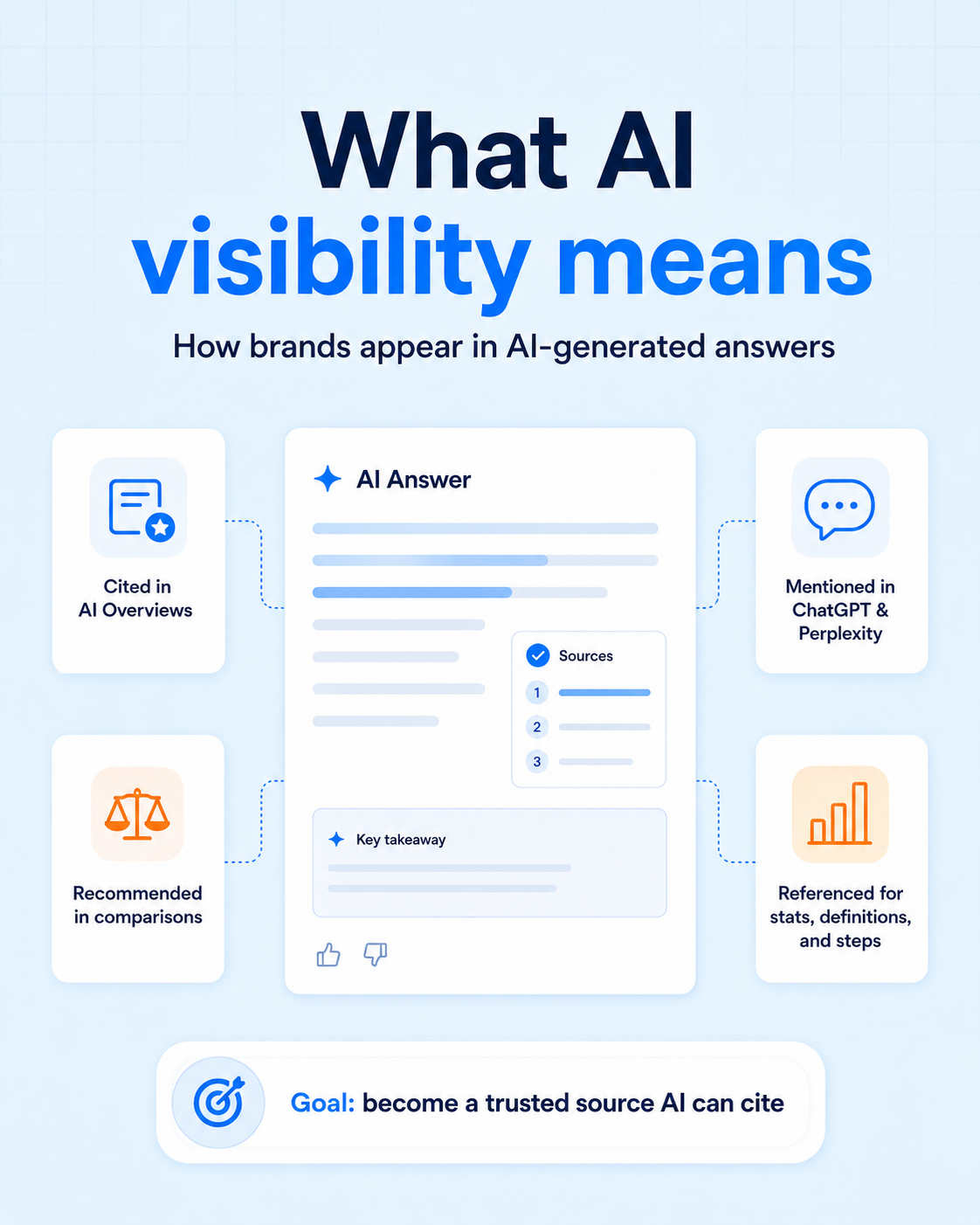
Unlike traditional SEO, where the goal is to rank in blue links, AI visibility is about becoming a trusted source that AI systems can cite.
If you are still new to this concept, you can also read our guide on what AEO is to understand how Answer Engine Optimization connects with modern SEO.
Why technical SEO matters for AI Overviews
According to the Semrush study on technical SEO factors and AI search visibility, pages cited by AI platforms often share strong technical foundations.
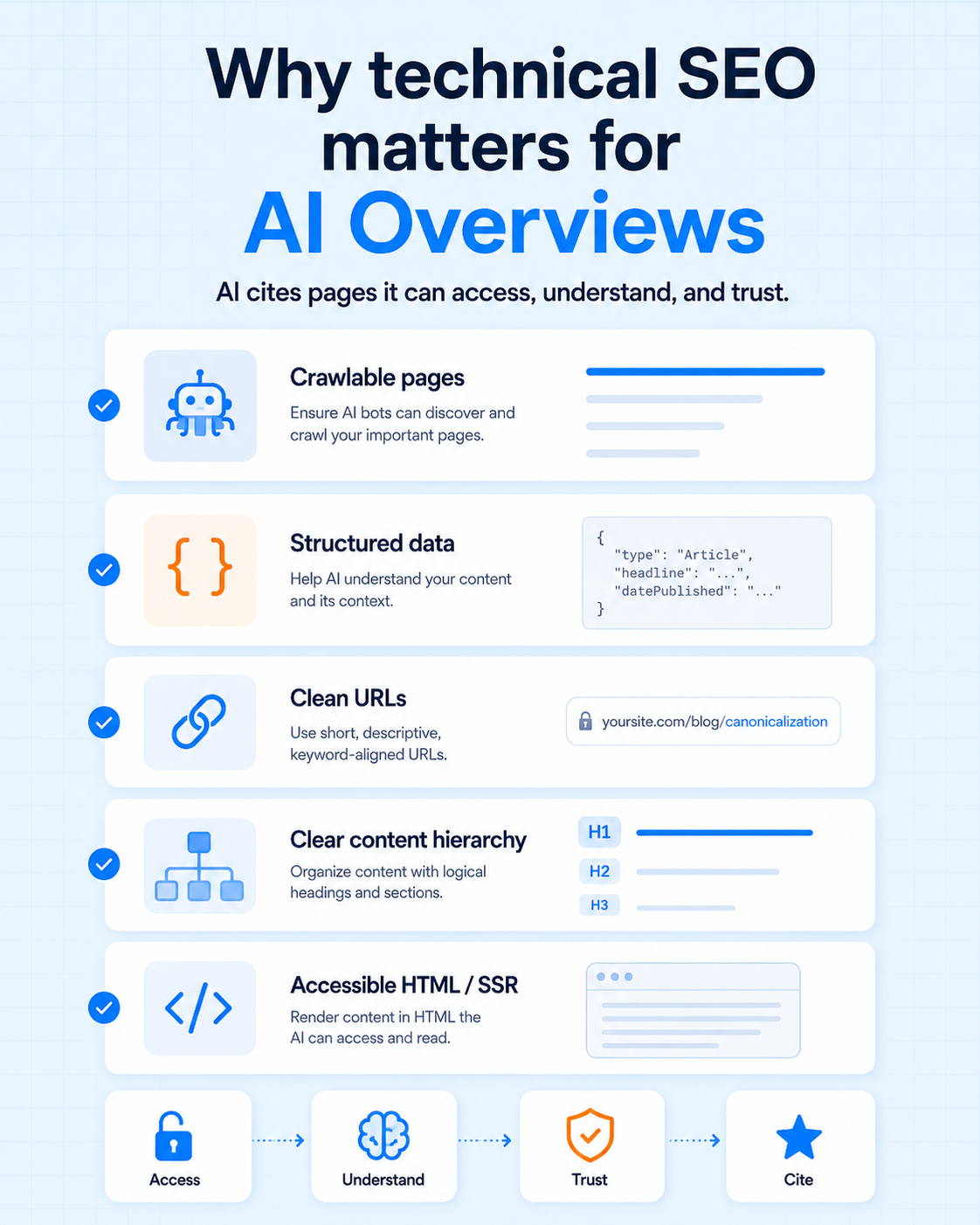
The study does not claim these are direct ranking factors. Instead, it shows that these elements are commonly found on pages that AI systems cite.
That means technical SEO should be treated as the foundation for AI visibility. Without it, even great content may be harder for AI systems to access, understand, or trust.
AI Overview optimization checklist
Below is a practical checklist you can use to improve your chances of ranking in Google AI Overviews and other AI-powered search results.
1. Make sure your pages are crawlable
AI systems cannot cite content they cannot access.
Your priority should be making sure important pages are crawlable by search engines and AI crawlers.
Checklist:
- Allow Googlebot to crawl important pages
- Avoid blocking important pages in robots.txt
- Submit and maintain an XML sitemap
- Fix 404 errors and redirect chains
- Make sure canonical tags point to the correct version of the page
- Avoid hiding important content behind JavaScript
- Ensure important content is available in clean HTML
For AI search, crawlability is not just a technical SEO best practice. It is a visibility requirement.
If your content is difficult to crawl, AI systems may skip it in favor of clearer, easier-to-parse pages.
2. Use server-side rendering where possible
JavaScript-heavy websites can create issues for AI crawlers.
While Google can render JavaScript better than many systems, not every AI crawler processes JavaScript in the same way. If your main content only appears after client-side rendering, some AI systems may struggle to access it properly.
Checklist:
- Use server-side rendering for important content
- Make sure the primary text appears in the initial HTML
- Avoid placing essential information inside scripts only
- Test pages using Google Search Console’s URL inspection tool
- Check how the page appears with JavaScript disabled
This is especially important for SaaS websites, product pages, blogs, pricing pages, and comparison pages.
AI systems prefer content that is easy to retrieve, parse, and summarize.
3. Implement structured data
Structured data helps search engines and AI systems understand entities, relationships, authorship, and page context.
The Semrush study found that AI-cited pages often used schema markup, especially:
- Organization schema
- Article schema
- BreadcrumbList schema
Google AI Mode cited pages with even higher structured data implementation rates compared to ChatGPT Search.
Checklist:
- Add Organization schema sitewide
- Add Article or BlogPosting schema to blog posts
- Add BreadcrumbList schema to pages with hierarchy
- Add FAQ schema where relevant
- Add Product schema for product or service-related pages
- Add Review schema only when reviews are genuine and visible on the page
- Use JSON-LD format where possible
- Validate schema using Google’s Rich Results Test or Schema Markup Validator
Recommended schema types for AI Overview optimization: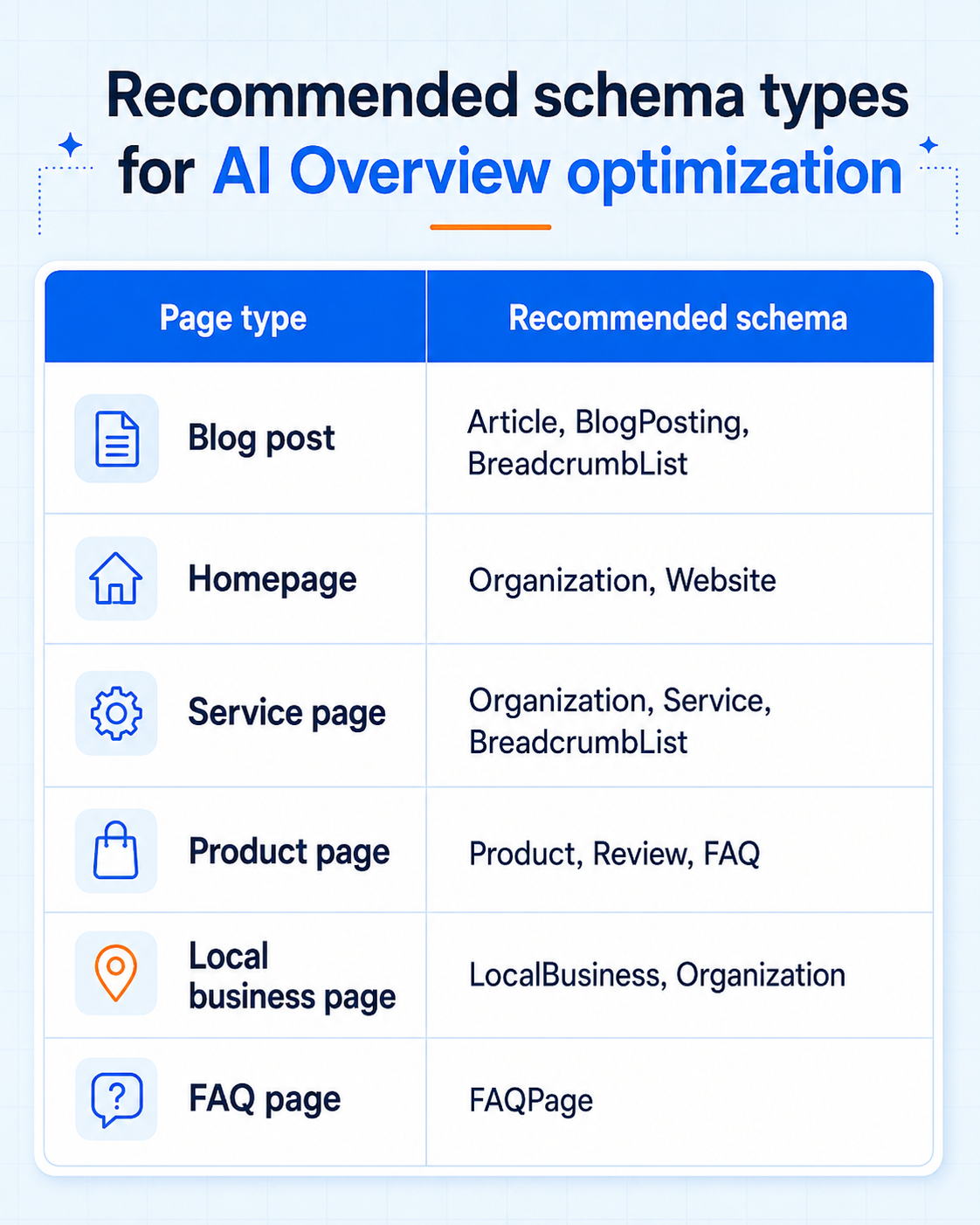
Structured data will not guarantee AI Overview rankings, but it can help AI systems better understand your content and brand entities.
4. Optimize URL slugs
The Semrush study found that URLs with moderate slug lengths performed better among AI-cited pages.
The strongest pattern appeared around 17–40 characters, with 21–25 character slugs receiving the highest number of citations.
This does not mean every URL must follow an exact character count. But it does suggest that clear, descriptive, and concise URLs are easier for systems to interpret.
Good examples:
- /ai-overview-seo
- /technical-seo-checklist
- /answer-engine-optimization
Poor examples:
- /post?id=7392
- /blog/category/seo/articles/2026/january/complete-guide-ai-overviews-ranking-strategy
- /ai
Checklist:
- Keep URLs descriptive
- Avoid unnecessary parameters
- Avoid keyword stuffing
- Use hyphens between words
- Keep folder depth short
- Include the main topic naturally
- Avoid changing URLs unless necessary
A clean URL gives both users and AI systems a quick understanding of what the page is about.
5. Structure content for direct answers
AI Overviews are designed to answer user questions quickly. So your content should make answers easy to extract.
Instead of writing long introductions before reaching the main point, provide a clear answer early on.
Checklist:
- Start sections with direct answers
- Use question-based headings
- Include short summaries
- Use lists and tables
- Define important terms clearly
- Add “Key Takeaways” sections
- Use step-by-step formatting where relevant
Example:
Instead of:
“AI Overviews have become a major part of modern search behavior, and businesses are now trying to understand how they work…”
Use:
“AI Overviews are AI-generated summaries that appear in Google Search to answer a user’s query using information from multiple sources.”
This makes your content easier for AI systems to quote, summarize, and cite.
For a deeper breakdown, read our guide on how to rank on Google’s AI Overviews.
6. Use conversational formatting
The Semrush study also highlights the importance of conversational formatting.
AI systems often surface content that is organized in a way that mirrors natural user questions.
Checklist:
- Use headings like “What is…?”, “How does…?”, and “Why does…?”
- Add FAQ sections
- Answer one question per section
- Keep paragraphs short
- Avoid unnecessary jargon
- Use examples to explain complex points
For example:
What is technical SEO for AI Overviews?
Technical SEO for AI Overviews is the process of making your website easier for AI systems to crawl, understand, and cite. It includes crawlability, structured data, page speed, clean URLs, mobile experience, and clear content hierarchy.
This type of format works well because it aligns with how users ask questions in AI search tools.
7. Improve engagement signals
The Semrush study found that AI-cited URLs often had stronger user engagement metrics, including:
- Longer session duration
- Lower bounce rate
- More pages per visit
- Higher conversion rates
However, engagement happens after the click, while AI citation happens before the click. So engagement is likely not a direct AI ranking factor.
Instead, strong engagement may reflect underlying quality signals such as better content, clearer UX, faster pages, and stronger trust.
Checklist:
- Improve page speed
- Make content easy to scan
- Add internal links to related resources
- Use clear calls to action
- Reduce intrusive popups
- Improve mobile usability
- Add helpful visuals
- Make navigation simple
When users engage better with your pages, it usually means your content is clearer, more useful, and more trustworthy.
Those same qualities can make your page more suitable for AI citations.
8. Add strong entity signals
AI systems need to understand who created the content, who owns the website, and why the source should be trusted.
Entity optimization helps AI connect your brand, authors, services, and topics.
Checklist:
- Use a consistent brand name across the website
- Add author bios to blog posts
- Include organization details
- Link to social profiles using the sameAs schema
- Mention relevant products or services clearly
- Build topic clusters around core services
- Maintain consistent NAP details for local businesses
- Add About, Contact, and Editorial Policy pages where relevant
For example, if your website publishes SEO content, AI systems should be able to clearly understand:
- Who the author is
- What the brand does
- What topics are the website authoritative on
- Which services or products does the company offer
Clear entity signals can help improve topical trust.
9. Use internal linking strategically
Internal links help search engines and AI systems understand relationships between your pages.
They also guide users to related content, improving engagement and topical depth.
Checklist:
- Link from informational blogs to service pages
- Link related blogs together
- Use descriptive anchor text
- Create topic clusters
- Add breadcrumbs
- Avoid orphan pages
- Keep important pages within a few clicks from the homepage
For example, a blog about AI Overview optimization should naturally link to related resources like:
This helps both users and AI systems understand the broader context of your content.
10. Add metadata for better context
Metadata gives platforms additional information about your page.
The Semrush study found that Open Graph, Twitter Cards, and schema.org JSON-LD appeared frequently on AI-cited pages.
Checklist:
- Add title tags
- Add meta descriptions
- Add Open Graph title and description
- Add Open Graph image
- Add Twitter Card tags
- Add canonical tags
- Use descriptive image alt text
- Keep metadata aligned with page content
Open Graph and Twitter Cards are not traditional ranking factors, but they help define the page’s identity across platforms.
For AI systems, this can add another layer of context.
11. Monitor AI crawler activity
As AI search grows, more websites are seeing activity from AI crawlers.
Monitoring logs can show which AI crawlers visit your site and which pages they access.
Checklist:
- Monitor Googlebot
- Monitor OAI-SearchBot
- Monitor GPTBot
- Monitor PerplexityBot
- Monitor ClaudeBot where relevant
- Identify crawl errors
- Check server response times
- Review which pages are being crawled most often
- Decide whether any crawler rules are needed in robots.txt
This can help you understand what content AI systems are accessing and whether technical barriers are limiting visibility.
12. Build pages that are easy to cite
AI Overviews often cite pages that clearly answer a question or explain a concept.
To improve your chances, create pages that include citation-friendly elements.
Checklist:
- Add definitions
- Include original statistics
- Use comparison tables
- Add step-by-step processes
- Include expert commentary
- Summarize key points
- Use clear source references
- Keep information updated
- Add publish and modified dates
Example sections that work well for AI search:
- “What is…?”
- “How does it work?”
- “Why is it important?”
- “Benefits”
- “Examples”
- “Common mistakes”
- “FAQs”
- “Key takeaways”
These sections make it easier for AI systems to extract useful information from your page.
AI Overview technical SEO checklist
Here is a quick checklist you can use for every important page:
- Crawlable by Google and AI crawlers
- Important content visible in HTML
- Server-side rendering is used where possible
- Fast page speed
- Mobile-friendly design
- Clean URL slug
- Clear H1 and heading structure
- Direct answer near the top
- Organization schema added
- Article or BlogPosting schema added
- BreadcrumbList schema added
- Open Graph tags added
- Twitter Cards added
- FAQ section included where relevant
- Internal links added
- Author information included
- Updated date visible
- Helpful visuals included
- Clear CTA added
- No major indexation errors
- No broken internal links
Common mistakes to avoid
While optimizing for AI Overviews, avoid these mistakes:
- Blocking important content from crawlers
- Relying too heavily on JavaScript
- Publishing thin or generic content
- Stuffing keywords into URLs
- Adding fake or irrelevant schema
- Ignoring mobile performance
- Writing vague introductions without direct answers
- Publishing content without an author or brand context
- Forgetting internal links
- Treating AI Overview optimization as separate from SEO
AI search optimization is not about tricking AI systems. It is about making your content easier to access, understand, verify, and cite.
Final thoughts
The Semrush study shows that pages cited by AI platforms often have strong technical SEO foundations. Structured data, clean URLs, crawlability, page experience, and content clarity all appear to create favorable conditions for AI visibility.
But these elements should not be treated as isolated ranking hacks.
To improve your chances of appearing in AI Overviews, focus on building pages that are:
- Technically accessible
- Clearly structured
- Entity-rich
- Helpful to users
- Easy for AI systems to understand
- Strong enough to be cited as a trusted source
As AI search continues to evolve, brands that combine traditional SEO with Answer Engine Optimization will have a stronger chance of staying visible across both Google and AI-powered discovery platforms.
Want to improve your visibility in AI Overviews? Connect with webdew and start optimizing your website for AI-powered search.
Dive Into our
Client Testimonials
Listen to business owners like you share how we’ve helped them grow. Your story could be next!





.svg)
“Recently we reached out to Webdew for a website inside of HubSpot and they also did some mocking automation for us.”
“Webdew team was quite honest and quite easy to work with in terms of taking feedback implementing it, showing that it doesn’t happen again and things like making sure that it meets our expectations.”

“We worked with webdew to help us build our HubSpot website and they did an amazing job with it. They were very quick.”
“webdew has helped us optimize the sales and marketing processes, and this is automating a lot of processes.”
“Hi everyone my name is Kara and I work as a channel consultant at HubSpot Singapore. I’ve been working closely with webdew agency”
“Hi my name is Christian from OpenDoors Mortgage team and I’m in the mortgage business and just trying to work on new projects and kind of incorporating HubSpot for my operations”
“I’m one of the technology directors for Travelopia. We are the largest experiential travel company in the world. We’ve engaged webdew recently, not recently, it’s been about a couple of quarters now.”
“We worked with Chehak over the past several months to create a series of animated videos for an academic planner that we produce. And from the very beginning, she was absolutely professional and a pleasure to work with.”


6x
We helped clients multiply their website conversion rates through strategic design and UX optimization.
20%
Our marketing campaigns led to a 20% uplift in customer engagement across digital channels.
2K+
Delivered over 2,000 qualified leads through targeted funnels and smart automation.
120+
Our video content has earned 120,000+ views, driving brand awareness and audience retention.
“I recently had the pleasure of working with Chehak on a video demo project, and I was thoroughly impressed with her services.”
.svg)

Additional Resources
Access expert tips, trends, and strategies designed for small businesses. Stay ahead of the curve and make informed decisions with our comprehensive resources!