

 We typically respond the same day

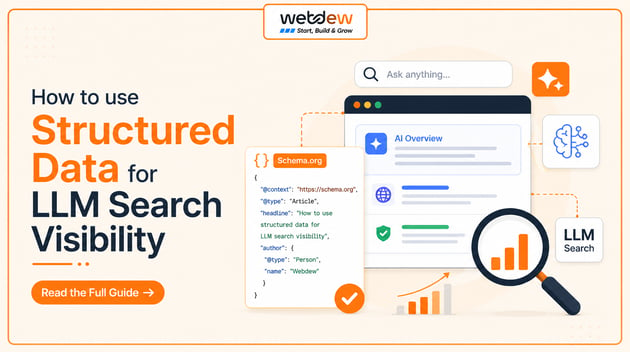
TL;DR: Structured data labels your content so AI systems can read it without guessing. When AI search tools like ChatGPT, Perplexity, Google AI Overviews, and Gemini compile answers, they pull from pages where facts are explicit and machine-readable, not buried in unstructured prose. This guide covers what structured data is, which schema types matter most for AI visibility, and how to implement it so your content gets cited, not skipped.
Search has changed faster in the past two years than in the previous decade. Users now get answers directly from AI tools rather than clicking through a list of blue links. Google's AI Overviews appear on a growing share of queries. ChatGPT now browses the web. Perplexity cites sources inline as it generates responses.
For marketers and SEO teams, the implications are practical: a page can rank on page one and still get zero credit in an AI-generated answer if the content is not structured in a way that AI retrieval systems can parse.
Structured data is how you close that gap. It is not a new concept, but its role has shifted. What used to be a tactic for earning star ratings and event carousels in traditional search is now a core signal for how large language models (LLMs) interpret, extract, and cite your content.
This guide explains how structured data works in an AI search context, which schema types carry the most weight, and what implementation looks like in practice.
What is structured data, and why do AI systems depend on it?
Structured data is machine-readable markup added to a webpage that tells external systems what the content means, not just what it says. HTML tells a browser how to display text. Structured data tells search engines and AI crawlers what that text represents: a product, an article, a question and answer pair, an organization.
The standard vocabulary is Schema.org, a shared specification created by Google, Microsoft, Yahoo, and Yandex. Most implementations use JSON-LD, a format that sits in a <script type="application/ld+json"> block separate from the page HTML. It is the format Google recommends and the one most easily parsed by crawlers, including those that do not execute JavaScript.
Traditional search engines used structured data primarily to generate rich results: star ratings, event times, product prices, FAQ dropdowns. Those features still matter. But the more consequential shift is happening in AI retrieval.
LLMs do not guess. When an AI system retrieves your page to assemble an answer, it scans for explicit signals. Without structured markup, a model has to infer whether a number represents a price, a rating, a year, or a statistic. It has to guess whether a name is an author, a company, or a subject. That inference introduces errors and reduces the likelihood your content gets used accurately.
Structured data removes the ambiguity. It labels fields directly so that retrieval systems can extract verifiable facts rather than inferred ones.
Microsoft has confirmed that Bing uses Schema.org markup to help its models, including Bing Chat and Copilot, understand page content. Google has not disclosed the exact mechanics behind AI Overviews, but the behavior of those results (favouring clearly marked up, factually precise pages) points in the same direction. OpenAI's GPTBot crawler parses static HTML and processes embedded JSON-LD.
If you are thinking about answer engine optimization or trying to understand how AI search engines pick their sources, structured data is one of the clearest on-page levers available to you.
How does AI retrieval actually work?
From rankings to extraction
Traditional search worked by ranking pages. AI search works by extracting facts from pages and assembling those facts into a response. The shift matters because a page no longer needs to rank first. It needs to be usable as a source.
Many AI search systems use a technique called retrieval-augmented generation (RAG). The workflow has two stages. First, the system retrieves relevant documents from a web index or internal knowledge base. Second, it passes those documents to a language model, which assembles a response using the retrieved content as context.
Structured data improves both stages. During indexing, clearly labelled fields let the system build richer semantic representations of your content. During retrieval, those labels help the system match your page to relevant queries with greater precision. During generation, the model can pull exact values from structured fields (a price, a publish date, an author name) rather than inferring them from surrounding text.
Why clarity beats volume
AI systems do not reward more content. They reward clearer content. A page with 800 words and tight, explicitly labelled facts is more likely to be cited than a 3,000-word page where the key claims are buried in long paragraphs.
This is the same principle that drives good AEO content strategy: answer the question directly, label the answer clearly, and give the AI system nothing to guess at.
Structured data makes that clarity machine-readable.
Which schema types matter most for LLM visibility?
Not every schema type contributes equally to AI search performance. These are the ones that carry the most weight.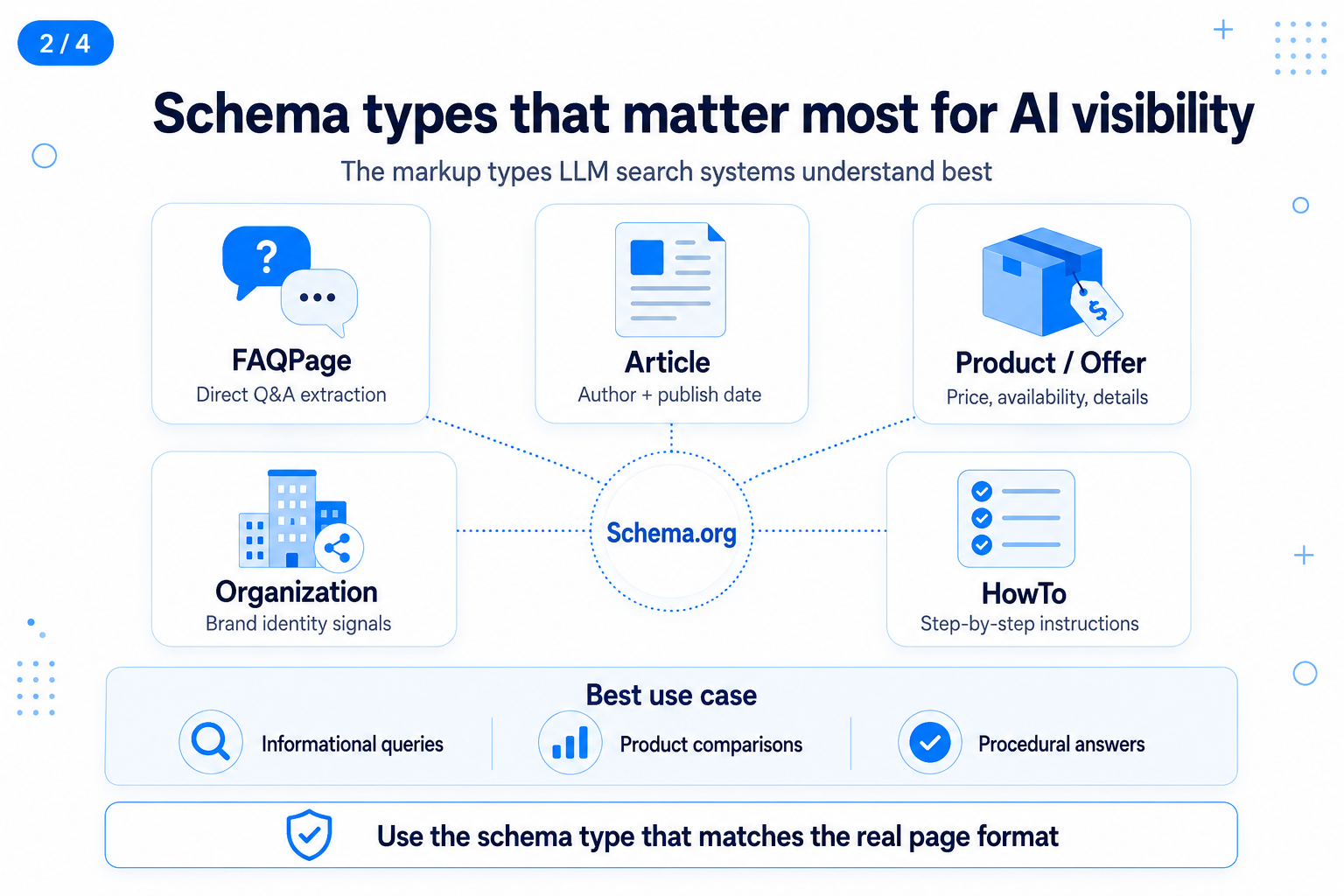
FAQPage
FAQPage schema pairs questions with explicit answers. That structure maps directly to how AI systems generate responses to informational queries: a question, an answer, a source. When a retrieval system scans your page and finds clearly labelled Q&A pairs, it can extract and cite them with minimal inference.
FAQPage also improves "People Also Ask" visibility in traditional search, which feeds the same informational intent queries that appear in AI search tools.
The answers should be 40-60 words: long enough to be complete, short enough to be extractable without reformatting.
Article and BlogPosting
Article schema establishes authorship, publication date, and modification date. These fields matter for AI systems because they signal credibility and freshness. A page marked up with a named author, a verifiable publish date, and a recent modification date signals that a real person wrote it and that it has been maintained.
This connects directly to Google's E-E-A-T signals. Structured authorship markup is one of the clearest ways to communicate experience and expertise to both search engines and AI crawlers. The technical SEO checklist for AI Overviews covers this alongside other on-page signals.
Product and Offer
Product schema includes price, availability, brand, identifiers such as SKUs, and review aggregates. For AI-powered shopping tools and product comparison queries, these fields let retrieval systems match your product to specific queries and extract accurate details without parsing prose.
When a model compares products across multiple sources, explicitly structured product data is what allows your page to participate in that comparison accurately.
Organization and LocalBusiness
Organization schema defines your company's identity: name, logo, URL, social profiles, and contact information. LocalBusiness schema adds address, phone, operating hours, and geographic coordinates.
These entity definitions help AI systems build consistent representations of your brand. When the same entity appears across multiple pages with consistent markup, models build stronger associations and are more likely to surface your organization as a cited source in brand queries.
HowTo and HowToStep
Step-by-step guides are among the most common query types in AI search tools. HowTo schema makes the steps explicitly ordered and machine-readable. Rather than inferring sequence from numbered lists in prose, a retrieval system can extract each step directly.
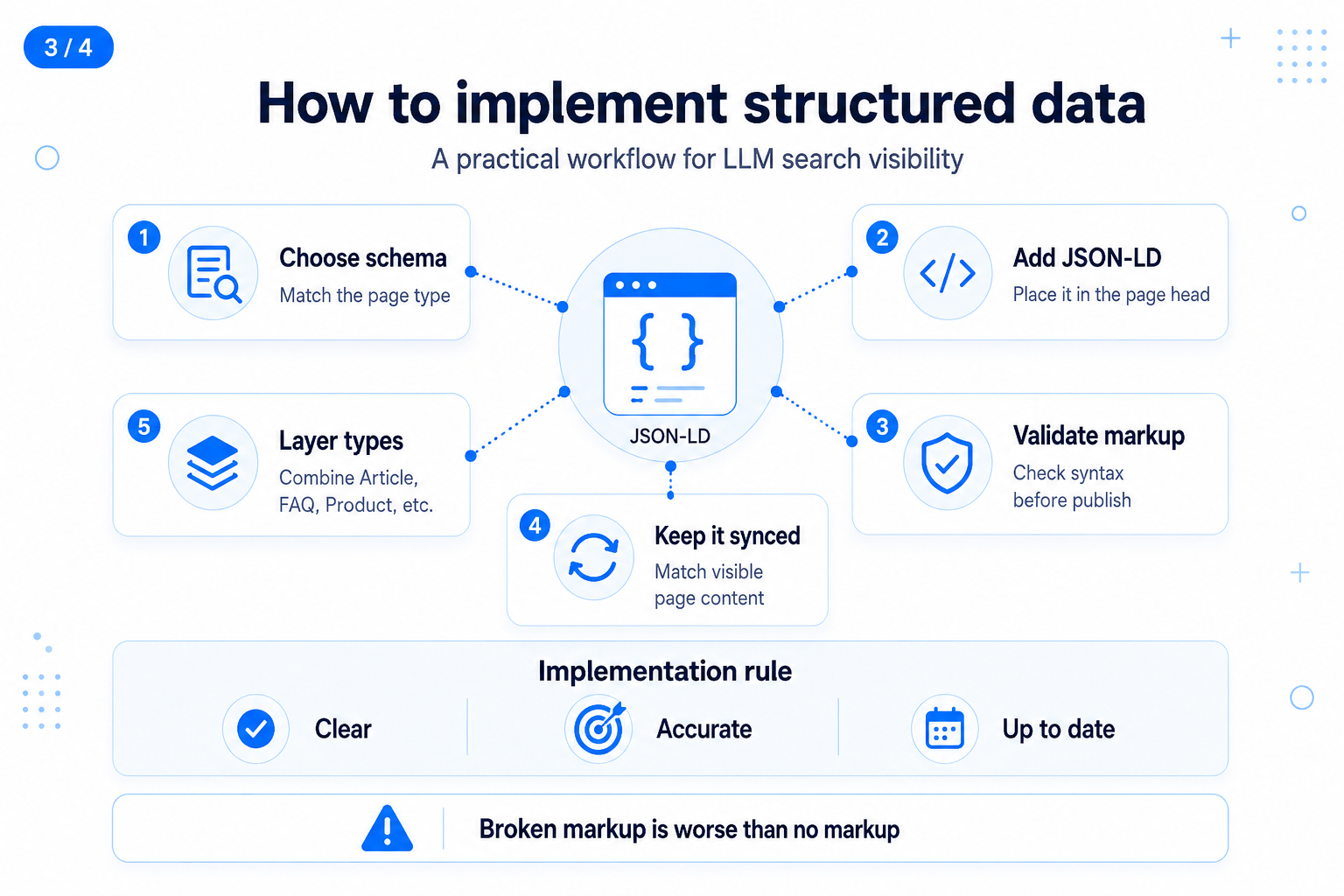
What does structured data implementation look like?
JSON-LD is the standard
JSON-LD belongs in the <head> of your page inside a <script type="application/ld+json"> block. It is separate from your HTML, which means it does not affect page rendering and can be updated independently. Google and most major AI crawlers support it. Other formats (Microdata, RDFa) are still valid but harder to maintain.
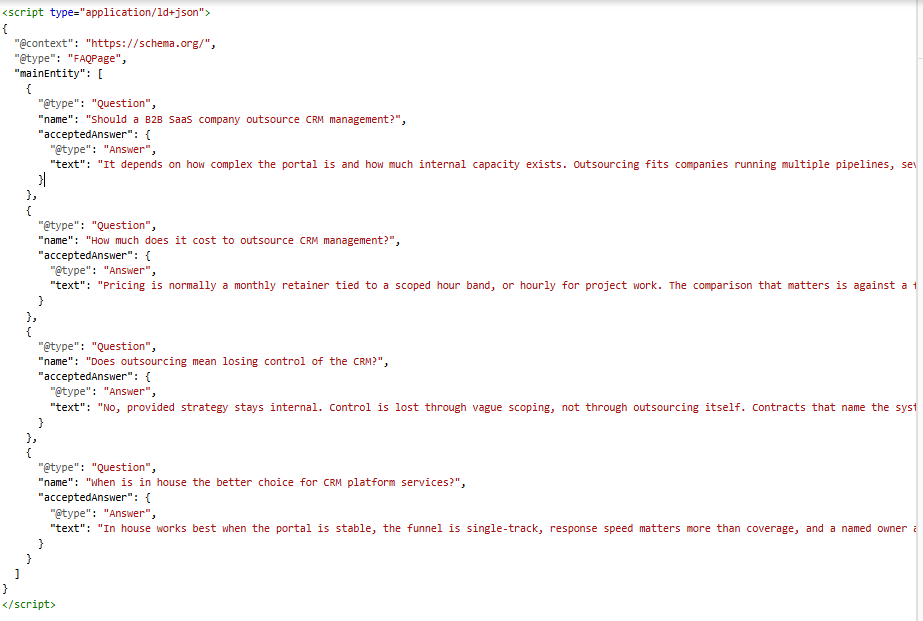
Here is a basic FAQPage block:
And an Article block with authorship:
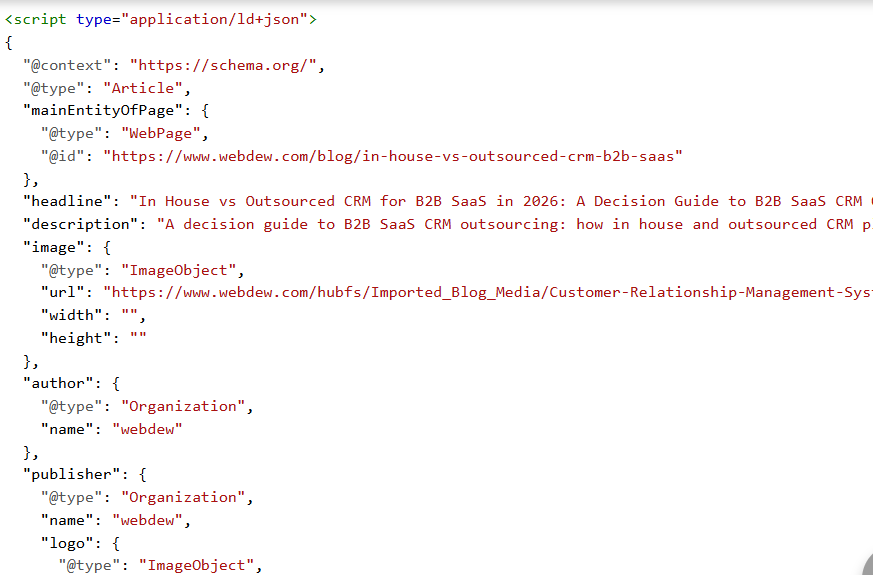
Multiple schema types can appear on the same page. A blog post can carry both Article and FAQPage blocks. A product page can carry Product, Offer, AggregateRating, and FAQPage simultaneously.
Validate before publishing
Two tools catch implementation errors before they affect crawlers:
Google's Rich Results Test checks whether your markup is eligible for rich results and flags syntax errors. The Schema.org Validator confirms that your markup conforms to the Schema.org specification.
Broken markup is worse than no markup. A malformed JSON-LD block can cause crawlers to skip the structured data entirely.
Keep markup synchronized with visible content
This is the point most implementations get wrong. Structured data must match what a user actually sees on the page. A Product schema claiming a price of $99 when the visible page shows $129 is a trust violation. AI systems that detect inconsistencies between structured and unstructured content are more likely to distrust the source entirely.
Schema markup should update dynamically from your CMS or data layer, not sit as static code that drifts out of sync when page content changes.
How does structured data connect to broader AI visibility strategy?
Structured data is one signal among several. It works best when it supports content that already meets the criteria AI systems use to select sources.
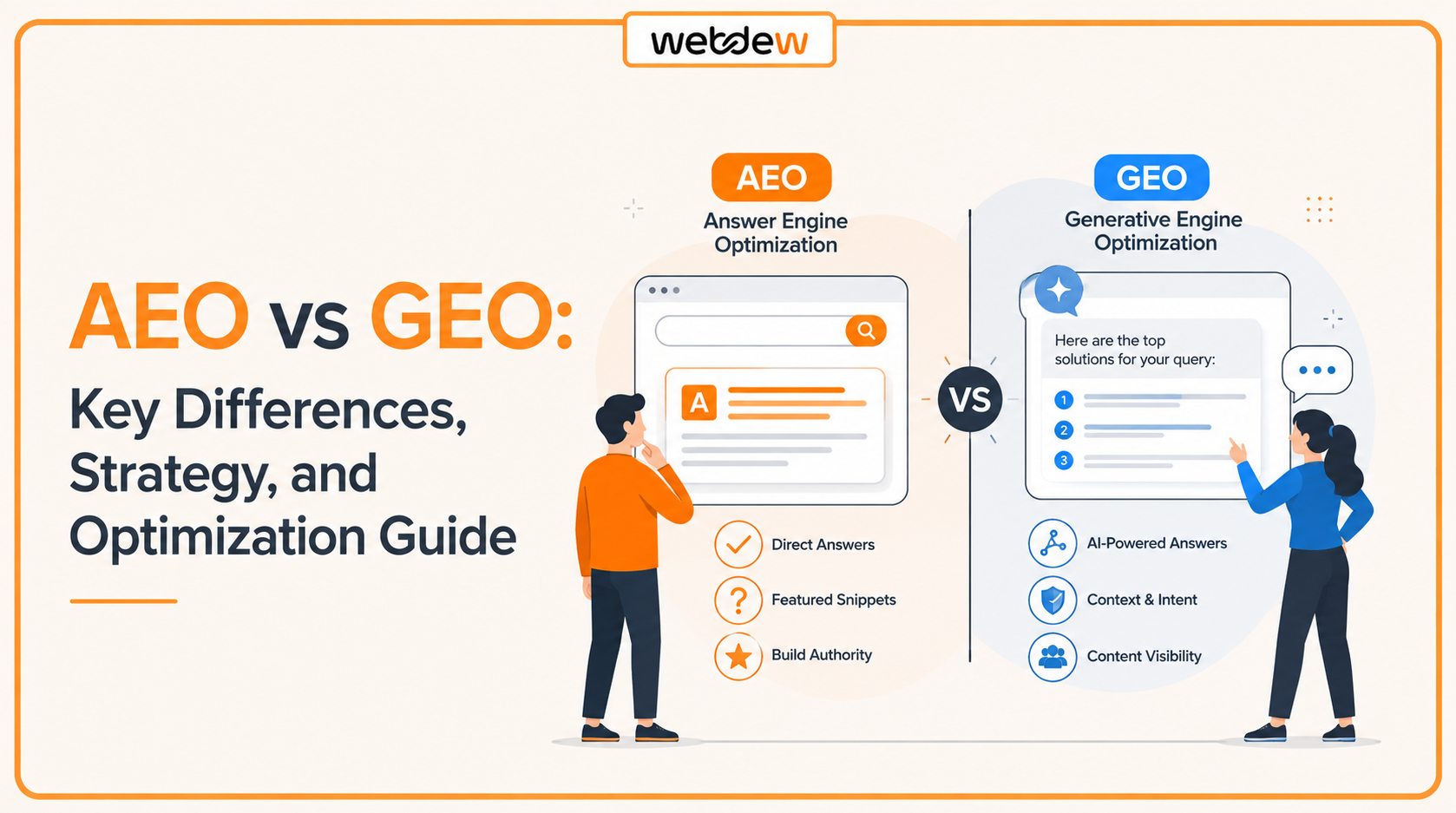
Those criteria, covered in depth in the AEO vs GEO comparison, include factual precision, topical authority, and clear answer structure. Structured data labels the facts; the content itself has to provide them.
A few principles that connect structured data to the broader picture:
Content that follows an answer-first structure (stating the key fact at the top of a section before expanding on it) is easier for AI systems to extract. Structured markup amplifies that by making the extraction explicit rather than probabilistic.
Internal linking within a content cluster reinforces topical authority. When your structured pages link consistently to a category hub and to related topic pages, AI systems build stronger entity associations between your domain and the subject area. SEO basics for website optimization cover internal linking as a foundation signal worth getting right first.
Author entities matter. When Person schema appears consistently across your content, associating the same author with multiple articles on a topic, AI systems recognize that author as a recurring source. That association improves the likelihood that queries referencing the topic surface your content as a credible reference.
How to monitor whether structured data is working
AI search visibility does not show up in traditional rank-tracking dashboards. The signals are indirect but checkable:
Run manual queries in ChatGPT, Perplexity, Claude, and Google AI Overviews using your target keywords. Note whether your domain appears as a cited source. Track whether the answers quote or paraphrase content from your marked-up pages.
Check Google Search Console for rich result impressions. The Enhancements tab shows which structured data types Google has detected and whether any are flagged for errors. An increase in FAQ or Article impressions after a markup implementation is a positive signal.
Monitor referral traffic in GA4 from AI tool domains: chatgpt.com, perplexity.ai, claude.ai, bing.com (for Copilot traffic). Growth in referrals from these sources correlates with AI citation activity.
Common structured data mistakes
Implementing markup on content that does not deserve it
Schema markup on thin, generic, or outdated content does not help. AI systems use structured data to extract facts from credible sources. A page with weak content and good markup is still a weak source. Fix the content first, then mark it up.
Using the wrong schema type
A how-to guide marked up as a generic Article misses the more specific HowToStep extraction that AI systems prefer for procedural content. Match the schema type to the actual content format. Schema.org's documentation lists recommended properties for each type.
Incomplete properties
FAQPage markup with questions but no answers, or Product markup without price and availability, provides partial signals that retrieval systems cannot fully use. Fill out all relevant properties, not just the required ones.
Setting and forgetting
Schema is not a one-time implementation. Pages change. Prices update. Authors change roles. Events pass. Structured data that no longer matches visible content erodes trust with crawlers over time.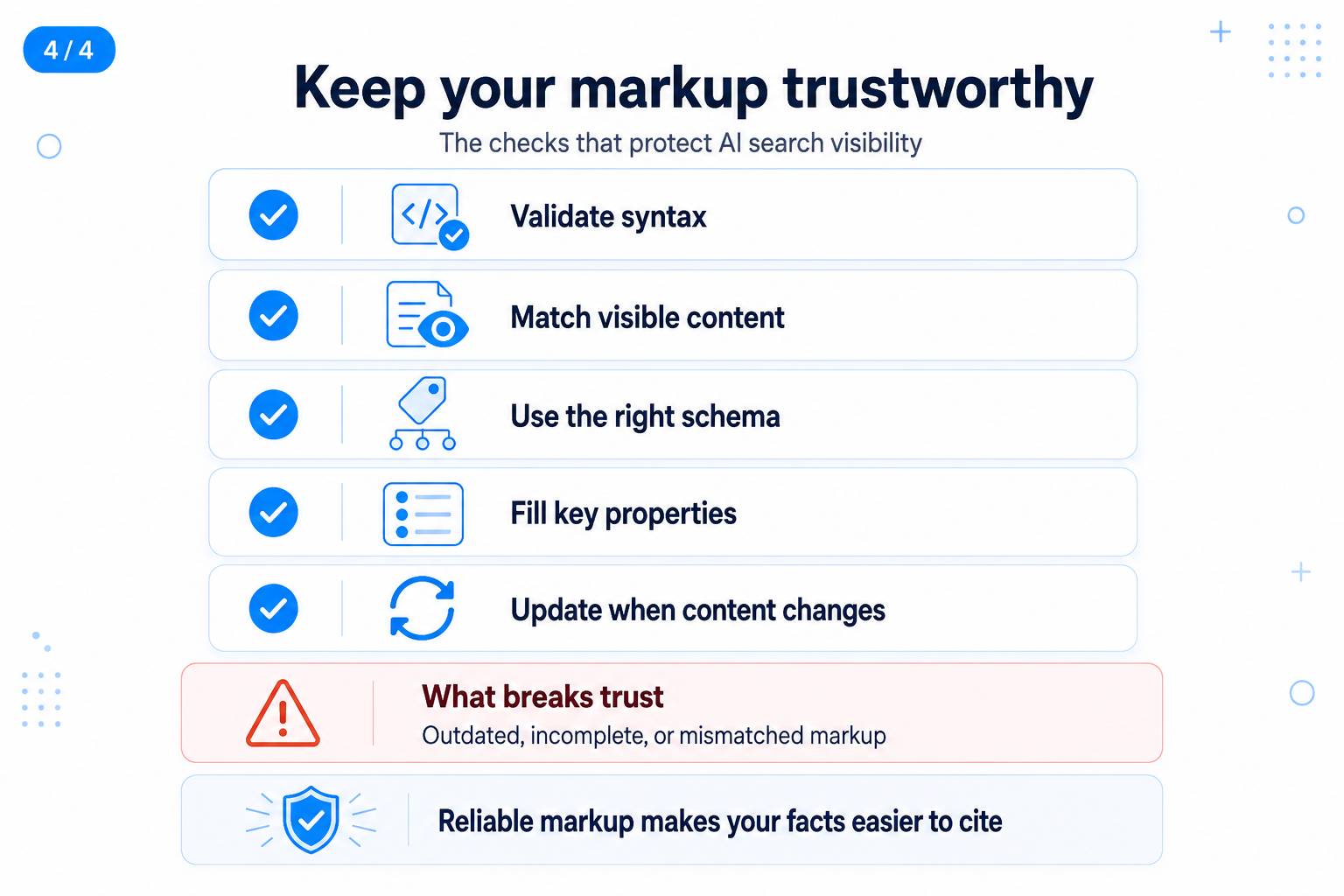
Structured data does not replace good content. But good content without structured data is harder for AI systems to read, harder to extract, and harder to cite accurately. Getting the markup right is the part of AI search optimization that happens before the content is ever read.
If you are building out your AI search strategy, the Webdew AEO service covers how this fits into a broader answer engine optimization approach.
Dive Into our
Client Testimonials
Listen to business owners like you share how we’ve helped them grow. Your story could be next!





.svg)

“Recently we reached out to Webdew for a website inside of HubSpot and they also did some mocking automation for us.”

“Webdew team was quite honest and quite easy to work with in terms of taking feedback implementing it, showing that it doesn’t happen again and things like making sure that it meets our expectations.”

“We worked with webdew to help us build our HubSpot website and they did an amazing job with it. They were very quick.”

“webdew has helped us optimize the sales and marketing processes, and this is automating a lot of processes.”

“Hi everyone my name is Kara and I work as a channel consultant at HubSpot Singapore. I’ve been working closely with webdew agency”

“Hi my name is Christian from OpenDoors Mortgage team and I’m in the mortgage business and just trying to work on new projects and kind of incorporating HubSpot for my operations”

“I’m one of the technology directors for Travelopia. We are the largest experiential travel company in the world. We’ve engaged webdew recently, not recently, it’s been about a couple of quarters now.”
“We worked with Chehak over the past several months to create a series of animated videos for an academic planner that we produce. And from the very beginning, she was absolutely professional and a pleasure to work with.”


6x
We helped clients multiply their website conversion rates through strategic design and UX optimization.
20%
Our marketing campaigns led to a 20% uplift in customer engagement across digital channels.
2K+
Delivered over 2,000 qualified leads through targeted funnels and smart automation.
120+
Our video content has earned 120,000+ views, driving brand awareness and audience retention.
“I recently had the pleasure of working with Chehak on a video demo project, and I was thoroughly impressed with her services.”
.svg)

Additional Resources
Access expert tips, trends, and strategies designed for small businesses. Stay ahead of the curve and make informed decisions with our comprehensive resources!