

 We typically respond the same day

Most B2B SaaS leaders believe their sales and marketing teams already work well together. The data says otherwise. Forrester's 2024 research found that 82% of C-level executives think their sales and marketing teams collaborate effectively, while 65% of the people doing the actual work report a lack of alignment (Forrester, 2024, via The Growth Syndicate). That perception gap is where revenue quietly leaks: leads that sales never call, content sales never use, and forecasts no one trusts.
A CRM is supposed to close that gap. In practice, most do the opposite, because the system was configured to store data rather than to move a lead cleanly from a marketing campaign to a closed deal. Fixing that is less about buying new software and more about rebuilding the platform around a shared revenue process. This guide explains how CRM consulting services do exactly that, and how revenue leaders can use a CRM to turn two siloed teams into one pipeline.
TL;DR
- Sales and marketing misalignment costs B2B companies 10% or more of revenue per year, yet only 8% of companies report strong alignment (ZoomInfo; Revenue Memo, 2026). A correctly configured CRM is the system that fixes it.
- CRM consulting services align teams by enforcing one shared lead definition, automating handoffs, and reporting both teams against the same pipeline, not separate vanity metrics.
- The four moves that matter most: agree on a single qualified-lead definition, automate the marketing-to-sales handoff inside the CRM, build shared dashboards leadership actually uses, and run quarterly optimization as the process changes.
- Alignment is a process problem the CRM enforces, not a software feature you switch on. Aligned B2B organizations grow revenue 24% faster over three years (SiriusDecisions).
Why does sales and marketing alignment matter in 2026?
Alignment matters because misalignment is now the most expensive and most measurable problem in B2B revenue. Forrester found that aligned organizations achieve 2.4x higher revenue growth and 2x higher profitability growth than misaligned peers (Forrester, via The Growth Syndicate, 2026). SiriusDecisions documented 24% faster three-year revenue growth for aligned B2B organizations, and Aberdeen Group measured a 32% year-over-year revenue lift for highly aligned companies against a revenue decline for laggards (via Revenue Memo, 2026).
The cost of getting it wrong is just as concrete. B2B companies lose 10% or more of revenue per year to misalignment, which is at least $5 million annually for a $50 million company (ZoomInfo; Revenue Memo, 2026). Two numbers explain where that money goes: 73% of marketing-generated leads are never contacted by sales, and roughly half of sales time is wasted on unproductive prospecting (ZoomInfo). Marketing produces leads sales ignores; sales chases prospects marketing has already disqualified. Both teams stay busy. Neither moves the number.
In 2026, three shifts make this harder to ignore. Buyers complete most of their research before talking to sales, so a broken handoff costs a deal that was nearly won. Buying committees have grown, so inconsistent messaging across touchpoints compounds. And Gartner found that 76% of mid-sized B2B companies have their CMO and sales director reporting to different leaders, which means alignment cannot be solved by asking the two teams to be friendlier (Gartner, 2024, via Momo85). It has to be built into the system that both teams use every day. That system is the CRM.
What are CRM consulting services, and what do they actually do?
CRM consulting services are engagements that redesign a CRM around a company's revenue process rather than around its data. A consultant maps the customer journey, the data flow, and how each team actually works, then configures the platform so marketing and sales operate from one source of truth (Two Impress, 2026). The deliverable is not a tidier database. It is a working revenue engine with automated handoffs, shared reporting, and a pipeline that leadership can forecast against.
Most CRM consulting engagements cover six areas:
- CRM strategy and architecture. Mapping the customer journey and data flow first, so every pipeline stage and field exists for a reason tied to how the company sells.
- Implementation and configuration. Setting up pipelines, custom fields, automation rules, and reporting frameworks so the platform is standardized from day one (Two Impress, 2026).
- Data migration and integration. Moving and cleaning existing records, then connecting the CRM to marketing automation and analytics tools so there is one central record per account.
- Marketing and revenue operations alignment. Building shared KPIs and automated handoffs so the two teams report against the same pipeline rather than separate scorecards.
- Reporting and dashboards. Turning CRM data into live attribution and forecasting views that leadership uses to make decisions.
- Training and ongoing optimization. Live enablement plus a recurring optimization cycle, because a revenue process changes and the CRM has to change with it.
The thread running through all six is business process optimisation. A consultant's real job is to encode the agreed revenue process into the platform so that following the process is the path of least resistance for every rep and marketer. This is the model Webdew uses on HubSpot engagements: the configuration follows the revenue process, not the other way around.
How does a CRM align sales and marketing?
A CRM aligns sales and marketing by forcing both teams to share one definition of a qualified lead, one record of the buyer, and one set of numbers, then automating the moments where alignment usually breaks. The platform turns a verbal agreement to "work together" into rules that the system enforces. Four mechanisms do most of the work.
How does a shared lead definition fix the handoff?
A shared lead definition fixes the handoff by removing the disagreement that causes most rejected leads. Research shows 62% of companies define a qualified lead differently across the two teams, which means every handoff is a coin flip (SiriusDecisions data, via GTM 80/20, 2026). When marketing measures volume and sales measures conversion, marketing sends everything, and sales trusts nothing.
CRM consulting services fix this by building the agreed lead definition directly into the platform: lead scoring thresholds, required fields, and ICP-fit criteria that a contact must meet before the system routes it to sales. The definition stops being a debate and becomes a gate. Marketing sees exactly which leads qualify and why; sales receives only leads that clear the bar both teams set.
How do automated handoffs reduce revenue leakage?
Automated handoffs reduce revenue leakage by removing the manual step where 73% of marketing leads currently die (ZoomInfo). When a lead has to be passed by email, a spreadsheet, or memory, follow-up depends on someone remembering. A CRM workflow assigns the lead, notifies the rep, sets a follow-up task, and starts a timer the moment the lead qualifies.
The result is a handoff that happens in seconds with no lead left uncontacted. Sales sees the full marketing context, including which campaigns and content the lead engaged, so the first conversation starts informed rather than cold. This is where CRM implementation does the most direct work: the automation is the alignment.
How do shared dashboards keep both teams accountable?
Shared dashboards keep both teams accountable by reporting marketing and sales against the same pipeline instead of separate metrics. A common driver of misalignment is that 96% of teams do not use the same metrics, and 97% plan customer engagement separately (via GTM 80/20, 2026). When marketing reports MQLs and sales reports closed deals, no one owns the gap between them.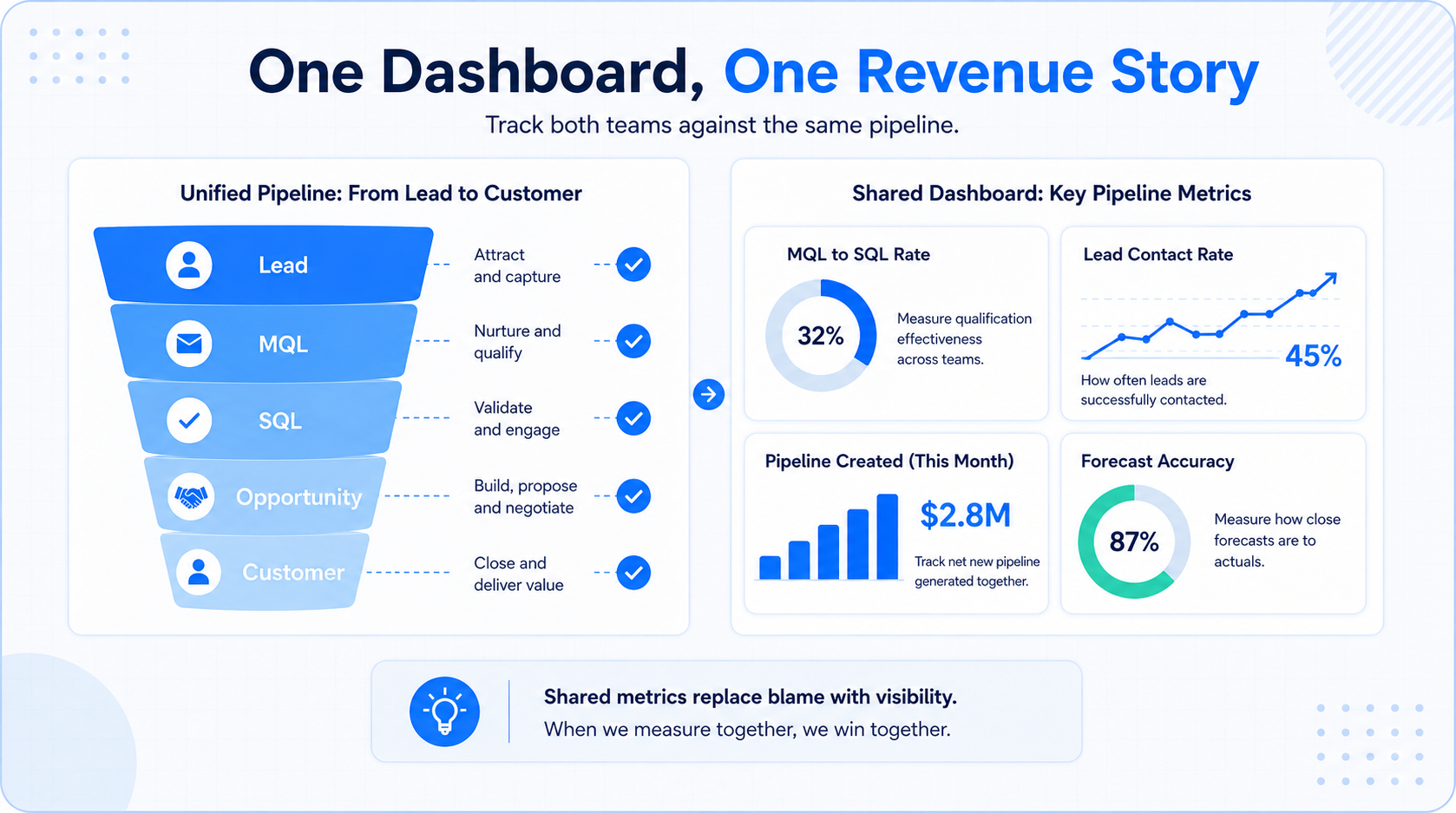
CRM consulting services build dashboards that track a lead from first touch to closed-won in one view, with attribution showing which marketing activity produced pipeline and revenue. Both teams see the same funnel, so the conversation shifts from blame to the specific stage where deals stall. Leadership forecasts from facts rather than two conflicting spreadsheets.
How does the CRM support sales enablement?
The CRM supports sales enablement by putting the right content and context in front of reps at the moment they need it, inside the system they already work in. This matters because 65% of sales reps say they cannot find content to send prospects, and 60 to 70% of B2B content created is never used (ZoomInfo). Marketing produces assets that sales never finds.
A well-configured CRM surfaces stage-appropriate content, logs which assets influence deals, and feeds that data back to marketing so the next round of content maps to real buyer-journey stages. That feedback loop is a cross-functional strategy in practice: marketing builds what sales actually uses, and the CRM proves which content moves the pipeline.
How do you implement CRM-based alignment? A step-by-step approach
Implementing CRM-based alignment works best as a sequence, not a single switch. Rushing to configure software before the two teams agree on a process just automates the existing dysfunction. Here is the order that works:
- Align on shared revenue goals first. Anchor both teams to the same pipeline and revenue targets before touching the platform. If marketing is measured on lead volume and sales on closed revenue, the system will encode that conflict.
- Agree on one qualified-lead definition. Document the scoring, fit, and intent criteria a lead must meet. This single artifact resolves most downstream friction.
- Map the current process and find the leaks. Audit where leads stall, where data is dirty, and where handoffs break. A consultant usually finds that the two teams are running on different definitions no one had written down.
- Configure the CRM to the agreed process. Build the pipeline stages, fields, scoring, and automated handoffs that enforce what the teams agreed in steps one and two.
- Clean and migrate the data. One reliable record per account, connected to the marketing and analytics stack, so the dashboards reflect reality.
- Build shared dashboards and train both teams. Reporting that both sides trust, plus enablement so reps and marketers use the system the same way.
- Optimize quarterly. Revenue processes change. Schedule a recurring review so the CRM evolves instead of decaying back into silos.
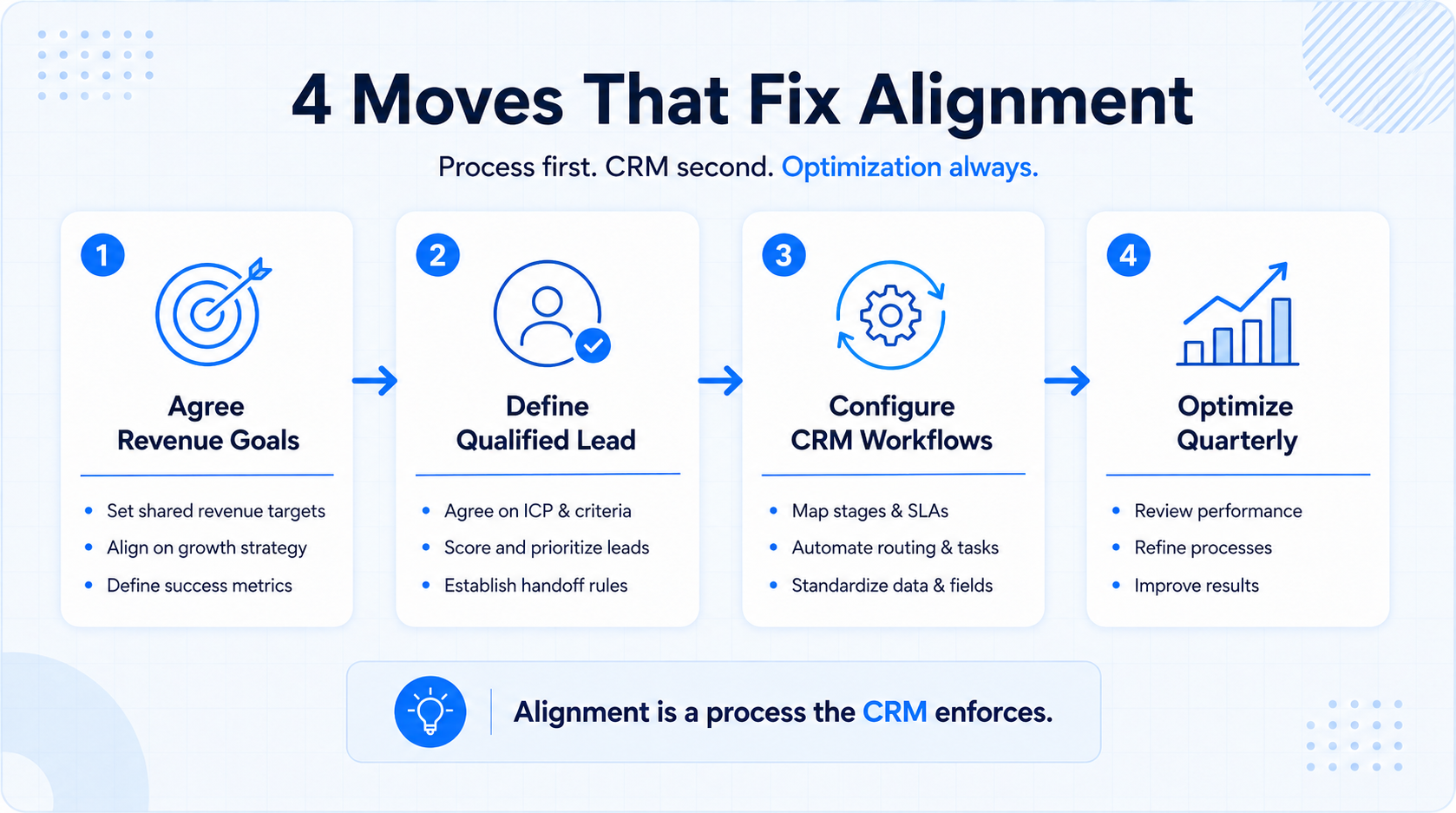
Skipping straight to step four is the most common and most expensive mistake. The configuration is only as good as the process agreement underneath it.
What does CRM-based alignment cost a business that delays it?
Delaying CRM-based alignment costs a predictable percentage of revenue every year the gap stays open. At 10% or more of annual revenue lost to misalignment, the cost compounds quietly while the CRM keeps producing reports no one trusts (ZoomInfo). For a growth-stage SaaS company, that is often more than the entire cost of fixing the system.
The trend also runs in one direction. Gartner projected that 75% of the highest-growth companies would deploy a RevOps model by 2025, treating aligned, CRM-enforced revenue operations as standard rather than optional (via Revenue Memo, 2026). The companies that close the alignment gap keep compounding the 24% faster growth aligned organizations see; the ones that wait keep paying the 10% tax. The decision is not whether alignment is worth it. The numbers settled that. The decision is how quickly a team scopes the work.
Conclusion: alignment is a process the CRM enforces, not a feature you buy
Aligning sales and marketing comes down to one idea: agree on a shared revenue process, then encode it into the CRM so following that process is automatic. The software does not create alignment. It enforces the agreement the two teams make about what a qualified lead is, how it gets handed off, and which numbers everyone reports against. Without that agreement, a new CRM just automates the old silos faster.
For B2B SaaS revenue leaders, the practical next step is small and concrete. Audit how a lead currently travels from a marketing campaign to a sales conversation, and find the points where it stalls, gets rejected, or goes uncontacted. That audit usually reveals the same root cause the data predicts: two teams running on definitions no one wrote down. Webdew works with SaaS revenue teams to rebuild HubSpot around exactly that shared process, sequencing the lead definition, automated handoffs, and shared reporting so the platform moves pipeline instead of storing it.
As buyers do more of their research before ever speaking to sales, the handoff between marketing and sales becomes the moment that decides the deal. The revenue teams that win the next few years will be the ones whose CRM makes that handoff invisible and automatic. Alignment stopped being a nice-to-have when the data put a number on it. The only open question is how soon a team decides to capture it.
Dive Into our
Client Testimonials
Listen to business owners like you share how we’ve helped them grow. Your story could be next!





.svg)
“Recently we reached out to Webdew for a website inside of HubSpot and they also did some mocking automation for us.”
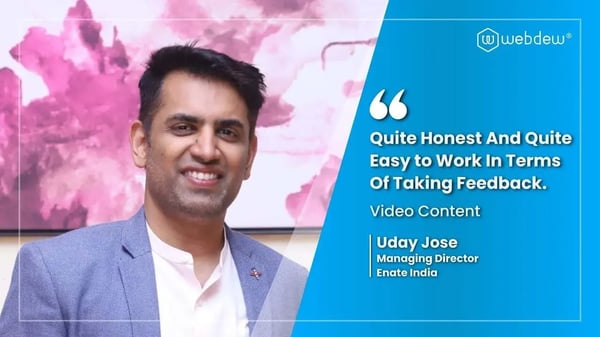
“Webdew team was quite honest and quite easy to work with in terms of taking feedback implementing it, showing that it doesn’t happen again and things like making sure that it meets our expectations.”

“We worked with webdew to help us build our HubSpot website and they did an amazing job with it. They were very quick.”

“webdew has helped us optimize the sales and marketing processes, and this is automating a lot of processes.”

“Hi everyone my name is Kara and I work as a channel consultant at HubSpot Singapore. I’ve been working closely with webdew agency”

“Hi my name is Christian from OpenDoors Mortgage team and I’m in the mortgage business and just trying to work on new projects and kind of incorporating HubSpot for my operations”

“I’m one of the technology directors for Travelopia. We are the largest experiential travel company in the world. We’ve engaged webdew recently, not recently, it’s been about a couple of quarters now.”
“We worked with Chehak over the past several months to create a series of animated videos for an academic planner that we produce. And from the very beginning, she was absolutely professional and a pleasure to work with.”


6x
We helped clients multiply their website conversion rates through strategic design and UX optimization.
20%
Our marketing campaigns led to a 20% uplift in customer engagement across digital channels.
2K+
Delivered over 2,000 qualified leads through targeted funnels and smart automation.
120+
Our video content has earned 120,000+ views, driving brand awareness and audience retention.
“I recently had the pleasure of working with Chehak on a video demo project, and I was thoroughly impressed with her services.”
.svg)

Additional Resources
Access expert tips, trends, and strategies designed for small businesses. Stay ahead of the curve and make informed decisions with our comprehensive resources!