

 We typically respond the same day

Most B2B SaaS leaders already know their CRM is holding them back. The pipeline reports do not reconcile. Sales reps keep their own spreadsheets. Marketing hands over leads that sales never works. The fix, bringing in an outside partner to rebuild the platform properly, sits on the table for months and sometimes years. The decision keeps getting pushed.
That hesitation is expensive. Research from Johnny Grow puts the CRM failure rate at 55%, measured as deployments that never hit their planned objectives (Johnny Grow, CRM Failure Report, 2025). A botched in-house rebuild does not just waste money. It burns a year of pipeline visibility and erodes the data investors look at during the next raise. Every quarter a broken CRM stays broken, the cost of fixing it climbs.
So why do capable leaders stall on a decision they have already half-made? The reasons are rarely about the platform itself. They are about control, timing, trust, and a few well-founded fears about what outsourcing a core revenue system actually involves. Below are the seven that surface most often, and how SaaS teams move past each one before the delay turns into lost growth.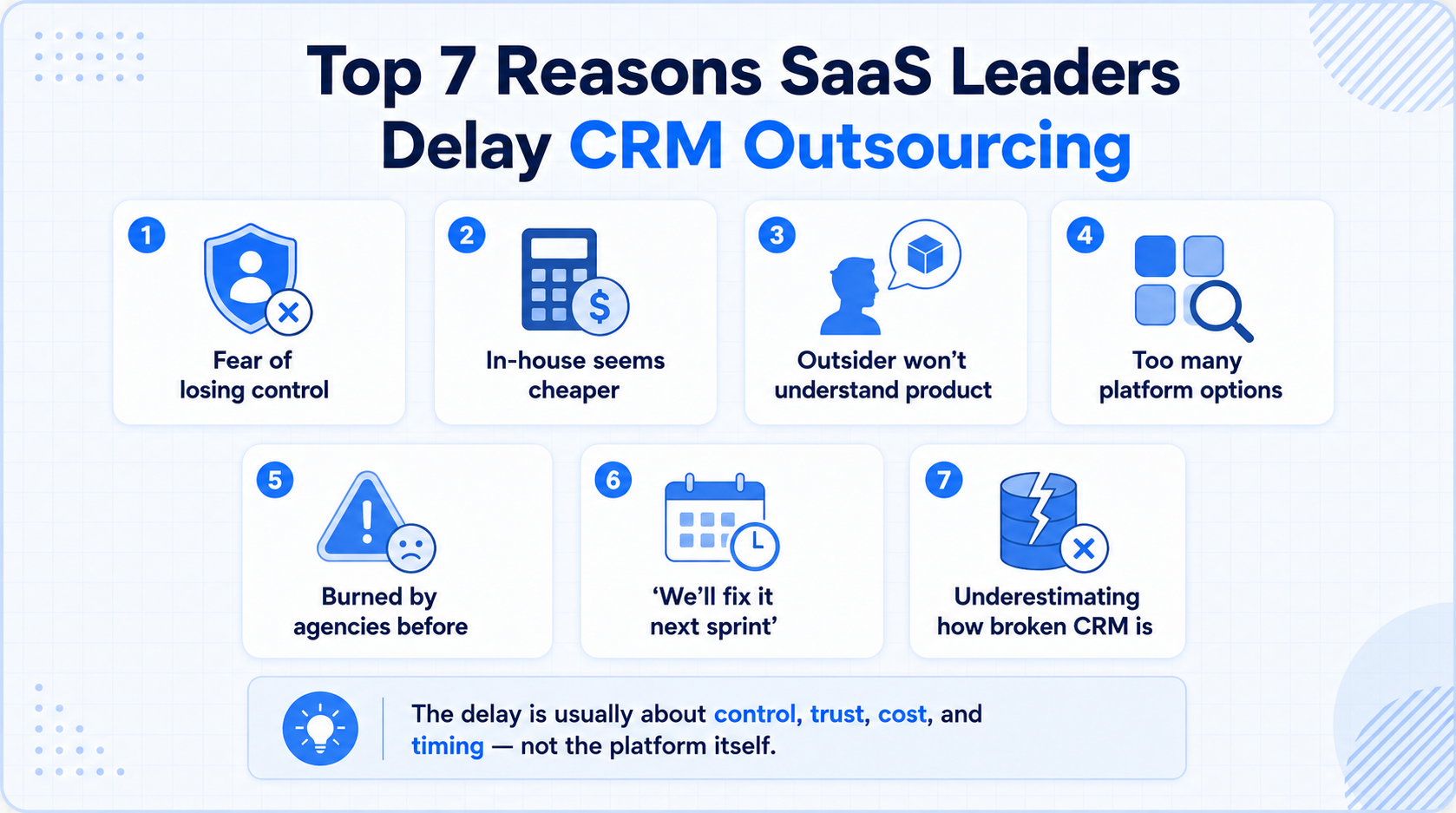
This is a problem Webdew sees constantly in HubSpot rebuilds: the company knew what was wrong long before it asked for help.
1. Fear of losing control over the revenue engine
The CRM is where deals, forecasts, and customer history live. Handing the keys to an outside team feels like giving away the steering wheel of the business. Founders who built the early sales motion by hand are especially reluctant, and the worry is legitimate. A partner who reconfigures pipelines without understanding how the team actually sells can do real damage.
The reluctance usually rests on a false choice between full control and no control. Strong CRM platform services run on approval workflows, shared dashboards, and agreed KPIs, so leadership signs off on structural changes before anything goes live. Kalungi, which has worked with more than 100 SaaS companies, frames this as the founder keeping the narrative while the partner handles execution (Kalungi, 2025). The leader still owns the system. The partner builds inside guardrails the leader sets.
The way to test a partner here is simple: ask who approves a change to a deal stage. If the answer is anyone but you, keep looking.
2. The assumption that an in-house hire is cheaper and safer
Outsourcing looks like an admission that the team cannot do it alone, and a full-time RevOps or HubSpot admin feels like the more permanent, lower-risk choice. On a spreadsheet, one salary can even look cheaper than an agency retainer.
The math rarely holds once the full picture is in view. Building and keeping an in-house marketing or operations team grows more expensive every year, with salaries climbing 10 to 40% annually on top of the cost of finding, onboarding, and training each hire (Kalungi, 2025). A single specialist also carries a single-point-of-failure risk: when they leave, the institutional knowledge of your CRM configuration walks out with them. An outsourced team spreads that knowledge across several people and several disciplines, from data migration to reporting to automation, which a lone admin cannot cover at once.
The harder cost to see is time. A new hire needs months to ramp before touching the system. A specialized partner brings a tested implementation sequence on day one, which matters when a broken CRM is actively costing the pipeline.
3. Worry that an outsider will not understand the product or market
B2B SaaS leaders sell complex products to specific buyers, and a generalist agency that has never touched their category feels like a risk. The fear is that an outside team will impose a generic playbook that ignores the technical, regulatory, or market-specific details that matter to the audience.
This concern is valid against the wrong partner and irrelevant against the right one. A SaaS-focused team starts by learning the product, the ideal customer profile, and the buyer's pain points before configuring anything, often through onboarding workshops and market research built into the engagement (Kalungi, 2025). The deeper issue is that CRM problems are usually less about product knowledge than about process design. Apty's analysis of CRM implementation failures lists unclear goals, no planning, ignored IT implications, poor cross-department collaboration, and no user training as the recurring causes, none of which require category expertise to diagnose (Apty, 2022). They require implementation discipline, which is exactly what a specialized partner sells.
4. Decision paralysis from too many platform options
The CRM market is crowded, and the choice between staying on the current platform, switching, or rebuilding feels too consequential to rush. Leaders freeze because every option carries a switching cost, and being wrong is visible to the whole company.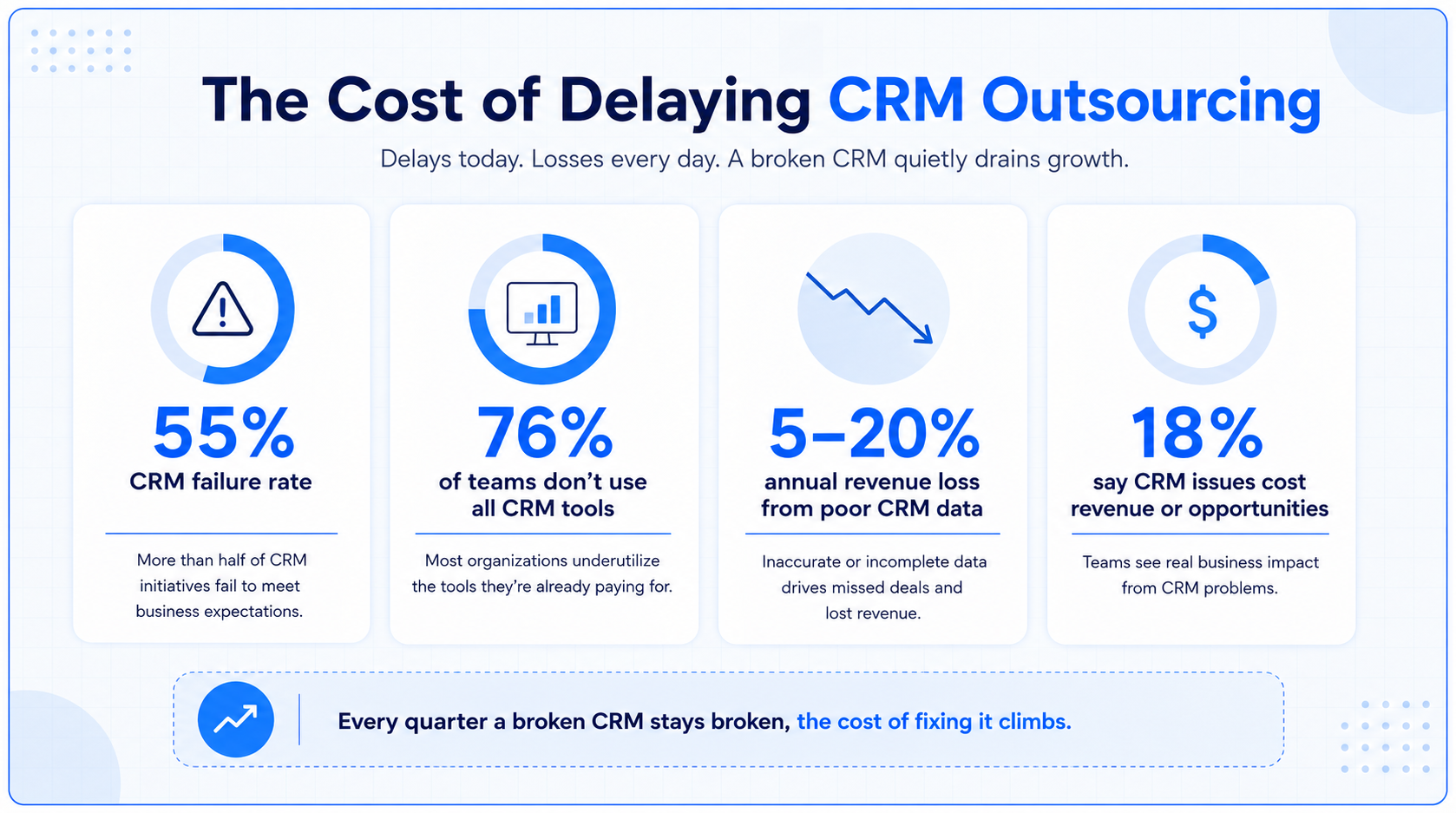
The paralysis usually comes from treating the platform as the decision when it is not. Adoption outcomes vary wildly on the same software: one company hits 95% adoption on a CRM while another struggles to reach 40% on the identical product, which means the implementation matters more than the logo on the login screen (Hey DAN, 2026). The 76% of leaders who report their sales teams do not use all the tools in their CRM are not describing a software problem; they are describing an implementation and adoption problem (EmailVendorSelection, citing Oracle data, 2026).
An outsourcing partner reframes the question from "which CRM" to "what does the revenue process need," then maps the platform to that. The decision gets smaller, and the fear of being wrong shrinks with it.
5. Bad past experiences with agencies
Many SaaS leaders have been burned before: an agency that overpromised, missed deadlines, billed for activity instead of outcomes, or vanished after the contract was signed. One bad engagement makes the whole category look like a gamble, and that scar tissue keeps the decision on hold.
The fix is structural, not emotional. Performance-based engagement models tie a partner's pay to agreed outcomes rather than hours logged, so the incentive aligns with the leader's goals from the start (Kalungi, 2025). Service level agreements that set response times and delivery expectations turn vague promises into commitments a leader can hold the partner to. The lesson from a bad agency experience is not "never outsource." It is "structure the next engagement so the partner only wins when you do."
Webdew structures HubSpot engagements around defined deliverables and shared reporting for exactly this reason: the leader should never have to guess whether the work is on track.
6. The "we'll fix it ourselves after the next sprint" trap
Engineering-led SaaS cultures default to building, not buying, and the CRM cleanup keeps getting slotted behind product work. There is always a more urgent sprint, so the rebuild slides another quarter. The intention to fix it internally is real; the bandwidth never appears.
This is the most expensive delay because it never resolves, it just persists. Half of sales leaders say they struggle with successful CRM implementation, and 18% report it cost them opportunities or revenue (EmailVendorSelection, citing Oracle data, 2026). Meanwhile, low-quality CRM data alone drives annual revenue losses of 5 to 20%, according to a Validity study (Validity, 2025). Those losses compound every quarter the rebuild waits in the backlog. The internal team that would do the work is the same team already too busy to do it, which is why the project never starts.
Outsourcing exists precisely to break this loop. A partner runs the rebuild in parallel with the internal roadmap, so the CRM gets fixed without pulling engineers off the product.
7. Underestimating how broken the current setup actually is
Some leaders delay because they do not believe the problem is urgent. The CRM works, sort of. Reports come out, even if no one trusts them. The dysfunction is normalized, so outsourcing feels like an overreaction to a minor annoyance.
The data argues otherwise. When CRM systems are stretched to serve too many goals at once, the failure rate climbs toward 90%, as Scott Edinger documented in the Harvard Business Review (Harvard Business Review, 2018). Most "working" CRMs are quietly in this state: serving sales, marketing, finance, and the C-suite, doing none of it well, and bleeding adoption as a result. A specialist's first job is often diagnostic, surfacing how much pipeline visibility and forecast accuracy the team has lost without noticing. Leaders who think their setup is fine are frequently the ones with the most to recover.
How to stop delaying and start scoping
The seven reasons above share a root: outsourcing a CRM feels like surrendering a core system, when a well-structured engagement is closer to hiring expertise that works under the leader's direction. The way through is not a bigger leap of faith. It is a smaller, controlled first step.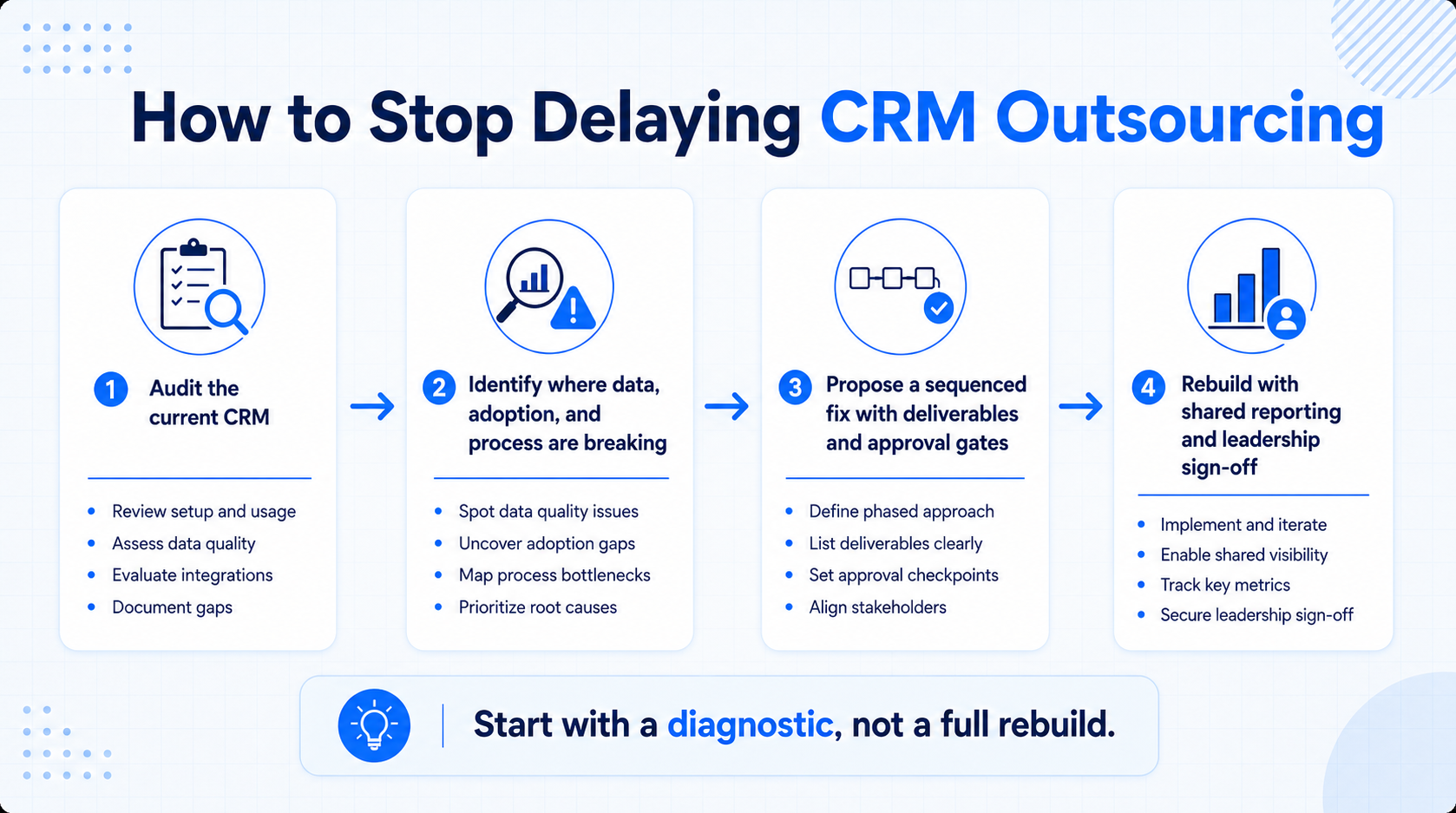
Start with a diagnostic rather than a full rebuild. Ask a prospective partner to audit the current CRM, document where data, adoption, and process are breaking, and propose a sequenced fix with defined deliverables and approval gates. That scopes the risk down to something a cautious leader can say yes to, and it surfaces the real cost of the status quo in numbers, not hunches.
For B2B SaaS teams weighing this, Webdew runs HubSpot audits and migrations built around exactly that model: a clear sequence, shared reporting, and leadership sign-off at each stage, so the rebuild moves growth forward instead of stalling it. The delay is the expensive part. The fix, scoped properly, rarely is.
Dive Into our
Client Testimonials
Listen to business owners like you share how we’ve helped them grow. Your story could be next!





.svg)
“Recently we reached out to Webdew for a website inside of HubSpot and they also did some mocking automation for us.”
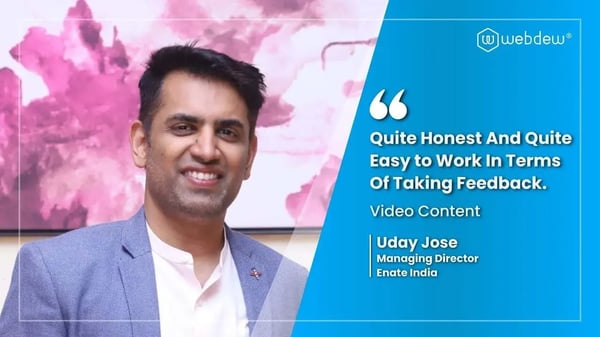
“Webdew team was quite honest and quite easy to work with in terms of taking feedback implementing it, showing that it doesn’t happen again and things like making sure that it meets our expectations.”

“We worked with webdew to help us build our HubSpot website and they did an amazing job with it. They were very quick.”

“webdew has helped us optimize the sales and marketing processes, and this is automating a lot of processes.”
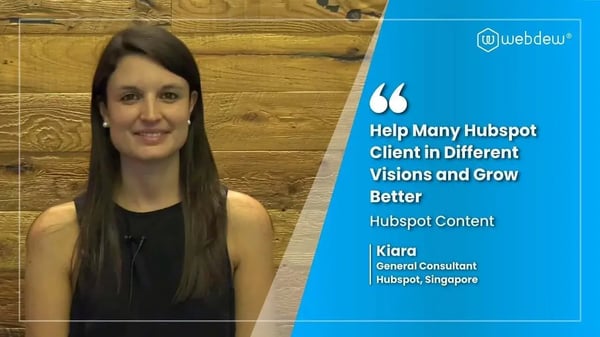
“Hi everyone my name is Kara and I work as a channel consultant at HubSpot Singapore. I’ve been working closely with webdew agency”

“Hi my name is Christian from OpenDoors Mortgage team and I’m in the mortgage business and just trying to work on new projects and kind of incorporating HubSpot for my operations”
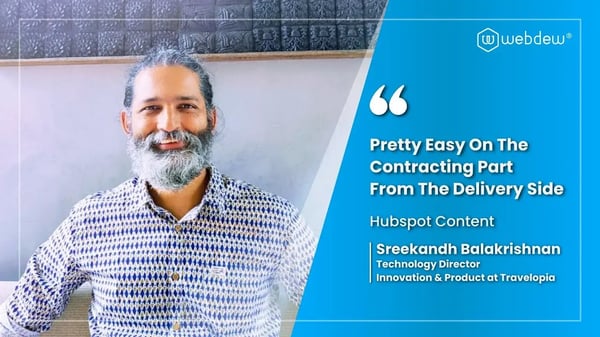
“I’m one of the technology directors for Travelopia. We are the largest experiential travel company in the world. We’ve engaged webdew recently, not recently, it’s been about a couple of quarters now.”
“We worked with Chehak over the past several months to create a series of animated videos for an academic planner that we produce. And from the very beginning, she was absolutely professional and a pleasure to work with.”


6x
We helped clients multiply their website conversion rates through strategic design and UX optimization.
20%
Our marketing campaigns led to a 20% uplift in customer engagement across digital channels.
2K+
Delivered over 2,000 qualified leads through targeted funnels and smart automation.
120+
Our video content has earned 120,000+ views, driving brand awareness and audience retention.
“I recently had the pleasure of working with Chehak on a video demo project, and I was thoroughly impressed with her services.”
.svg)

Additional Resources
Access expert tips, trends, and strategies designed for small businesses. Stay ahead of the curve and make informed decisions with our comprehensive resources!