

 We typically respond the same day

Most CRM projects do not fail because the software is broken. They fail because three teams, sales, marketing, and operations, end up running the same system in three different ways.
The numbers back this up. Across industry research, somewhere between 50% and 70% of CRM projects fall short of their original goals, and a 2026 review of CRM data found that 55% of implementations still miss their objectives despite better tools and surging AI adoption (Wave Connect, 2026). After working through enough of these projects with B2B SaaS teams, the pattern is hard to miss: companies spend the bulk of their effort configuring the platform and almost none of it closing the gaps between the people who have to use it.
This guide walks through where CRM implementations actually break, sales handoffs, marketing automation sync, integration logic, and daily adoption, and how to fix each one without ripping out the system you already paid for.
Why CRM implementations break down in the first place
There is a useful breakdown from a consultancy that has run more than 400 CRM rollouts: roughly 60% of failures trace back to people, about 30% to process, and only 6% to 10% to the technology itself (Vantage Point, 2026). Yet most teams pour 80% of their implementation budget into technical configuration. That mismatch is the root of almost every problem in this article.
The damage is not abstract. When a rollout stalls, you lose the licensing fees, but you also lose pipeline visibility, forecast accuracy, and the trust of the reps who quietly drift back to spreadsheets. One analysis put direct failure costs anywhere from tens of thousands to several hundred thousand dollars a year in wasted licenses, consulting, and migration time, before counting lost productivity (Vantage Point, 2026).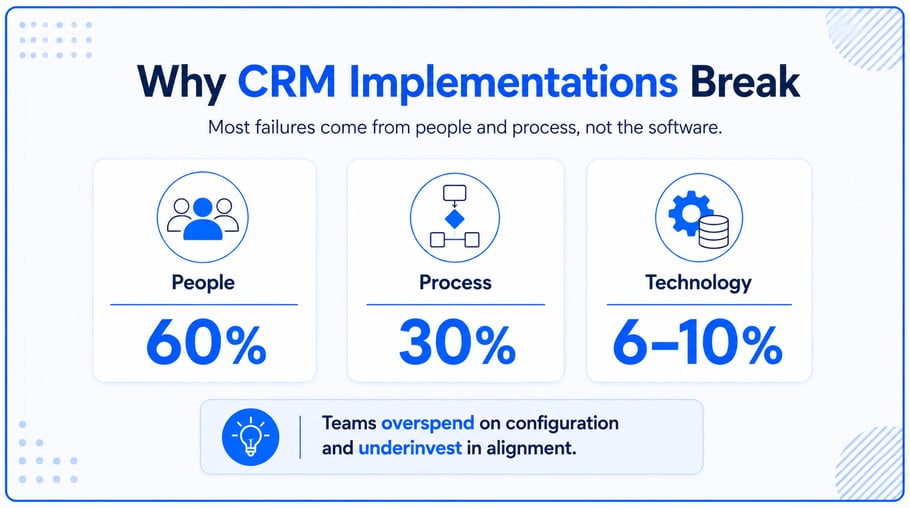
So the question for 2026 is not "which CRM should we buy?" Most B2B SaaS teams already have one. The question is how to close the gaps between what the system promises and how it gets used. There are four that matter most.
Gap 1: The sales and marketing handoff is undefined
The most expensive gap is also the most invisible. Marketing generates leads, hands them to sales, and assumes the work is done. Sales receives a list with no context, no scoring, and no agreed-upon definition of what counts as ready to call.
When that handoff is loose, the cost shows up fast. Companies with poor data alignment see up to 30% of deals incorrectly attributed, according to Forrester research cited by revenue operations practitioners, which means budget flows to channels that look like they convert but do not (The Clueless Company, 2025). Sales and marketing alignment itself drops by an estimated 43% when the two teams work from conflicting information.
The fix is procedural before it is technical. Both teams need to sit down and agree, in writing, on what an MQL and an SQL actually mean for your business, what lead score triggers a handoff, and which team owns the contact at each stage. Without that shared definition, no amount of automation will route leads correctly, because the system has no rule to follow.
This is the stage where a structured CRM strategy earns its keep. At Webdew, the handoff work almost always comes before any field gets built, because a clean lifecycle map is what every downstream automation depends on.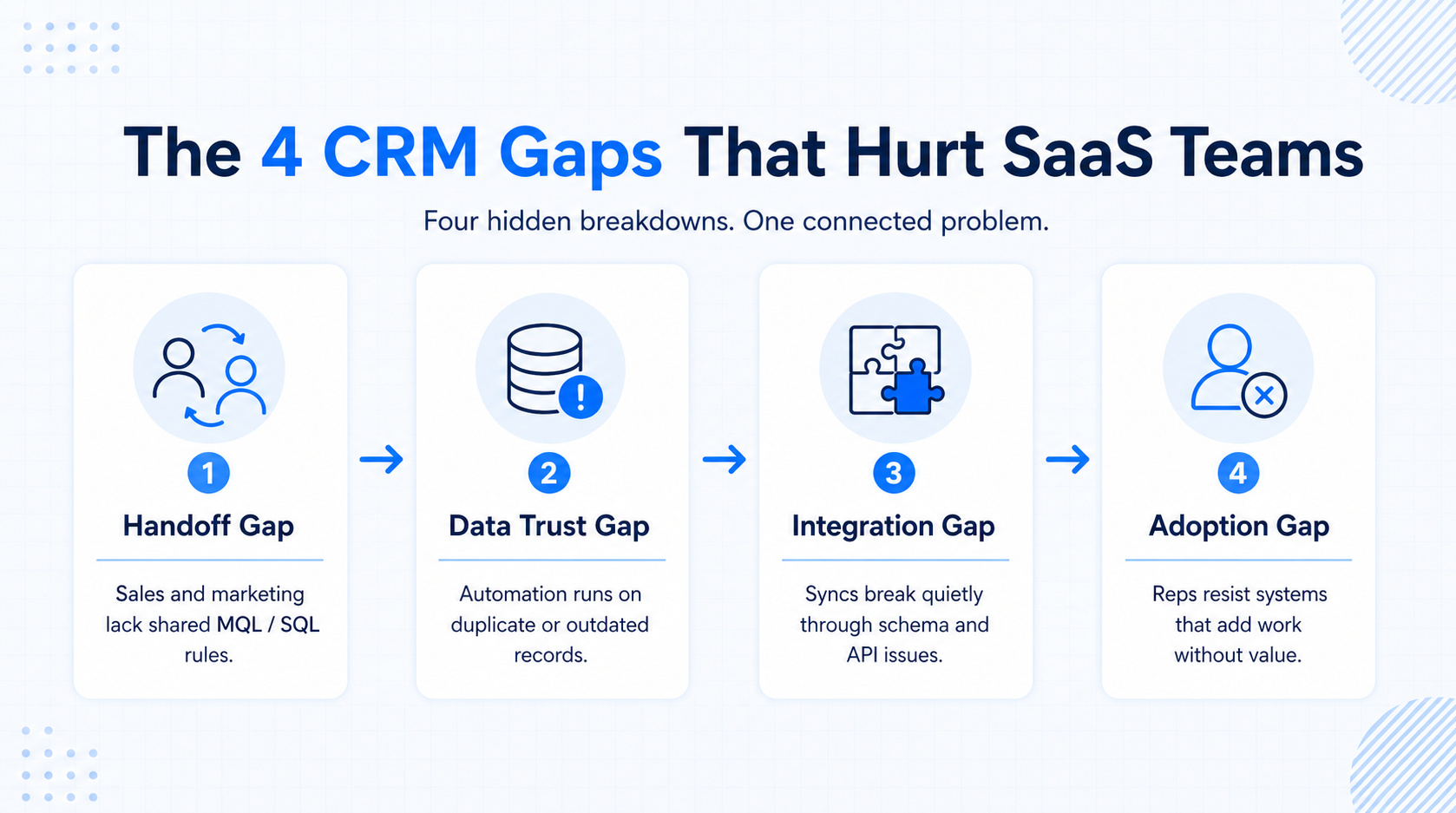
A few moves that close this gap:
- Write a one-page lead handoff agreement that both teams sign off on, covering MQL and SQL definitions, score thresholds, and ownership at each lifecycle stage.
- Set up inclusion lists so only sales-ready leads, those past a defined score or stage, reach the sales pipeline. Dumping every contact on sales is how reps learn to ignore the system.
- Build automatic alerts so a rep is notified the moment a lead crosses the threshold, with the context attached. Speed matters here; teams that respond within the first five minutes are far more likely to connect.
Gap 2: Marketing automation runs on data the CRM no longer trusts
A CRM and a marketing automation platform are built for different jobs. The CRM is the system of record for firmographic and sales data, account names, deal stages, and opportunity amounts. The automation platform owns behavioral data, email opens, page visits, and form fills. Problems start the moment those two stop agreeing on who owns what.
The most common failure is mundane: duplicate records. A contact duplicated across both systems loses its campaign history and attribution, which quietly breaks personalization and makes pipeline reporting unreliable (Stackmatix, 2026). From there, it compounds. A buyer who has already purchased still shows as a lead, so they get a nurture sequence for a product they own. A sales rep updates a note, and the next marketing list import overwrites it.
Poor data quality is not a small tax. Gartner estimates it costs organizations an average of $12.9 million a year, and manual processes can stretch lead response times to 12 to 24 hours when systems are not aligned (Campaign Creators, 2026). Meanwhile, 76% of CRM users report that less than half their data is accurate and complete, and 37% of companies say poor data quality has directly cost them revenue (Cyntexa, 2026).
To fix the automation layer, work in this order:
- Clean the data before you sync, not after. Deduplicate, standardize fields ("USA" versus "United States" is a real culprit), and enrich missing firmographics. Treating hygiene as a post-launch cleanup is how bad data circulates faster.
- Assign a single system of record for every synced field. The CRM owns lead owner and opportunity amount; the automation platform owns email engagement. Write it into a field mapping document so the rule is explicit, not assumed.
- Decide conflict resolution upfront. When both systems update the same field, you need a rule, usually "last write wins" or "system of record wins." For high-stakes fields like lifecycle stage, build the logic deliberately, so a closed-lost status from sales overrides a marketing-qualified status.
This is the part of an implementation where careful marketing automation design saves you from rebuilding the whole thing in a year.
Gap 3: The integration works until it silently doesn't
CRM integrations are rarely plug-and-play, and the failures that hurt most are the quiet ones. One mid-market software company found that its custom integration broke after they crossed 50,000 records and needed a full architecture redesign (StackSync, 2025). Another team had their integration hit API limits every morning at 9 a.m. when SDRs started prospecting, leaving qualified leads stuck for hours while scores failed to update (The Clueless Company, 2025).
The pattern behind sales integration failures is consistent: API rate limits, schema changes that break field mappings, authentication that expires, and bidirectional syncs that loop on themselves. Most of these never throw a loud error. The sync looks like it is working, while the data underneath is corrupt.
What actually keeps an integration stable:
- Map your critical data flows first and protect the revenue-impacting fields. You do not need every field synced in real time; you need the fields that drive routing and reporting to be right.
- Use delta sync where you can. Syncing only changed records instead of every record on every cycle cuts API usage dramatically and reduces the throttling that causes morning outages.
- Put change management around the integration. A marketing team adding a new field or a sales team creating a custom property can break a sync overnight. Require a quick approval step for schema changes so nobody discovers the break three weeks later in a board report.
- Build a monitoring you will actually look at. Track sync success rates, latency, and the count of records with mismatched lifecycle stages. Set alerts for sudden spikes so you move from firefighting to governance.
This is where a partner doing dedicated CRM services tends to pay for itself, because the maintenance load on an in-house team is real. One VP of engineering described a custom CRM integration as a permanent tax on development resources, time pulled straight off the product roadmap (StackSync, 2025).
Gap 4: Nobody actually uses it
You can fix every technical gap above and still fail here. CRM adoption is the single biggest predictor of success or failure, and it has almost nothing to do with the platform.
User adoption ranks as the number one cause of CRM failure, ahead of any technical issue (Radin Dynamics, 2025). The reason is plainer than most playbooks admit: reps experience the CRM as work that benefits management. They enter more data, follow new processes, and get reports and pipeline visibility in return, none of which helps them close their next deal. Researchers call this an effort-reward imbalance, and people reliably resist systems that cost them effort to benefit someone else.
The friction is measurable. Around 32% of sales reps spend more than an hour a day on manual data entry instead of selling, and 23% of users name manual input as the single biggest obstacle to using the CRM at all (CRM.org, 2026). On top of that, 42% of businesses point to lack of training or CRM expertise as the top barrier to a successful rollout (CRM.org, 2026).
The implementation strategy that fixes adoption flips the value equation back toward the user:
- Automate data capture so the system logs emails, calls, and calendar activity on its own. Every minute of manual entry you remove is a minute of resistance you remove with it.
- Deliver personal value on day one. Give reps individual-level reports and time-saving templates, not just dashboards their manager reads. If the CRM makes their day easier immediately, adoption follows.
- Start with one workflow, not everything. A minimum viable rollout, lead management and pipeline tracking done well, beats a full-feature launch that overwhelms the team. Get one process working cleanly, then layer on complexity.
- Secure visible executive sponsorship. When leadership uses the system and checks in on it, the team reads the CRM as a must-have. When sponsorship is delegated to a project manager with no authority, it reads as a nice-to-have, and adoption stalls.
- Involve skeptics early. Power users design workflows that make sense; skeptics surface the problems before they become abandoned. You need both in the room during design, not after launch.
A sequence that holds the gaps closed
The reason these four gaps recur is that teams treat them as separate projects handled by separate owners. Marketing fixes its automation, IT fixes the integration, sales is told to adopt, and the seams between them never get owned.
A rollout that holds tends to move in this order: define the lead lifecycle and handoff rules first, clean and govern the data second, build the integration around protected critical fields third, and design for adoption throughout rather than bolting it on at the end. The teams that get this right do not spend more on technology than the ones that fail. They spend more on the alignment between people and process, which is exactly where the failures live.
If your CRM is technically live but not delivering, the gap is rarely the platform. It is one of these four seams. Fix the seam, and the system you already own starts doing the job you bought it for.
If you are working through a stalled implementation and want a second set of eyes on where the gaps sit, the team at Webdew works with B2B SaaS companies on exactly this kind of alignment, integration, and adoption work.
Dive Into our
Client Testimonials
Listen to business owners like you share how we’ve helped them grow. Your story could be next!





.svg)

“Recently we reached out to Webdew for a website inside of HubSpot and they also did some mocking automation for us.”
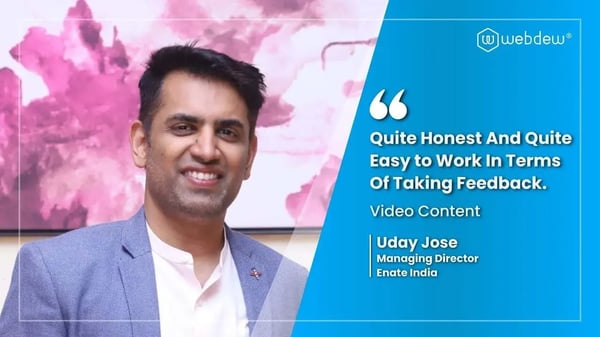
“Webdew team was quite honest and quite easy to work with in terms of taking feedback implementing it, showing that it doesn’t happen again and things like making sure that it meets our expectations.”

“We worked with webdew to help us build our HubSpot website and they did an amazing job with it. They were very quick.”

“webdew has helped us optimize the sales and marketing processes, and this is automating a lot of processes.”

“Hi everyone my name is Kara and I work as a channel consultant at HubSpot Singapore. I’ve been working closely with webdew agency”

“Hi my name is Christian from OpenDoors Mortgage team and I’m in the mortgage business and just trying to work on new projects and kind of incorporating HubSpot for my operations”

“I’m one of the technology directors for Travelopia. We are the largest experiential travel company in the world. We’ve engaged webdew recently, not recently, it’s been about a couple of quarters now.”
“We worked with Chehak over the past several months to create a series of animated videos for an academic planner that we produce. And from the very beginning, she was absolutely professional and a pleasure to work with.”


6x
We helped clients multiply their website conversion rates through strategic design and UX optimization.
20%
Our marketing campaigns led to a 20% uplift in customer engagement across digital channels.
2K+
Delivered over 2,000 qualified leads through targeted funnels and smart automation.
120+
Our video content has earned 120,000+ views, driving brand awareness and audience retention.
“I recently had the pleasure of working with Chehak on a video demo project, and I was thoroughly impressed with her services.”
.svg)

Additional Resources
Access expert tips, trends, and strategies designed for small businesses. Stay ahead of the curve and make informed decisions with our comprehensive resources!