

 We typically respond the same day

The pattern is predictable enough to spot before it happens. HubSpot works beautifully with 12 people. It feels shaky at 40. And somewhere around 80 to 100 seats, the system, as a whole revenue engine that depends on it, starts producing numbers nobody trusts. Pipeline reports contradict each other. A "qualified" lead means three different things across three teams. Workflows fire twice, or not at all. The platform didn't break, but B2B SaaS CRM reliability quietly eroded while everyone was busy hitting quota.
The uncomfortable truth behind most of these cases is the same: the platform rarely fails, but the architecture around it does. And because the decay is gradual, most teams only notice once a board deck is built on data that turns out to be wrong.
This guide is about preventing that. It covers why CRM platform stability degrades as SaaS businesses grow, what actually causes the failures, and how to architect, process-design, and onboard a HubSpot instance that scales with a team instead of against it.
Why HubSpot CRM Reliability Breaks Down as You Grow
It helps to reframe what "reliability" means here, because it's the root of most confusion. When marketing and RevOps leaders say their CRM has become unreliable, they rarely mean uptime. HubSpot's servers are fine. What they mean is that the data and processes the CRM holds have stopped being trustworthy. That's a different failure mode, and it's the one that actually kills deals.
The numbers around CRM failure are sobering. Industry analysts have long cited that somewhere between half and 70% of CRM projects fall short of their goals, and that figure has barely budged year over year despite better software. Studies tracking SaaS implementations put error rates in the 40% to 70% range, driven by poor data quality, inconsistent planning, weak training, and security gaps. The platform keeps improving; the failure rate doesn't. That tells you the problem isn't the tool.
To evaluate how these pros and cons uniquely impact scaling teams, it helps to look at an honest HubSpot CRM review to benchmark system strengths against architectural limitations.
Three structural forces make this worse, specifically as B2B SaaS companies scale:
Compounding data entropy. At 10 users, one person can eyeball the contact database and fix what's broken. At 100 users across sales, marketing, customer success, and RevOps, nobody owns the whole picture. Duplicate records multiply. Custom properties accumulate. A field someone created for a 2024 campaign is still firing automations in 2026. The disorder compounds faster than any human can clean it.
Process drift between teams. Early on, "lifecycle stage" is whatever the founder decided. As you add teams, each one bends the definitions to fit their own reporting. Sales calls a lead "qualified" at one threshold; marketing at another. When those definitions diverge, every cross-functional report becomes a negotiation instead of a fact.
Automation interdependency. This is the most dangerous of the three. A mature HubSpot instance can hold hundreds of interlocking workflows. Change one property and five automations downstream can break silently. The same single-point-of-failure risk that plagues any complex software architecture shows up inside the CRM, and most teams have no map of those dependencies.
None of these are HubSpot bugs. They're the predictable result of running a growing organization on a system that was configured for a smaller one and never re-architected.
The Real Causes of CRM Failure (A Quick Failure Analysis)
Fixing reliability starts with being honest about where it actually breaks. A proper software failure analysis of a struggling HubSpot instance sorts the causes into four buckets. Across the implementations, Webdew has audited for scaling SaaS teams, and the damage usually concentrates here..png?width=1200&height=800&name=The%20Real%20Causes%20of%20CRM%20Failure%20(A%20Quick%20Failure%20Analysis).png)
1. Data quality is the silent killer
A CRM is only as credible as the data inside it. Roughly half of CRM implementations are undermined by poor data, which is alarming for an industry that runs on it. Duplicate records, incomplete fields, and inconsistent formatting don't announce themselves. They quietly corrupt segmentation, lead scoring, and reporting until someone notices the forecast was built on sand. By then, the damage is done: redundant follow-ups sent, leads misrouted, and budget decisions made on bad inputs.
2. Low adoption hollows out the system from the inside
The best-architected CRM is useless if people don't use it consistently. More than half of CRM systems struggle because of weak adoption, and the reason is almost always the same: users don't see immediate value, so they keep their real work in spreadsheets and treat HubSpot as a compliance chore. Every skipped log and every shadow spreadsheet is a hole in the data, and the holes compound exactly like the entropy problem above.
3. No clear ownership
When no one owns the CRM, no one can make decisions about it, and it slowly rots. This is the most common failure in fast-growing SaaS orgs, because everyone is too busy shipping. Successful teams designate a clear owner, usually inside RevOps, who holds the authority to standardize properties, gate new automations, and enforce the data model. Without that role, every team optimizes locally, and the system degrades globally.
4. Strategy and execution fall out of sync
Many SaaS businesses treat HubSpot as a piece of technology to install rather than a business process to operate. The moment that happens, it becomes an expensive database with no measurable goals attached. Reliability isn't a setting that gets toggled on; it's the byproduct of strategy, process, and the tool staying aligned as the company grows. For modern teams evaluating their technology foundations, balancing layout vs. technical scalability is a massive factor, as analyzed deeply in our breakdown of GoHighLevel vs HubSpot.
Case Study: Orbital Nexus Ventures
When operations and strategy misalign during rapid SaaS business growth, the data structure completely falls apart. Webdew worked with Orbital Nexus Ventures to resolve severe tracking inefficiencies by overhauling their operational pipeline. By mapping their actual strategic goals directly to their HubSpot architecture, Webdew built an aligned system that unified their growth efforts and restored core data accuracy.
👉 Read the full Orbital Nexus Ventures Case Study here.
Architecting HubSpot to Scale: The Reliability Layer
This is where prevention actually happens. Most reliability problems are architecture problems wearing a data-quality costume. Fix the architecture, and the symptoms recede. In Webdew's work with scaling B2B SaaS teams, these are the priorities that determine whether a B2B customer relationship management deployment holds up past 100 seats.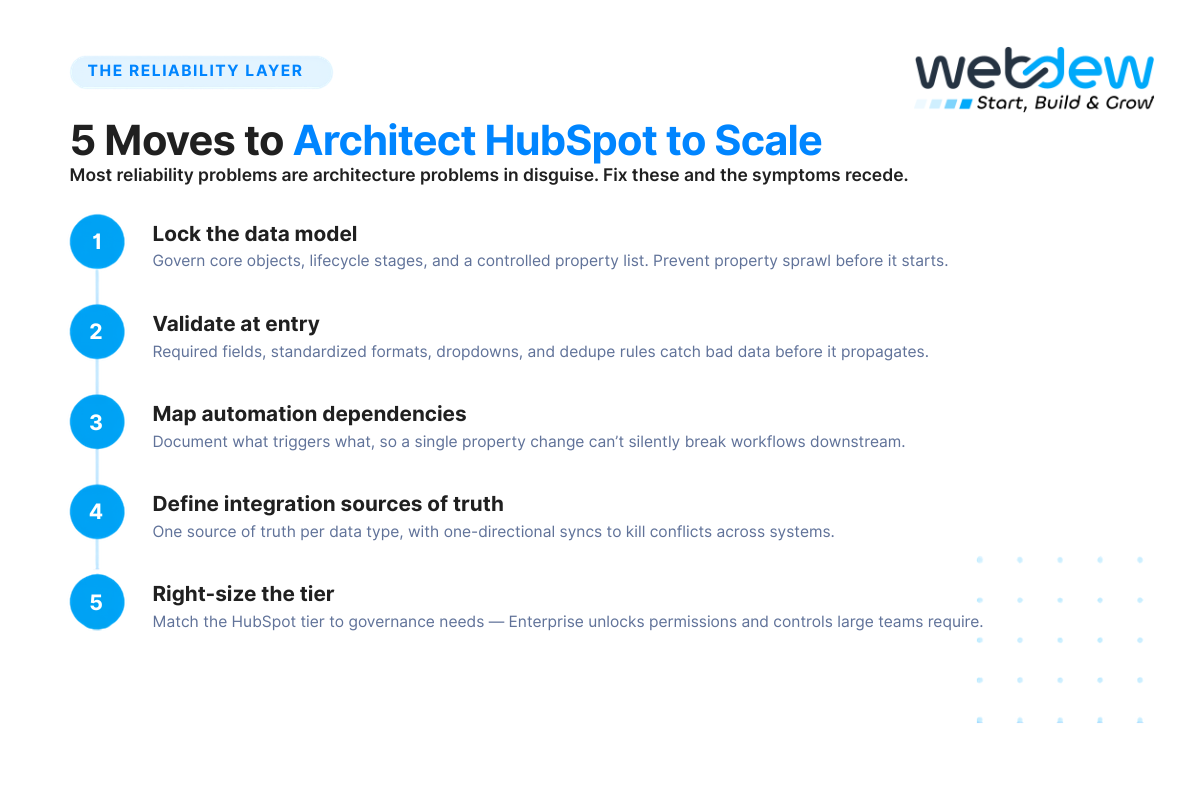
Lock down the data model before scaling, not after. Define core objects, lifecycle stages, and a controlled set of custom properties, then govern additions to that list. The single highest-leverage move for CRM platform stability is preventing property sprawl. Every team wants its own field; the discipline is saying no unless the field serves the shared model. A clean, deliberate data model is the foundation on which everything else rests.
Build validation in, so bad data can't enter. The cheapest place to fix a data problem is at the point of entry. Required fields, standardised formats, dropdowns instead of free text wherever possible, and deduplication rules all help. Real-time validation catches errors before they propagate. Retroactive cleanup is expensive; prevention is nearly free.
Map automation dependencies. Before scaling workflow count, document what depends on what. Which properties trigger which workflows? What happens downstream if a stage changes? This map is the insurance policy against the silent-breakage problem. When something eventually needs to change, the risk is already known.
Case Study: Obsidian Insurance Holdings
Scale requires precise data architecture and clean integration mappings. Webdew partnered with Obsidian Insurance Holdings to execute a comprehensive HubSpot optimization project. By structuring their custom objects, aligning properties, and setting clear governance rules, Webdew eliminated data fragmentation and created a highly scalable "source of truth" infrastructure.
👉 Read the full Obsidian Insurance Holdings Case Study here.
Plan integrations as a hub-and-spoke, not a tangle. As a company grows, HubSpot connects to the product, the billing system, the data warehouse, and more. Poorly planned integrations create data silos and sync conflicts, where the same customer shows different states in different systems. To unpack this further, exploring an all-inclusive HubSpot CRM integration guide can help map out exactly how to tie ancillary systems together smoothly without generating massive data discrepancies.
Right-size the tier deliberately, not reactively. HubSpot pricing scales steeply, and the jumps matter for architecture, not just budget. In 2026, the free CRM remains free for unlimited users, but the full Professional Customer Platform costs $1,300/month, including 5 seats, and the Enterprise Customer Platform starts at $4,300/month. Enterprise unlocks the governance features that large teams genuinely need: granular permissions, advanced custom objects, and the controls that keep a 100-seat instance from descending into chaos. Scaling teams that delay the enterprise move often pay for it in reliability instead of dollars.
Note: Pricing verified June 2026; HubSpot updates list prices periodically, so confirm against the live pricing page before budgeting.
Process Design: Making Reliability a Habit, Not a Heroic Effort
Architecture sets the foundation, but processes keep it from decaying. The teams whose HubSpot instances stay reliable at scale all share a few operational habits.
They run scheduled data audits, not occasional panic cleanups. Monthly or quarterly reviews catch duplicates, decaying records, and format drift before they reach a board deck. Data quality is an ongoing commitment, not a one-time project, and the cadence is what makes it sustainable.
They standardize definitions across teams and write them down. A shared, documented glossary of what every lifecycle stage and property means is unglamorous and absolutely critical. When sales, marketing, and CS all reference the same definitions, cross-functional reports stop being arguments and start being facts.
They gate new automations and properties through the CRM owner. Anyone can request a change; only the owner approves it against the shared model. This single piece of governance prevents most of the sprawl that erodes reliability over time.
They track shared KPIs that force alignment. When sales, marketing, and customer success report against the same metrics, misalignment surfaces immediately instead of festering inside divergent dashboards.
Onboarding: Where Reliability Is Won or Lost
Most reliability failures are seeded during onboarding, long before anyone notices the symptoms. Adoption is the variable that determines whether all the careful architecture actually holds, because a perfectly designed CRM that people route around is still an unreliable one.
Effective onboarding for a scaling SaaS team has a few defining traits. Train by role, not by feature. AEs, marketers, and CS teams interact with HubSpot completely differently. Scenario-based training tailored to each role's actual daily workflow lands far better than a generic feature tour, and continuous CRM training has been shown to meaningfully accelerate sales cycles. Show value on day one, because users who don't see immediate benefit revert to spreadsheets fast and never come back. Appoint adoption champions inside each team, respected peers who model good behavior and provide local support. And keep feedback loops running after launch, because onboarding isn't a launch-day event; it's an ongoing program that keeps the system aligned as the org changes.
Get onboarding right, and the data stays clean because people actually use the system as designed. Get it wrong, and no amount of architecture will save it.
A Practical Checklist for Scaling HubSpot Reliably
A condensed version for teams that want a starting point:
- Designate a single CRM owner with authority over the data model
- Lock down core objects, lifecycle stages, and a governed property list
- Build validation rules and deduplication at the point of data entry
- Map automation dependencies before scaling workflow count
- Define integration sources of truth and enforce one-directional syncs
- Document a shared glossary of definitions across all revenue teams
- Schedule recurring data audits (monthly or quarterly)
- Gate new properties and automations through the owner
- Train onboarding by role, with adoption champions per team
- Right-size the HubSpot tier to match governance needs, not just headcount
Final Thoughts
The hardest part of scaling HubSpot for B2B SaaS isn't the software. It's accepting that an instance configured for 15 people will not reliably serve 150 without deliberate re-architecture. The failure is rarely a HubSpot outage. It's data entropy, process drift, and unmanaged automation quietly compounding until the numbers stop being trustworthy.
The good news is that every one of those forces is preventable. Strong data governance, mapped dependencies, disciplined process design, and role-based onboarding turn HubSpot from a system that gets shakier as a company grows into one that gets stronger. Reliability at scale isn't luck. It's architecture plus habit, maintained on purpose.
When CRM data starts to feel less trustworthy than it used to, that's the signal to invest in the reliability layer now, before the next board deck is built on numbers nobody can defend. As highlighted in our industry roundup of the best HubSpot agencies for B2B SaaS, working with an elite ecosystem partner turns HubSpot from a system that gets shakier into one that gets stronger as you grow.
Dive Into our
Client Testimonials
Listen to business owners like you share how we’ve helped them grow. Your story could be next!





.svg)

“Recently we reached out to Webdew for a website inside of HubSpot and they also did some mocking automation for us.”

“Webdew team was quite honest and quite easy to work with in terms of taking feedback implementing it, showing that it doesn’t happen again and things like making sure that it meets our expectations.”

“We worked with webdew to help us build our HubSpot website and they did an amazing job with it. They were very quick.”

“webdew has helped us optimize the sales and marketing processes, and this is automating a lot of processes.”

“Hi everyone my name is Kara and I work as a channel consultant at HubSpot Singapore. I’ve been working closely with webdew agency”

“Hi my name is Christian from OpenDoors Mortgage team and I’m in the mortgage business and just trying to work on new projects and kind of incorporating HubSpot for my operations”

“I’m one of the technology directors for Travelopia. We are the largest experiential travel company in the world. We’ve engaged webdew recently, not recently, it’s been about a couple of quarters now.”
“We worked with Chehak over the past several months to create a series of animated videos for an academic planner that we produce. And from the very beginning, she was absolutely professional and a pleasure to work with.”


6x
We helped clients multiply their website conversion rates through strategic design and UX optimization.
20%
Our marketing campaigns led to a 20% uplift in customer engagement across digital channels.
2K+
Delivered over 2,000 qualified leads through targeted funnels and smart automation.
120+
Our video content has earned 120,000+ views, driving brand awareness and audience retention.
“I recently had the pleasure of working with Chehak on a video demo project, and I was thoroughly impressed with her services.”
.svg)

Additional Resources
Access expert tips, trends, and strategies designed for small businesses. Stay ahead of the curve and make informed decisions with our comprehensive resources!