

 We typically respond the same day

Most B2B SaaS companies don't lose deals because their product is wrong. They lose them because the data behind sales, marketing, and customer success is a mess: duplicate contacts, stale lifecycle stages, pipelines that nobody trusts. CRM implementation services promise to fix that. But the wrong partner can cost you six months and a lot of money while creating new problems on top of the old ones.
So before you sign anything, get clear answers to these five questions. They'll tell you whether a CRM partner actually knows B2B SaaS, or just knows CRM software.
TL;DR
Before hiring CRM implementation services for your SaaS business, ask about SaaS-specific experience, onboarding methodology, technical integration depth, data migration approach, and post-launch support. The answers will separate partners who understand recurring revenue from those who sell generic CRM setups.
- CRM implementation services configure, integrate, and launch CRM platforms for SaaS go-to-market teams.
- The right CRM partner reduces time-to-value and prevents data quality problems that stall revenue operations.
- Wrong-fit partners create rework cycles that cost more than the original implementation.
Question 1: Have You Worked with B2B SaaS Companies at Our Growth Stage?
CRM implementation services built for SaaS look different from generic CRM setups. You're managing free trial conversions, product-qualified leads, expansion revenue, and churn risk, often in the same pipeline. A partner who's spent their career setting up CRMs for agencies or e-commerce brands will approach your data model differently than someone who's built CRM infrastructure for SaaS startups specifically.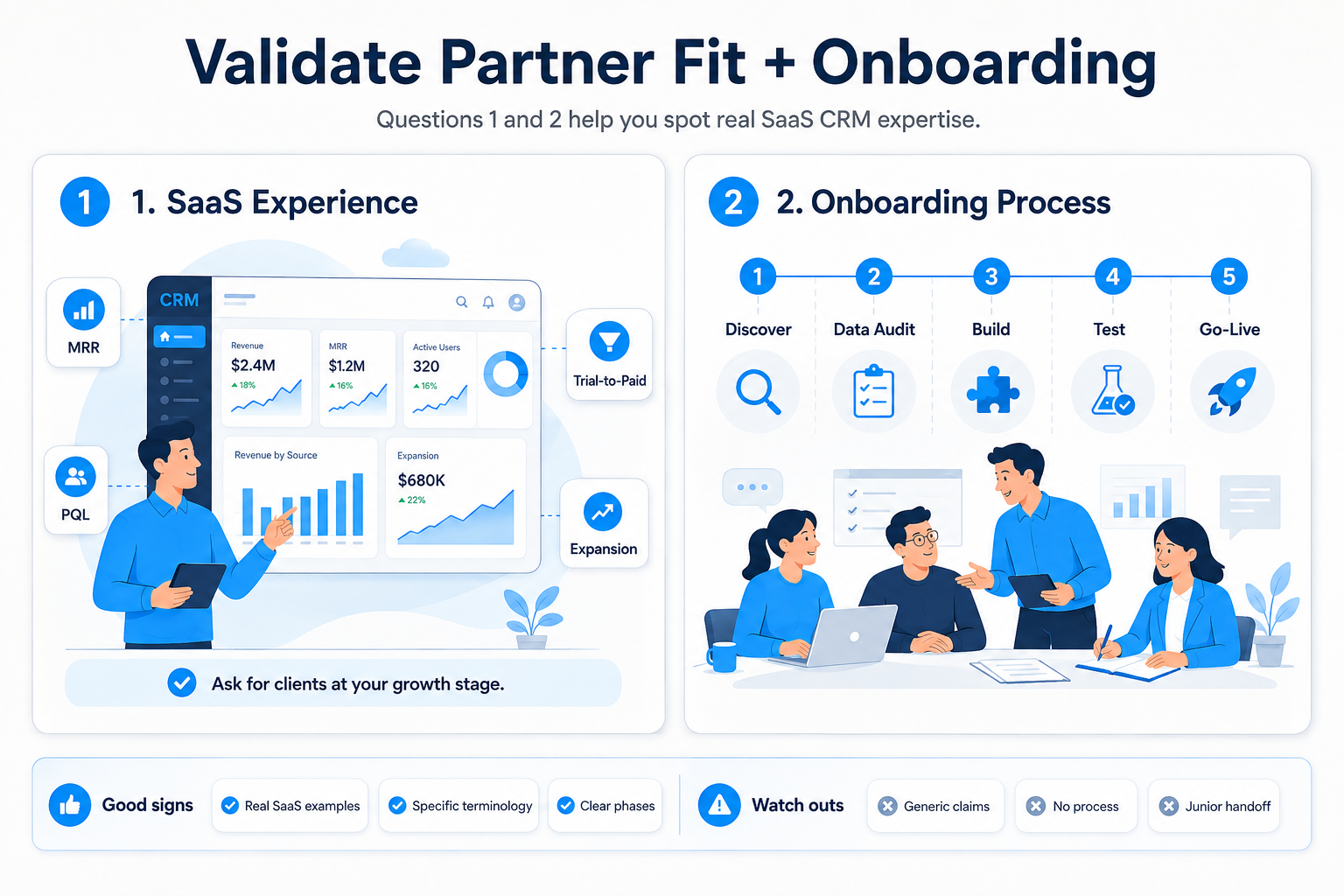
The distinction matters more than it sounds. SaaS companies deal with problems that don't come up in other industries: how to model a freemium funnel in a CRM designed for linear sales motions, how to connect product usage data to contact records, how to track MRR and expansion without turning your CRM into a billing system. A partner without SaaS experience will make decisions that work fine in theory but break down when your CS team tries to run QBRs or your marketing team tries to segment by product tier.
Ask for two or three client examples at a similar ARR or team size. If they can't name them, that's useful information. If they can, ask what the biggest CRM challenge was at that stage. A good partner will have a real answer, not a rehearsed sales line. If you want a baseline for how CRM should work inside a SaaS go-to-market, the HubSpot for SaaS overview lays out the core data model and pipeline structure that experienced partners build toward.
What to listen for: Specific SaaS terminology such as MRR, expansion revenue, PQL, and trial-to-paid conversion. Vague answers about "helping teams grow" are a flag.
Key points:
- CRM implementation services for B2B SaaS require a data model built around recurring revenue.
- SaaS-experienced partners configure pipelines that track trial conversions, expansions, and churn in one system.
- Partners without SaaS experience build CRM structures that break when product usage data enters the workflow.
Question 2: What Does Your Onboarding Process Actually Look Like?
CRM onboarding methodology determines whether your team adopts the system or abandons it within 90 days. "We'll get you set up in four weeks" is not a methodology. A real answer covers how they handle requirements gathering, who owns each decision, how they manage scope changes, and what happens when something doesn't work.
CRM consulting for complex implementations can help businesses address these decisions before onboarding begins.
Ask them to walk you through a recent onboarding timeline. What went wrong, and how did they handle it? Every CRM project of any substance hits friction somewhere, whether that's messy source data, a stakeholder who changes requirements mid-build, or an integration that behaves differently in production than in testing. If they've never had a project run long or get complicated, they're either not being honest or they haven't worked on implementations with real complexity.
You also want to know who actually runs your onboarding. Some agencies sell you on senior consultants and hand you off to junior staff once contracts are signed. Ask directly: who is on the implementation team, and what's their individual experience with CRM for SaaS companies? For context on what a structured onboarding engagement covers from kickoff through go-live, see how HubSpot onboarding services work for SaaS teams.
What to listen for: A clear phase-by-phase breakdown with realistic timelines. References to iteration and adjustment, not just delivery. Honest answers about common delays such as data quality issues, stakeholder alignment, and technical dependencies.
Key points:
- CRM onboarding methodology defines the phase structure, decision ownership, and scope change process.
- A structured onboarding timeline includes requirements gathering, data audit, build, testing, and go-live phases.
- Partners who name specific onboarding phases demonstrate repeatable process, not improvised delivery.
Question 3: How Deep Do Your Integrations Go?
CRM integration depth determines whether your platform becomes a single source of truth or an isolated record system. A CRM that doesn't talk to your billing system, product analytics, or customer success tools is an expensive address book. Integration depth is where most CRM projects fall apart, and where promises are easiest to make without substance behind them.
Ask specifically about the tools in your current stack. If you use Stripe, ask how they handle billing sync and whether revenue data flows back into contact records. If you're on Intercom or Amplitude, ask how they've connected those tools before. The answer should include specifics: which API approach they'd use, whether they'd rely on native connectors or middleware like Make or Zapier, and what happens when a field doesn't map cleanly across systems. Understanding the basics of how a CRM connects systems is worth reviewing before these conversations. The fundamentals of a customer relationship management system covers the integration layer and what a connected CRM should do.
If an integration you depend on isn't something they've handled before, you want to know that in the evaluation, not three weeks into the project.
What to listen for: Comfort with your specific tools, not generic answers about "integrating with most platforms." Honesty about any tools they haven't worked with. A clear approach to handling field mapping conflicts and data sync logic.
Key points:
- CRM integration services connect billing, product analytics, and customer success tools to a central contact record.
- Native connectors sync data automatically; middleware handles field mapping when direct APIs don't align.
- Integration scope determines CRM build timelines and should be audited before project kickoff.
Question 4: How Do You Handle Data Migration and Cleanup?
Data migration quality determines whether your new CRM starts clean or inherits every problem from your old system. If you're moving from a spreadsheet, a legacy CRM, or a patchwork of disconnected tools, data quality is the real project. Most SaaS teams underestimate how messy their contact records are: duplicate leads, outdated lifecycle stages, companies with no contacts attached, contacts with no company, email addresses that bounced two years ago still sitting in the active database.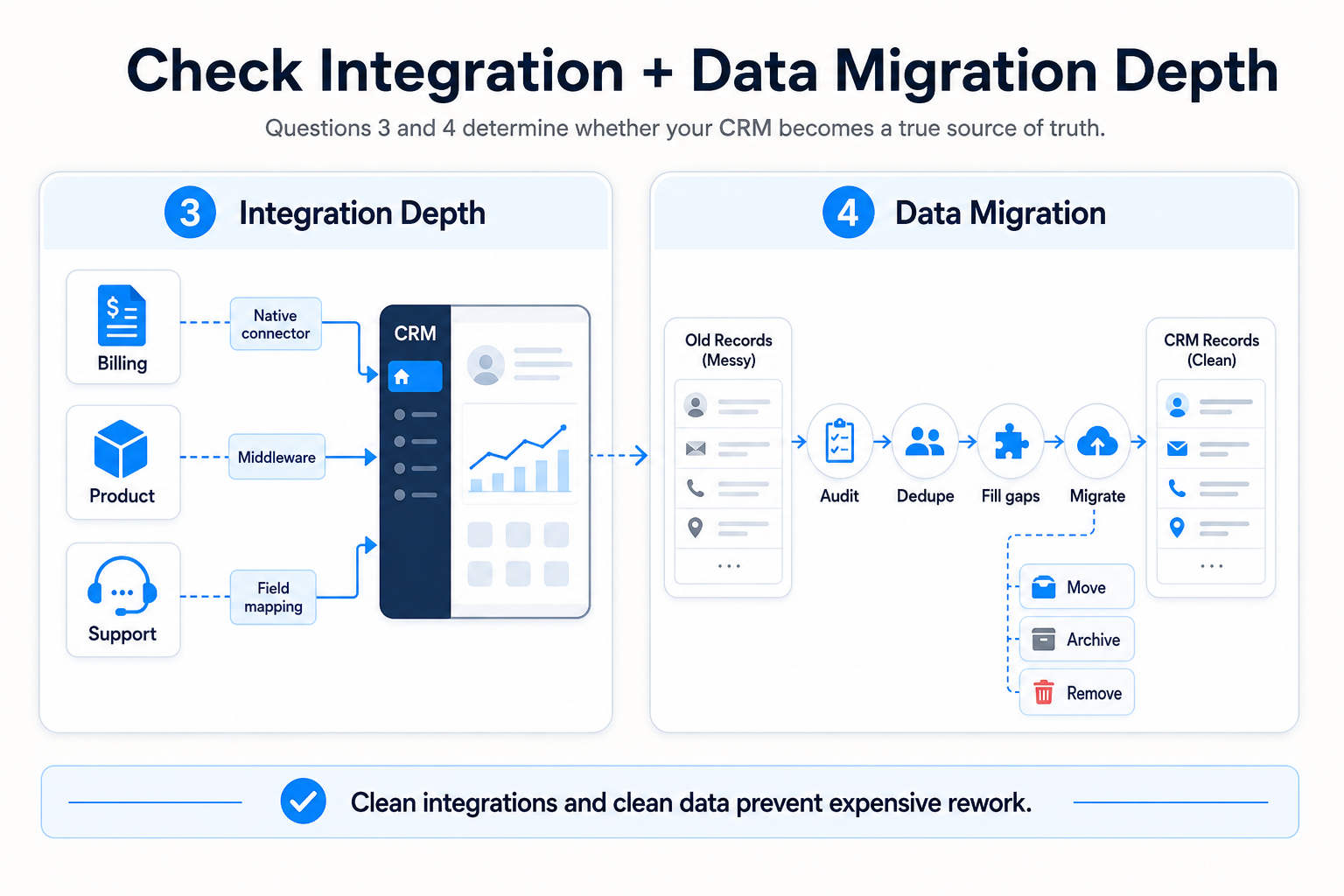
Ask the partner how they approach a data audit before migration. Do they have a defined process for flagging duplicates and resolving conflicts? How do they handle contacts where critical fields are missing? What's their position on cleaning before importing versus cleaning after the fact?
Some partners skip the audit and migrate everything, leaving you with a clean-looking CRM that still carries all the underlying problems. Others over-engineer the cleanup and delay go-live by months chasing perfection in the source data. The right answer sits between those extremes: a structured, scoped audit with clear criteria for what gets migrated, what gets archived, and what gets left behind. That decision framework should come from the partner before the project starts, not be improvised during it. If your team is thinking about scaling CRM operations after migration, the approach to scaling HubSpot CRM for B2B SaaS covers the data governance decisions that matter most at the growth stage.
What to listen for: A defined data audit process with specific deliverables. Clear migration criteria. Honest conversation about timeline implications when source data is poor.
Key points:
- Data migration audits identify duplicate contacts, missing fields, and outdated lifecycle stages before import.
- Migration criteria define which records move to the new CRM, which get archived, and which get removed.
- Partners who skip pre-migration audits transfer data problems from the old system into the new one.
Question 5: What Support Do You Provide After Go-Live?
Post-launch CRM support determines whether your team's adoption holds or erodes within the first quarter. The go-live date is not the finish line. It's the start of a different kind of work: training your team on the new system, adjusting workflows that don't behave as expected in production, and handling edge cases the initial build didn't account for. The first 60 to 90 days after launch are when most CRM implementations either stick or fall apart.
Ask exactly what's included in post-launch support and for how long. Is it a 30-day hypercare period with a dedicated contact? An ongoing retainer? Ad hoc support tickets with a service level agreement? Find out who handles requests after the implementation team rolls off the project. Is it the same consultants who built the system, or a different support tier with less context on your setup?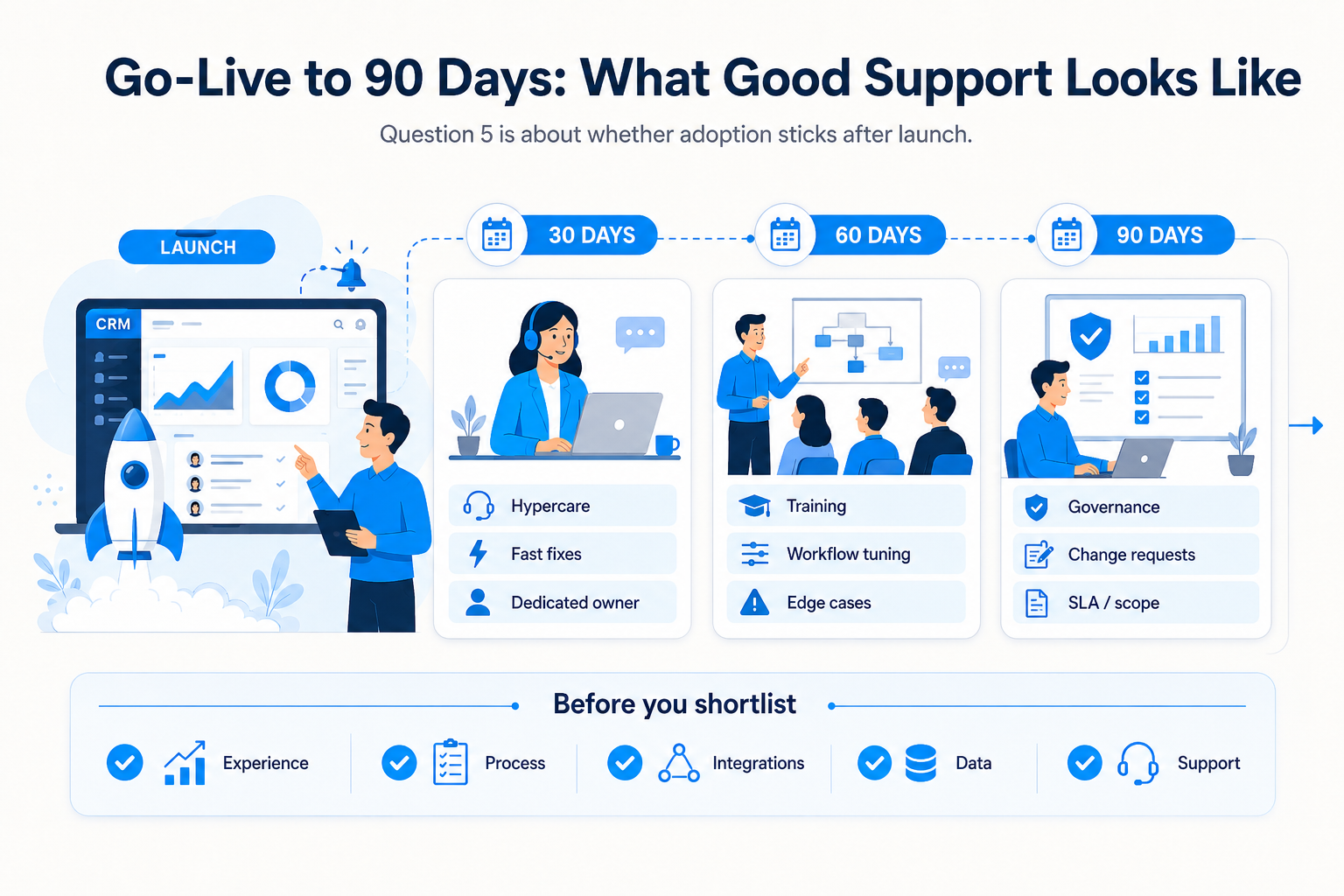
Also ask how they handle change requests after go-live. If your sales process changes three months in, what does it cost to update the CRM? Understanding the post-launch commercial model upfront prevents sticker shock and helps you plan CRM ownership internally. For context on what a long-term CRM consulting relationship covers, including managed support and platform governance, see what to look for in a CRM service partner for B2B SaaS.
What to listen for: Clear post-launch terms in writing. A defined handoff process. Realistic expectations about what ongoing CRM management requires from your internal team versus what stays with the partner.
Key points:
- Post-launch CRM support covers workflow adjustments, team training, and edge case resolution in the first 90 days.
- Hypercare periods define who handles escalations and response times after go-live.
- Change requests after go-live should have a documented scoping and pricing process, not be negotiated case by case.
Before You Shortlist Anyone
These five questions won't replace a proper evaluation process, but they'll filter out the wrong partners fast. Any CRM implementation services provider worth hiring should answer all five without hedging or defaulting to generic answers. If they can't, move on.
The right partner will have done this enough times that they anticipate the hard questions before you ask them. They'll tell you what's gone wrong on past projects and how they handled it. That kind of transparency in the sales conversation is a reliable indicator of how they'll behave when the project hits friction.
Webdew works with B2B SaaS companies on CRM implementation, HubSpot onboarding, and RevOps infrastructure built around the actual workflows of SaaS go-to-market teams. If you're evaluating CRM consulting partners and want to talk through what your implementation would involve, get in touch with our team.
Dive Into our
Client Testimonials
Listen to business owners like you share how we’ve helped them grow. Your story could be next!





.svg)

“Recently we reached out to Webdew for a website inside of HubSpot and they also did some mocking automation for us.”
“Webdew team was quite honest and quite easy to work with in terms of taking feedback implementing it, showing that it doesn’t happen again and things like making sure that it meets our expectations.”
“We worked with webdew to help us build our HubSpot website and they did an amazing job with it. They were very quick.”

“webdew has helped us optimize the sales and marketing processes, and this is automating a lot of processes.”

“Hi everyone my name is Kara and I work as a channel consultant at HubSpot Singapore. I’ve been working closely with webdew agency”

“Hi my name is Christian from OpenDoors Mortgage team and I’m in the mortgage business and just trying to work on new projects and kind of incorporating HubSpot for my operations”

“I’m one of the technology directors for Travelopia. We are the largest experiential travel company in the world. We’ve engaged webdew recently, not recently, it’s been about a couple of quarters now.”
“We worked with Chehak over the past several months to create a series of animated videos for an academic planner that we produce. And from the very beginning, she was absolutely professional and a pleasure to work with.”


6x
We helped clients multiply their website conversion rates through strategic design and UX optimization.
20%
Our marketing campaigns led to a 20% uplift in customer engagement across digital channels.
2K+
Delivered over 2,000 qualified leads through targeted funnels and smart automation.
120+
Our video content has earned 120,000+ views, driving brand awareness and audience retention.
“I recently had the pleasure of working with Chehak on a video demo project, and I was thoroughly impressed with her services.”
.svg)

Additional Resources
Access expert tips, trends, and strategies designed for small businesses. Stay ahead of the curve and make informed decisions with our comprehensive resources!
.svg)