

 We typically respond the same day

Here's a number that should make every SaaS leader pause: somewhere between half and two-thirds of CRM implementations never deliver what they promised. Merkle Group put the failure rate at 63%. Other studies land closer to 50%. Either way, it's a coin flip at best, and the deciding factor rarely turns out to be the software.
The pattern repeats across the industry. A team picks a capable platform, signs the contract with real optimism, and six months later, the reps are back in spreadsheets, and the forecast is guesswork again. The platform worked fine. The implementation didn't.
That gap is exactly why B2B SaaS CRM outsourcing has become less of a "should we?" question and more of a "who do we trust with it?" question. But choosing a service partner is genuinely hard to do well, and most of the hesitation RevOps and marketing leaders feel is reasonable. This guide walks through that decision, the risks worth weighing, the fit signals worth chasing, and the long-term value worth paying for.
Why Outsourcing Hesitation Is Rational (and How to Move Past It)
The fear deserves to be named, because pretending it doesn't exist helps no one. Handing a customer relationship management system to an outside team means handing over the data layer on which the entire go-to-market motion runs. Pipeline, attribution, renewals, churn signals, all of it. If that goes sideways, a company doesn't just lose a project. It loses visibility into its own business.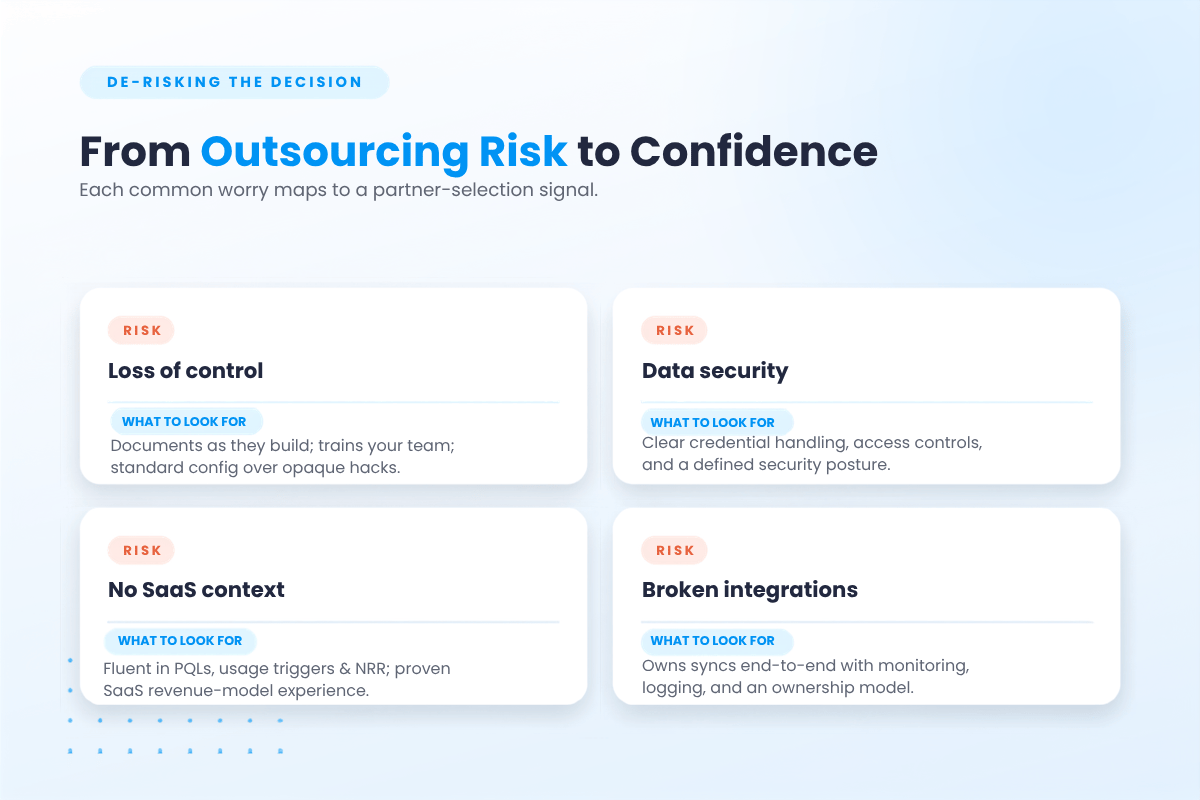
So the outsourcing hesitation usually breaks down into a few specific worries:
- Loss of control. "What if they configure it in a way only they understand?"
- Data security. "We're moving sensitive customer records through a third party."
- Context gap. "An agency doesn't know our product, our sales cycle, our weird edge cases."
- Lock-in. "What happens when the engagement ends? Are we stranded?"
Every one of these is legitimate. But notice something: none of them is an argument against outsourcing. Each is an argument for choosing the right partner. A strong CRM service partner reduces every one of these risks rather than introducing them. The trick is knowing what "strong" actually looks like before signing anything, which is what the rest of this guide is about.
It helps to be honest about the alternative, too. Building deep CRM expertise in-house is expensive and slow. Most SaaS companies don't have a dedicated RevOps architect who has configured the same platform across forty different businesses. A good partner has, and that pattern recognition is most of what the engagement is paying for.
The Real Risks and How a Good Partner Neutralizes Them
The most useful way to evaluate a potential partner is to reframe vague unease as concrete risk. Here's how the serious risks map to partner-selection criteria.
Risk 1: They build something only they can maintain
This is the lock-in fear, and it's the one that warrants the most caution. Some agencies quietly benefit from making themselves indispensable, undocumented workflows, custom code with no handoff notes, and configuration logic that lives in one consultant's head.
What to look for instead: A partner who documents as they build, trains the internal team along the way, and treats knowledge transfer as part of the deliverable, not an upsell. Ask directly during evaluation: "When this engagement ends, what do we walk away with?" The answer should include documentation, admin training, and clean, standard configuration over clever-but-opaque hacks.
Risk 2: Data gets exposed in transit
CRM work means touching customer records, and customer relationship management data is exactly what a company can't afford to leak. This concern gets sharper in SaaS, where the CRM is often synced with the product, the billing system, and a stack of other tools.
What to look for instead: Vet their security posture the way any vendor would be vetted. How do they handle credentials? Do they work inside the client's environment or copy data into their own? What's their access-control model when multiple people touch a portal? A partner who answers these crisply has thought about them in advance. One who improvises is revealing something.
Risk 3: They don't actually understand B2B SaaS
A CRM configured for a local services business will quietly sabotage a SaaS company. The SaaS motion has product-qualified leads, trial-to-paid conversion, expansion revenue, and multi-touch attribution across long buying committees, none of which a generalist sets up correctly by default.
What to look for instead: Domain fit. Has the partner worked with SaaS revenue models specifically? Can they talk fluently about PQLs, usage-based triggers, and net revenue retention without needing the terms explained? This is where vertical-specialist agencies earn their keep over generalist shops.
Risk 4: Integrations break, and nobody owns it
This risk is underrated, and it's where many SaaS CRM projects quietly fall apart. As Prismatic's team puts it plainly, integrations are hard, and SaaS integrations are harder still because security is critical, scaling is complicated, and standards are all over the place. A CRM has to talk to the product, the data warehouse, the support desk, and the billing platform, and every one of those connections uses different auth, different data formats, and different failure modes.
What to look for instead: A partner who treats integration as a first-class part of the engagement, not an afterthought. Ask how they handle a sync that silently stops passing data at 2 a.m. The good ones have monitoring, logging, and an ownership model. The rest find out when the forecast is already wrong.
The Adoption Problem Most Partners Ignore
This section deserves real attention, because it covers the single biggest reason CRM projects fail and the thing most service providers underweight.
The high failure rate of CRM implementations, hovering around 50% to 55% as noted by Gartner and Forrester, is primarily a human and operational crisis, not a technological one. Up to 60-70% of implementation failures stem from poor user adoption, change resistance, and misaligned business goals
Why do people resist? It usually comes down to friction. When reps feel the system is something they maintain for management rather than a tool that helps them, they do the bare minimum or quietly route around it. The most cited culprit is the manual data entry time that feels stolen from selling.
The flip side is enormous. Businesses using CRM effectively see a 300% increase in conversion rates, a 29% revenue lift, and an average return of $8.71 for every dollar invested. The difference between shelfware and a 9x return isn't the platform. It's adoption.
So adoption capability should be a top-tier selection criterion, not a nice-to-have. Worth pressing a prospective partner on:
- How do they handle change management, not just configuration?
- Do they design for the rep's daily workflow, or just management's reporting needs?
- What's their plan for training, and is it a one-time launch session or an ongoing program?
- Will they help simplify required fields rather than bloat the system?
A partner who only talks about features and ignores the humans who'll use them is setting a company up to join the 50–63% that fail. The ones worth hiring obsess over making the system genuinely easier than the spreadsheet it's replacing. For a deeper look at this specific failure mode, this breakdown of how HubSpot drives CRM adoption across teams is a useful companion read.
A Practical Framework for Service Provider Selection
Running a disciplined service provider selection process is easier with a scorecard built around five dimensions. Weight them according to the situation, but don't skip any.
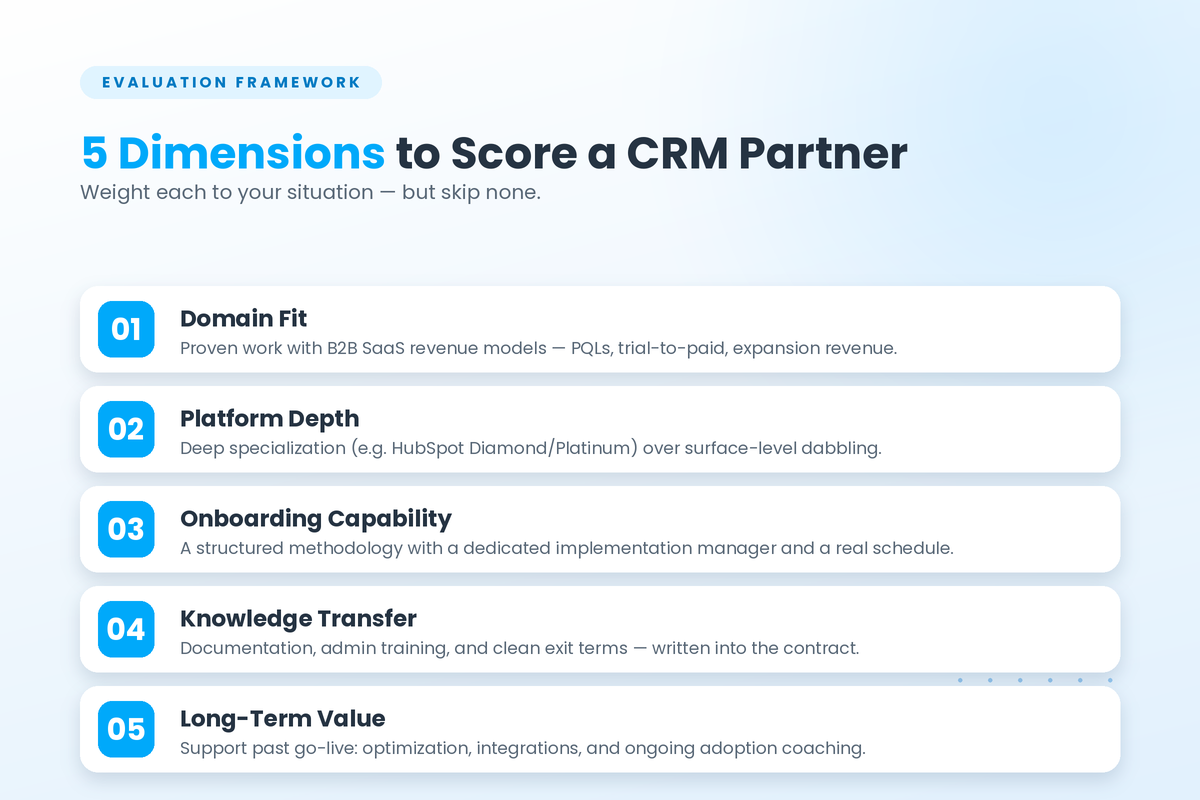
1. Domain fit (B2B SaaS specifically). Have they done this for similar companies? Ask for examples that match the revenue model, not just the logo size. A partner who has run the same migration ten times will surface problems a buyer didn't know to ask about.
2. Platform depth. There's a real difference between an agency that dabbles across six platforms and one that has gone deep on the platform in question. Certifications matter as a signal; a HubSpot Diamond or Platinum Partner badge, for instance, means the agency has demonstrated volume and competency that HubSpot itself vouches for. Depth shows up in the edge cases.
3. Onboarding capability. This is where many partners look great in the pitch and fall apart in week three. The data on this is striking: companies that succeed almost always credit a structured onboarding process. One frequently cited case involved a team that failed with a self-serve CRM rollout, then succeeded the second time around specifically because their partner assigned a dedicated implementation manager and set up a real schedule rather than leaving them to "teach yourself and wing it." Any prospective partner should be able to walk through their onboarding methodology step by step. Vagueness here is a red flag.
4. Knowledge transfer and exit terms. This was raised under lock-in, but it deserves its own line in the scorecard. The best partners make a client more self-sufficient over time, not less. Documentation, admin enablement, and clean handoffs should be contractual, not hopeful.
5. Long-term value, not just project delivery. A CRM isn't a build-and-leave artifact. It evolves as the product, pricing, and motion change. Look for a partner who can support the business past go-live optimization, new integrations, reporting refinement, and ongoing adoption coaching. The relationship that compounds is worth more than the cheapest quote.
For teams weighing a full migration as part of this, it's worth understanding what a structured transition actually involves before choosing who runs it. This guide on planning a CRM migration to HubSpot lays out the moving parts.
Where CRM Platform Services Fit Into a B2B SaaS Strategy
Stepping back: the reason this decision carries so much weight is that the CRM sits at the center of nearly every modern B2B SaaS strategy. It's where marketing hands off to sales, where sales hands off to customer success, and where the whole revenue team gets a shared view of reality or doesn't.
Good CRM platform services aren't just "set up the software." Done right, they connect the dots: clean data flowing from the product into the CRM, attribution that actually maps to buying committees, automation that nudges deals forward without nagging reps, and reporting leadership can trust enough to make decisions on. That's the difference between a CRM as a glorified contact database and a CRM as a revenue engine.
This is also why the integration question raised earlier matters so much in SaaS specifically. The CRM is rarely the only system of record; it has to play nicely with the rest of the stack. A partner who understands both the platform and the integration layer prevents the most common silent failure in SaaS CRM work. For a deeper look at how the platform itself handles this, this overview of HubSpot CRM integration covers the connective tissue in detail.
The honest takeaway is that the right partner doesn't just execute a task list. They become an extension of the RevOps function close enough to understand the business, expert enough to bring patterns that would never develop in-house, and disciplined enough to leave the company stronger than they found it.
How to Run the Evaluation: A Short Checklist
Before starting conversations with potential partners, here's the compressed version a RevOps leader can carry into vendor calls:
- Ask for a SaaS-specific case study that matches the revenue model.
- Make them walk through their onboarding methodology in detail.
- Get their answer on data security and where the data actually lives.
- Ask what the company walks away with when the engagement ends.
- Press hard on adoption and change management, not just configuration.
- Confirm they own integrations end-to-end, including monitoring.
- Check platform certifications as a competency signal.
- Discuss post-launch support and how the relationship evolves.
A partner who answers these confidently and specifically is likely a good one. A partner who gets vague, especially on onboarding, adoption, and exit terms, is one to keep looking past. The cost of choosing wrong here isn't a refund; it's a year of lost momentum.
A Final Word
CRM outsourcing isn't risky because outsourcing is risky. It's risky when a company outsources to the wrong partner without a framework for telling the difference. The teams that win don't pick the flashiest pitch or the cheapest rate. They pick the partner who understands B2B SaaS, obsesses over adoption, documents everything, and is still useful to them two years later.
Get that choice right, and the CRM stops being the system everyone avoids and becomes the one the whole revenue team runs on. That's the whole game.
For teams evaluating a CRM service partner and wanting a second opinion grounded in hundreds of real implementations, the team at Webdew is always happy to talk through where things stand and what good looks like for a specific motion.
Dive Into our
Client Testimonials
Listen to business owners like you share how we’ve helped them grow. Your story could be next!





.svg)
“Recently we reached out to Webdew for a website inside of HubSpot and they also did some mocking automation for us.”
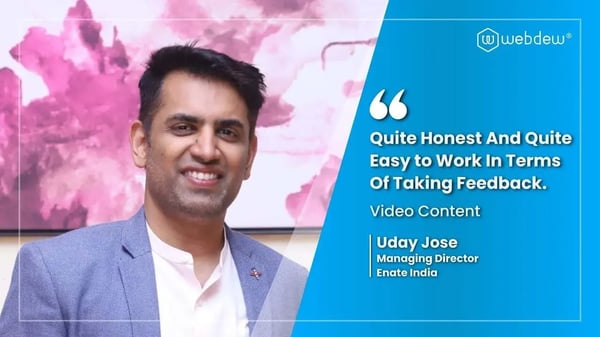
“Webdew team was quite honest and quite easy to work with in terms of taking feedback implementing it, showing that it doesn’t happen again and things like making sure that it meets our expectations.”
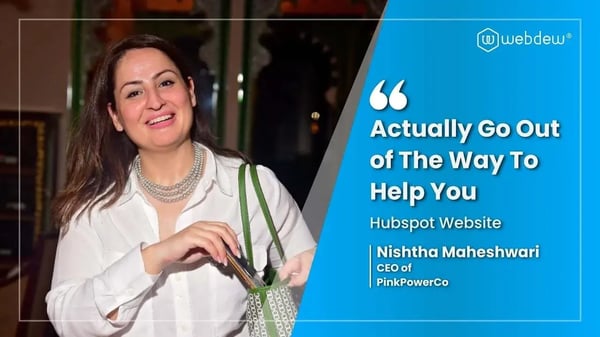
“We worked with webdew to help us build our HubSpot website and they did an amazing job with it. They were very quick.”

“webdew has helped us optimize the sales and marketing processes, and this is automating a lot of processes.”

“Hi everyone my name is Kara and I work as a channel consultant at HubSpot Singapore. I’ve been working closely with webdew agency”

“Hi my name is Christian from OpenDoors Mortgage team and I’m in the mortgage business and just trying to work on new projects and kind of incorporating HubSpot for my operations”
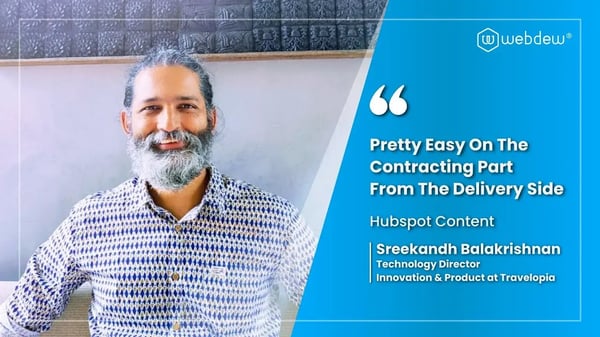
“I’m one of the technology directors for Travelopia. We are the largest experiential travel company in the world. We’ve engaged webdew recently, not recently, it’s been about a couple of quarters now.”
“We worked with Chehak over the past several months to create a series of animated videos for an academic planner that we produce. And from the very beginning, she was absolutely professional and a pleasure to work with.”


6x
We helped clients multiply their website conversion rates through strategic design and UX optimization.
20%
Our marketing campaigns led to a 20% uplift in customer engagement across digital channels.
2K+
Delivered over 2,000 qualified leads through targeted funnels and smart automation.
120+
Our video content has earned 120,000+ views, driving brand awareness and audience retention.
“I recently had the pleasure of working with Chehak on a video demo project, and I was thoroughly impressed with her services.”
.svg)

Additional Resources
Access expert tips, trends, and strategies designed for small businesses. Stay ahead of the curve and make informed decisions with our comprehensive resources!