

 We typically respond the same day

TL;DR
- B2B SaaS CRM outsourcing covers the platform's operational state: data hygiene, workflow maintenance, reporting, integration monitoring, and admin support. It is a separate decision from who builds the system.
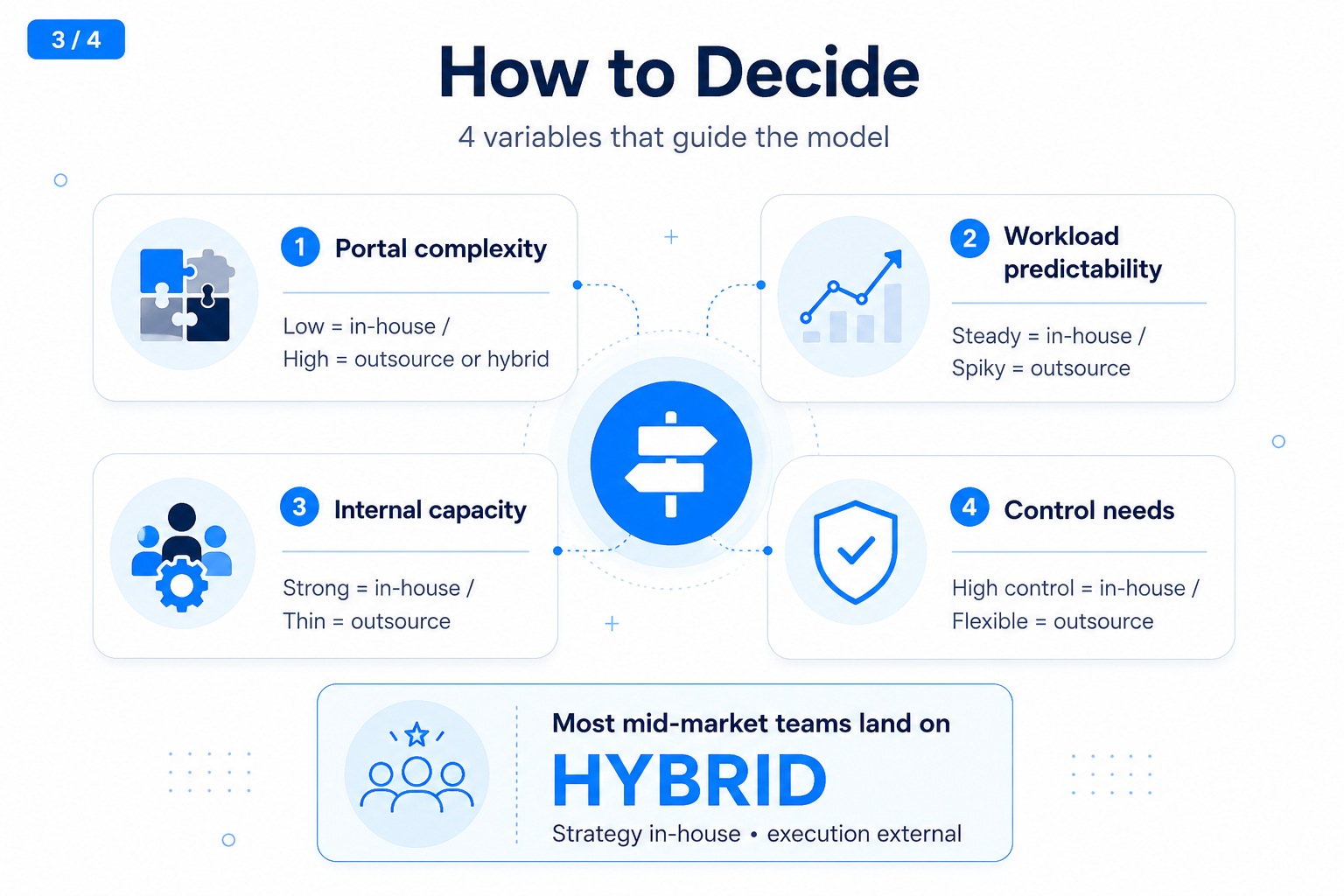
- Four variables decide it: how complex the portal is, how predictable the workload is, how much internal capacity exists, and how much control leadership wants over priorities.
- In-house wins on context and response speed. Outsourcing wins on coverage, cost flexibility, and continuity when one admin leaves.
- Most mid market SaaS teams land on a hybrid: an internal owner holding strategy, an external team handling build and maintenance.
- The failure mode is identical in both models: no named owner and no documentation.
What does B2B SaaS CRM outsourcing cover?
B2B SaaS CRM outsourcing is the practice of contracting an external team to run CRM platform services on an ongoing basis: data hygiene and deduplication, workflow and automation maintenance, reporting and dashboard updates, integration monitoring, permissions, and day-to-day admin requests.
That is a different purchase from implementation. Implementation is a one-time project with a defined end date and a handover. Outsourced management is a standing operating model with no end date. Teams that conflate the two buy a project when they need a retainer, then find the portal drifting six months after go-live.
What outsourcing does not cover is strategy. Deciding which pipelines exist, what a qualified lead means, and which metrics leadership reports on stays inside the company in every arrangement that works. webdew treats that line as part of the contract rather than something discovered later. For a plain definition of the underlying platform, see our overview of the customer relationship management system.
Why do B2B SaaS leaders revisit the in house model?
Teams revisit it because CRM workload does not scale with headcount. A portal one admin handled comfortably at forty employees can carry several pipelines, a dozen integrations, and reporting for three departments by the time the company doubles, and the work grows faster than the case for a second hire.
Five triggers show up repeatedly. Pipeline count grows past what one person can maintain. A product led motion starts running alongside a sales led one, doubling the lifecycle logic. A funding round adds board reporting the existing property set cannot produce. The sole admin resigns. Or an acquisition arrives with a second portal that has to merge into the first.
Growth is the common thread. Our guide to scaling HubSpot CRM for B2B SaaS covers what breaks first when volume climbs.
How do in house and outsourced CRM management compare?
The two models differ across six dimensions, and none of them makes one option correct for every company.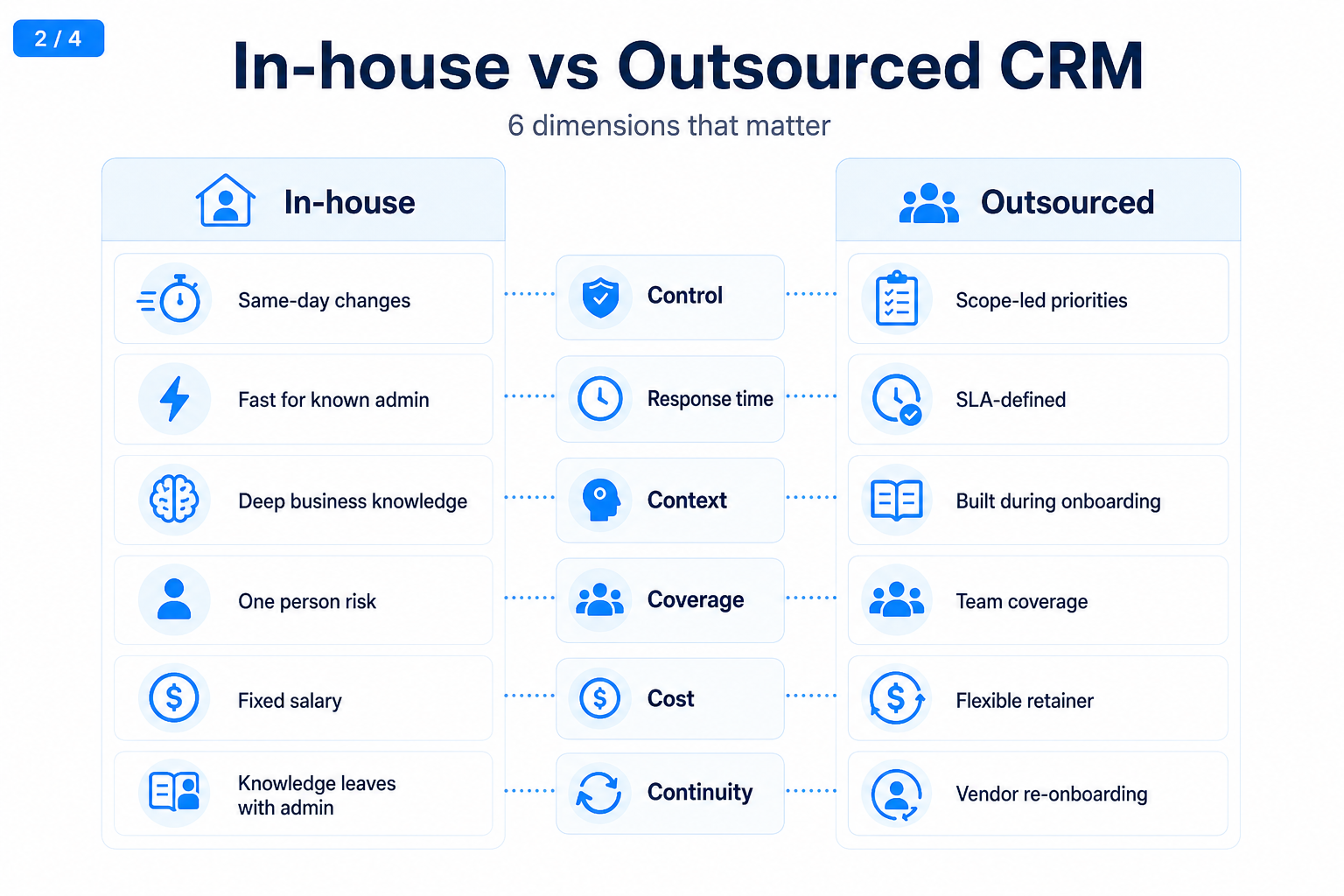
Read the table by weight rather than by column count. A company with one straightforward pipeline and a capable admin should stay in house. A company running three motions across two products, with reporting the board reads monthly, usually cannot cover that with one hire.
What does each model actually cost?
In-house cost is a fully loaded salary plus benefits, tooling, recruiting, and ramp time, and it stays fixed whether the workload that month is heavy or light. Outsourced cost is a retainer or hourly rate that moves with demand, plus an overhead most teams underestimate: someone internal still has to scope requests and review the work.
Two costs get left out of the comparison. The first is ramp. A new CRM admin needs months to learn an existing portal well enough to change it safely, and that time is paid whether or not anything ships. The second is opportunity cost. A RevOps hire who spends most of the week on ticket-level admin is not designing pipeline or fixing attribution, which is what the role was funded to do.
The honest comparison starts with measurement. Log the actual recurring CRM hours for one month, split between maintenance and project work, before pricing either option. Most teams find the maintenance share larger than expected, and that is the part that outsources cleanly. webdew starts scoping from that measurement rather than a headcount estimate.
Is your team ready to run CRM platform services in-house?
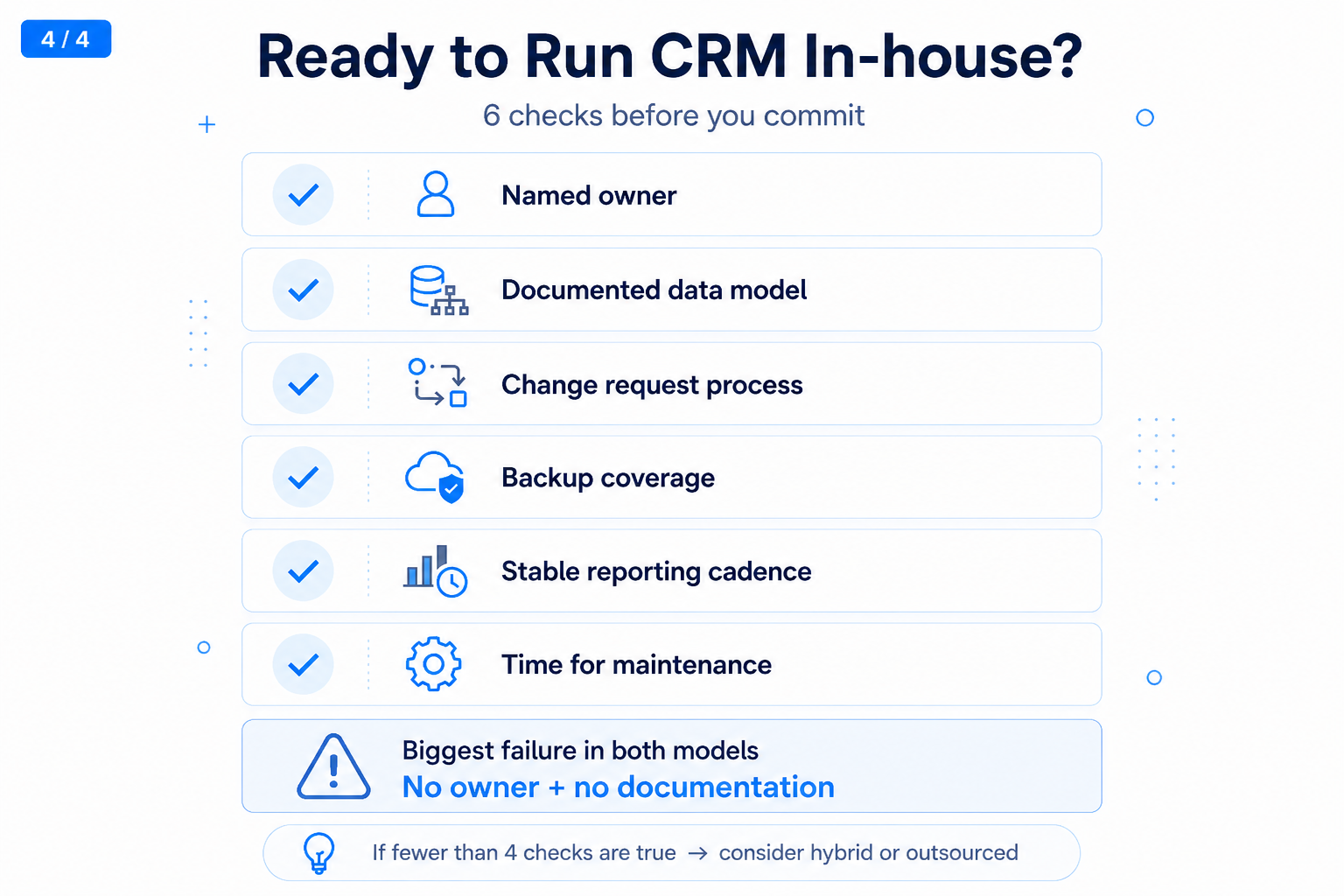
Yes, if six conditions hold. Fewer than four, and a hybrid or outsourced model will hold up better.
- One named owner with CRM as their primary responsibility, not an addition to a marketing or sales role.
- Written documentation of the object model, lifecycle definitions, and property naming conventions.
- A change request process, so new properties and workflows are reviewed rather than added ad hoc.
- Backup coverage, meaning at least one other person who can act during leave or after a resignation.
- A reporting cadence that is already stable, rather than rebuilt each quarter.
- Enough time in the week for maintenance instead of firefighting.
Each condition gets harder as the portal grows. Portals running several pipelines with stage logic across products need more governance than a single funnel does, as our breakdown of managing multi stage SaaS pipelines in HubSpot sets out. Data capture sits upstream of all of it, and forms, tracking, and CMS work often need a skill set the CRM owner does not have, which is why website development and CRM operations are frequently scoped together.
What goes wrong in each model, and how is it avoided?
The in house failure is concentration. One person holds the object model, the workflow logic, and the reasons behind both in their head, and none of it is written down. When they leave, the portal becomes archaeology. Documentation written during normal operation, not during a handover, is the only reliable fix.
The outsourced failure is abdication. A team hands over execution and strategy together, then finds the vendor making lifecycle-definition decisions that only the business can make. Three related mistakes follow: scoping the engagement in vague deliverables rather than named systems and response times, skipping an access review when a contract ends, and treating the partner as a ticket queue with no quarterly planning. Each is preventable in the contract.
Key takeaways
- Separate the implementation decision from the ongoing management decision. They have different answers.
- Measure a month of real CRM hours before comparing a salary to a retainer.
- Keep strategy in house in every model. Outsource execution, not judgment.
- Documentation is the control that makes either model survivable
Building a CRM management strategy that fits the company
The in house versus outsourced question is usually framed as a cost comparison, which is why it gets answered badly. The variables that decide it are complexity, capacity, and control. A CRM management strategy that names an internal owner, documents the object model, and defines which decisions can never be delegated will work under either model. Without those three, both models fail the same way.
For most B2B SaaS leadership teams the practical answer is a hybrid: keep strategy and approval rights inside SaaS business operations, and outsource the maintenance load that scales with the portal rather than with the org chart. webdew provides CRM platform services for B2B SaaS teams, covering data hygiene, automation maintenance, reporting, and integration support alongside the internal owner. Book a scoping call to map the current workload before deciding which model to fund.
Dive Into our
Client Testimonials
Listen to business owners like you share how we’ve helped them grow. Your story could be next!





.svg)
“Recently we reached out to Webdew for a website inside of HubSpot and they also did some mocking automation for us.”
“Webdew team was quite honest and quite easy to work with in terms of taking feedback implementing it, showing that it doesn’t happen again and things like making sure that it meets our expectations.”

“We worked with webdew to help us build our HubSpot website and they did an amazing job with it. They were very quick.”
“webdew has helped us optimize the sales and marketing processes, and this is automating a lot of processes.”

“Hi everyone my name is Kara and I work as a channel consultant at HubSpot Singapore. I’ve been working closely with webdew agency”
“Hi my name is Christian from OpenDoors Mortgage team and I’m in the mortgage business and just trying to work on new projects and kind of incorporating HubSpot for my operations”

“I’m one of the technology directors for Travelopia. We are the largest experiential travel company in the world. We’ve engaged webdew recently, not recently, it’s been about a couple of quarters now.”
“We worked with Chehak over the past several months to create a series of animated videos for an academic planner that we produce. And from the very beginning, she was absolutely professional and a pleasure to work with.”


6x
We helped clients multiply their website conversion rates through strategic design and UX optimization.
20%
Our marketing campaigns led to a 20% uplift in customer engagement across digital channels.
2K+
Delivered over 2,000 qualified leads through targeted funnels and smart automation.
120+
Our video content has earned 120,000+ views, driving brand awareness and audience retention.
“I recently had the pleasure of working with Chehak on a video demo project, and I was thoroughly impressed with her services.”
.svg)

Additional Resources
Access expert tips, trends, and strategies designed for small businesses. Stay ahead of the curve and make informed decisions with our comprehensive resources!