

 We typically respond the same day


Most SaaS companies don't fail at HubSpot because they picked the wrong platform. They fail because the platform got switched on without anyone deciding how leads would move through it, when a free trial signup should become a sales-qualified lead, or what happens automatically the moment a deal closes. The software was fine. The setup decisions never got made.
That is the real job of onboarding, and it's why this guide treats HubSpot onboarding as a decision rather than a checkbox. For a B2B SaaS team, the right onboarding sets up two things that determine whether the CRM earns its keep: clean lead management and lifecycle automation that runs without anyone babysitting it. Get those right early, and the system scales with the company. Get them wrong, and every quarter adds more mess to untangle.
This is written for B2B SaaS marketing leaders weighing how to onboard. There are three realistic options: self-serve, HubSpot's standard onboarding, or a partner. The framing throughout leans on CRM consulting services for SaaS as the lens, because the choice of how to onboard usually matters more than people expect.
Why SaaS Onboarding Is Different
A CRM built for a local services business and a CRM built for a SaaS company look similar in a demo and behave nothing alike in production. SaaS revenue doesn't arrive as a single transaction. It arrives as a trial that converts, a plan that upgrades, a seat count that expands, and a renewal that either happens or doesn't. The CRM has to model all of that, and a generic setup simply won't.
Salesforce's own guide to SaaS CRM makes the point plainly: a strong system has to handle lead and pipeline management, marketing and sales automation, analytics, and scalability as the customer base grows, not as separate add-ons but as one connected motion. SaaS CRM centralizes customer data and streamlines sales and marketing so teams can work from one source of truth rather than scattered tools. The catch is that "one connected motion" doesn't configure itself. Someone has to decide what connects to what.
That's the difference between switching HubSpot on and onboarding it properly. The first gives a SaaS team a database. The second gives them a revenue engine, but only if the onboarding accounts for how SaaS actually works.
The Two Things Onboarding Has to Get Right
If a SaaS marketing leader judges onboarding on nothing else, these two are the ones worth obsessing over.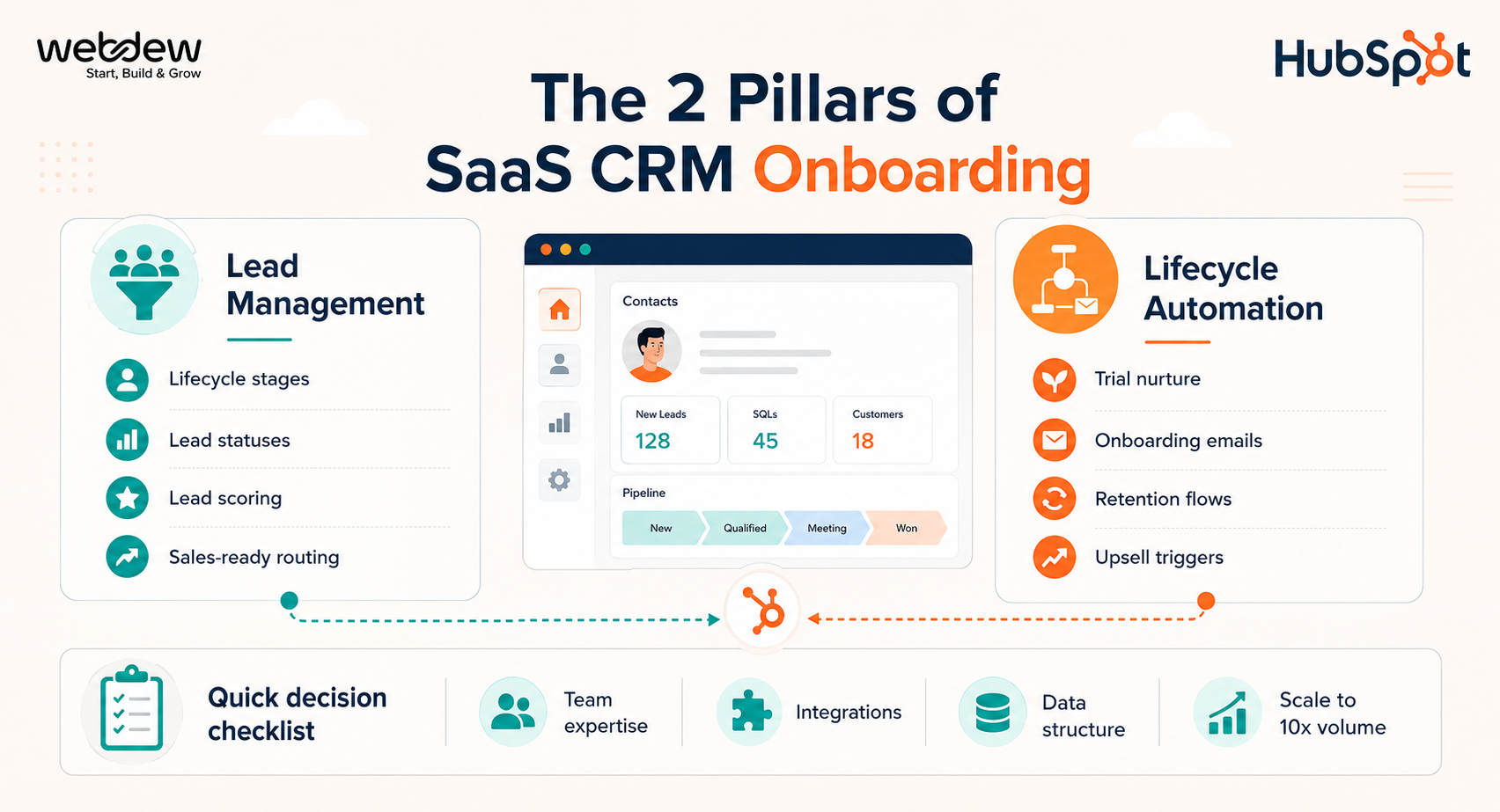
B2B SaaS lead management
Lead management is where most SaaS pipelines quietly leak. A trial signup, a demo request, and a pricing-page visitor are not the same lead, and treating them identically wastes sales time on people who aren't ready and ignores people who are. Good onboarding sets up the structure that prevents this: lifecycle stages, lead statuses, and lead scoring that reflect a SaaS funnel rather than a generic one.
This is concrete, not abstract. Webdew's HubSpot onboarding work, for instance, covers exactly this layer — defining lifecycle stages and lead statuses, implementing lead scoring to prioritize the right leads, and organizing records so sales-qualified leads surface instead of getting buried. The detail in our HubSpot onboarding service shows how granular this gets: custom properties for data storage, pipelines built for the actual sales process, and deals connected to the right contacts and companies. None of that is default behavior. It's a set of decisions made during onboarding.
When lead management is set up well, marketing stops arguing with sales about lead quality, because the definitions are written into the system. When it isn't, that argument never ends.
Lifecycle automation
The second pillar is automation that carries a customer through their lifecycle without manual nudging at every step. In SaaS, the lifecycle is long, and the touchpoints are many — onboarding emails for new users, nurture sequences for trial users who haven't converted, retention campaigns to cut churn, and upgrade prompts for accounts hitting usage limits.
Webdew's own breakdown of SaaS marketing automation lists the highest-impact candidates for this: lead nurturing, onboarding campaigns, customer lifecycle management, upselling and cross-selling, and feedback collection. The piece on SaaS marketing automation is worth reading alongside this one, because it maps the automation opportunities that compound over time. The principle is simple — automate the repeatable lifecycle moments so the team spends its hours on the judgment calls that actually need a human.
Proper onboarding builds these workflows from the start, tied to the lifecycle stages set up in lead management. The two pillars aren't separate. Lead management defines the stages; lifecycle automation moves people through them.
Three Ways to Onboard, and Who Each Suits
There's no single right answer here, only a right answer for a given situation. The three realistic paths:
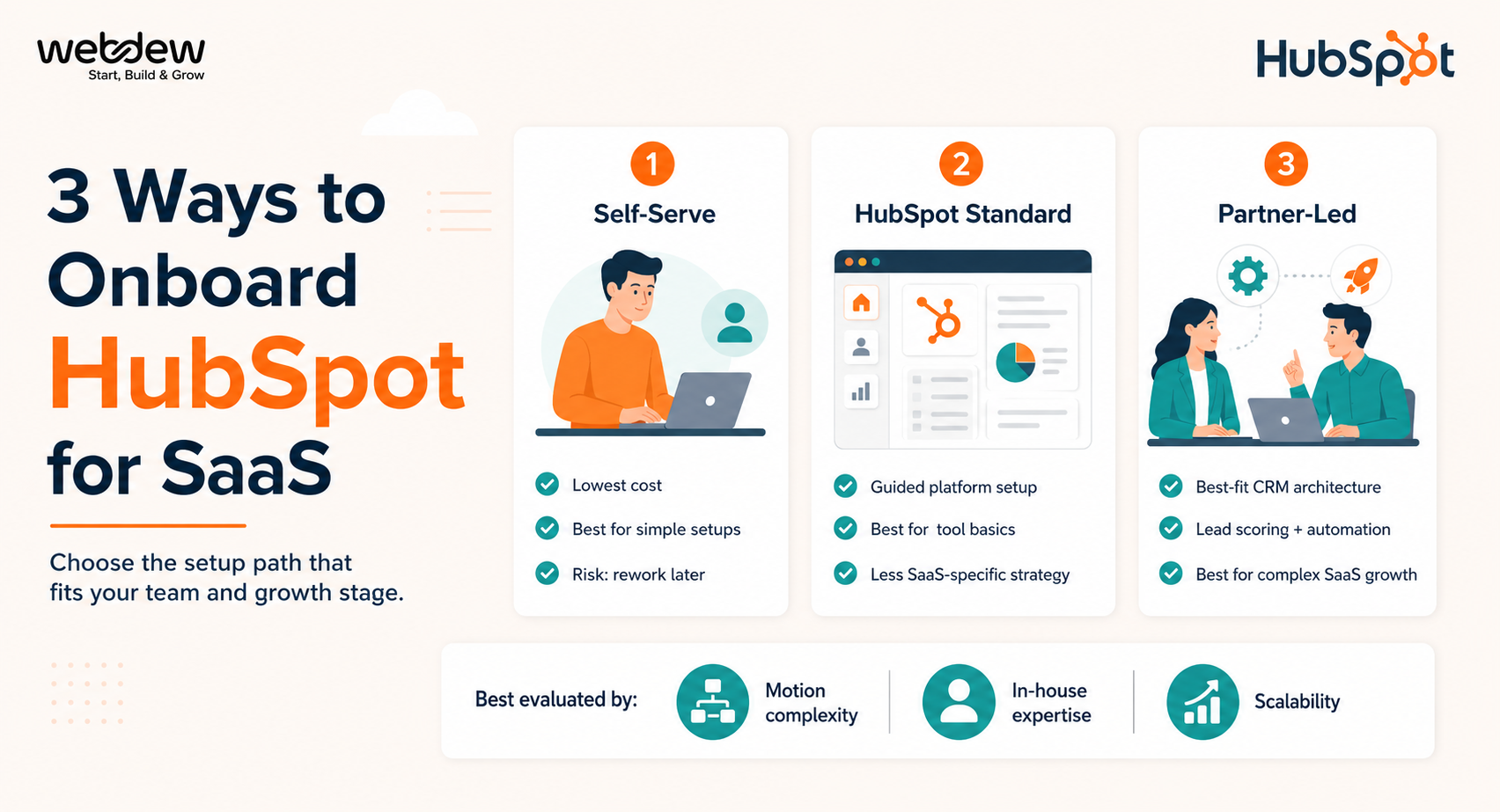
Self-serve onboarding. A team configures HubSpot themselves using HubSpot Academy and documentation. This is the cheapest up front and can work for a small, technical team with time to spare and a simple motion. The risk is that SaaS-specific structure — the lifecycle stages, the scoring logic, the automation — gets skipped or built wrong, and the cost shows up later as rework.
HubSpot's standard onboarding. HubSpot provides guided onboarding tied to the subscription tier. It's structured and competent at covering platform mechanics. What it's less suited to is deep, SaaS-specific strategy — it teaches the team how the tools work, not necessarily how to architect them around a particular trial-to-paid-to-expansion motion.
A partner-led onboarding. A specialist agency configures HubSpot around the company's actual revenue model and trains the team as they go. This costs more than self-serve and brings something neither other path does: pattern recognition from having built the same SaaS motions many times. For a mid-market SaaS team where the CRM is core infrastructure, this is usually where the math works out.
Cleveroad's guide to choosing an implementation partner frames the value well — a CRM implementation partner specializes in deploying, customizing, and optimizing the system and aligns it with an organization's specific needs and goals. They also handle project management, training, and ongoing support rather than just the initial build. For a SaaS company, the "aligns it with your specific needs" part is the whole game, since the needs are unusual.
How to Evaluate CRM Consulting Services for SaaS
For teams that decide partner-led onboarding makes sense, the next question is how to pick one. A short scorecard, drawn partly from how Cleveroad recommends vetting implementation partners and adapted for SaaS specifically:
SaaS domain fit. Has the partner onboarded SaaS companies before, not just businesses in general? They should speak fluently about trial conversion, lifecycle stages, expansion revenue, and churn — without needing those terms explained. A generalist will set up a generic CRM, and a generic CRM quietly works against a SaaS motion.
Platform depth. HubSpot certifications are a real signal here. A Diamond or Platinum Partner badge means HubSpot itself has vouched for the agency's volume and competence. Depth shows up in the parts of onboarding that are easy to get subtly wrong — scoring models, workflow logic, and how objects connect.
A documented onboarding methodology. Ask any prospective partner to walk through their process step by step. Cleveroad's guidance stresses reviewing a partner's portfolio, references, and track record on similar projects before committing. Vagueness about methodology is the clearest early warning sign.
Knowledge transfer. The best onboarding leaves the internal team more capable, not more dependent. Documentation, admin training, and a clean handoff should be part of the deliverables. If the only people who understand the setup work at the agency, that's a problem dressed up as a service.
Support past go-live. SaaS motions change — new pricing, new plans, new integrations. Look for a partner who can support the system as it evolves, not one who disappears the day onboarding ends.
The webdew homepage frames the underlying problem most SaaS companies run into: juggling separate vendors for HubSpot, paid media, SEO, and content creates disconnected campaigns and an inconsistent pipeline. Consolidating onboarding and growth under one partner who understands the SaaS context is one way to avoid that fragmentation — and it's a fair point worth weighing when comparing CRM implementation partners.
Connecting Onboarding to SaaS Revenue Scaling
The reason any of this matters is SaaS revenue scaling. Onboarding decisions made in month one either compound into smooth growth or harden into technical debt.
Consider what scaling actually demands from a CRM. More leads flowing in means lead scoring has to keep separating signal from noise without manual triage. More customers mean lifecycle automation has to handle onboarding, retention, and expansion at volume. More team members mean the data structure has to stay clean enough that everyone trusts the dashboards. A CRM set up casually handles the first hundred contacts fine and buckles somewhere around the first ten thousand.
This is the argument for treating onboarding seriously, regardless of which path a team picks. The decisions are cheap to make correctly at the start and expensive to fix once a year of messy data has accumulated on top of them. HubSpot itself is well-suited to SaaS. Webdew's overview of HubSpot for SaaS covers how its tools map to user onboarding, segmented marketing, and retention. But suitability is potential, not outcome. Onboarding is what turns one into the other.
For mid-market CRM solutions specifically, this tension is sharpest. Mid-market SaaS companies have outgrown the scrappy spreadsheet phase but rarely have a dedicated RevOps architect on staff. They need the CRM to be sophisticated enough to handle real complexity yet clean enough that a lean team can run it. That gap is precisely what a well-scoped onboarding and often a consulting partner are meant to close.
A Short Decision Checklist
For a marketing leader about to choose an onboarding path, the questions worth answering first:
- How complex is the SaaS motion? Simple PLG trial flow, or multi-product with sales-assisted expansion? More complexity tilts toward partner-led onboarding.
- Does the team have in-house HubSpot expertise and the time to apply it? If not, self-serve is a false economy.
- Are lifecycle stages and lead scoring defined, or would onboarding need to define them from scratch?
- What integrations does the CRM need — product, billing, data warehouse — and who owns them?
- What does the team walk away owning after onboarding ends?
- How will the setup hold up at ten times the current contact volume?
Answer those honestly, and the right path usually becomes clear. The teams that struggle are the ones that skip the questions and switch the platform on.
A Final Word
HubSpot onboarding for SaaS isn't really about learning where the buttons are. It's about deciding how leads get managed, how the customer lifecycle gets automated, and whether the whole thing will still work when the company is three times its current size. Those are strategy decisions wearing the costume of a setup task.
Pick the onboarding path that matches the complexity of the motion and the capacity of the team. For many mid-market SaaS companies, that means a partner who understands the SaaS context and leaves the team stronger than they found it. Whatever the path, the goal is the same: a CRM that scales with the business instead of one that the business has to keep apologizing for.
Teams weighing how to onboard HubSpot for their SaaS company can talk to Webdew about what a SaaS-specific setup looks like for their particular motion.
Dive Into our
Client Testimonials
Listen to business owners like you share how we’ve helped them grow. Your story could be next!





.svg)
“Recently we reached out to Webdew for a website inside of HubSpot and they also did some mocking automation for us.”
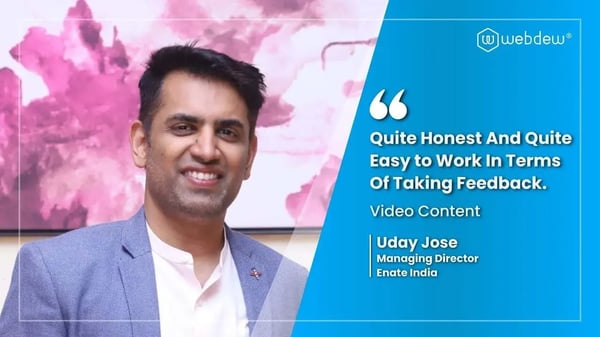
“Webdew team was quite honest and quite easy to work with in terms of taking feedback implementing it, showing that it doesn’t happen again and things like making sure that it meets our expectations.”
“We worked with webdew to help us build our HubSpot website and they did an amazing job with it. They were very quick.”

“webdew has helped us optimize the sales and marketing processes, and this is automating a lot of processes.”
“Hi everyone my name is Kara and I work as a channel consultant at HubSpot Singapore. I’ve been working closely with webdew agency”

“Hi my name is Christian from OpenDoors Mortgage team and I’m in the mortgage business and just trying to work on new projects and kind of incorporating HubSpot for my operations”

“I’m one of the technology directors for Travelopia. We are the largest experiential travel company in the world. We’ve engaged webdew recently, not recently, it’s been about a couple of quarters now.”
“We worked with Chehak over the past several months to create a series of animated videos for an academic planner that we produce. And from the very beginning, she was absolutely professional and a pleasure to work with.”


6x
We helped clients multiply their website conversion rates through strategic design and UX optimization.
20%
Our marketing campaigns led to a 20% uplift in customer engagement across digital channels.
2K+
Delivered over 2,000 qualified leads through targeted funnels and smart automation.
120+
Our video content has earned 120,000+ views, driving brand awareness and audience retention.
“I recently had the pleasure of working with Chehak on a video demo project, and I was thoroughly impressed with her services.”
.svg)

Additional Resources
Access expert tips, trends, and strategies designed for small businesses. Stay ahead of the curve and make informed decisions with our comprehensive resources!