

 We typically respond the same day


CRM failure rates sit between 30% and 70%, depending on which study you read. That range is wide because "failure" rarely means the software stopped working. It means sales stopped trusting the data, marketing kept its own spreadsheets on the side, and six months in, leadership is asking why the system that was supposed to unify the revenue team ended up dividing it further.
The pattern shows up in nearly every failed rollout: the technical implementation went fine, but sales and marketing never agreed on what the system was for. This guide walks through where that misalignment starts, the specific process gaps, integration issues, adoption barriers, and ownership conflicts that cause it, and how B2B SaaS teams can fix each one before it becomes a rebuild.
TL;DR
- CRM implementations fail at rates between 30% and 70%, and the root cause is usually misalignment between sales and marketing, not the software itself.
- Process gaps like undefined deal stages, inconsistent data entry, and missing handoff rules are the most common technical symptoms of a strategy problem.
- Around 73% of marketers report that marketing automation is challenging, largely because workflows get built before goals and ownership are defined.
- Low adoption traces back to one root cause more than any other: the people using the CRM daily were not involved in choosing or configuring it.
- Ownership conflicts between sales, marketing, and RevOps need a documented decision-maker before implementation starts, not after the first dispute over a broken field.
Why Does Sales and Marketing Misalignment Derail CRM Implementation?
A CRM is a shared system built on the assumption that sales and marketing agree on what a qualified lead looks like, when a deal moves stages, and who owns a record at each point in the funnel. When that agreement does not exist before implementation, the CRM inherits the disagreement instead of resolving it.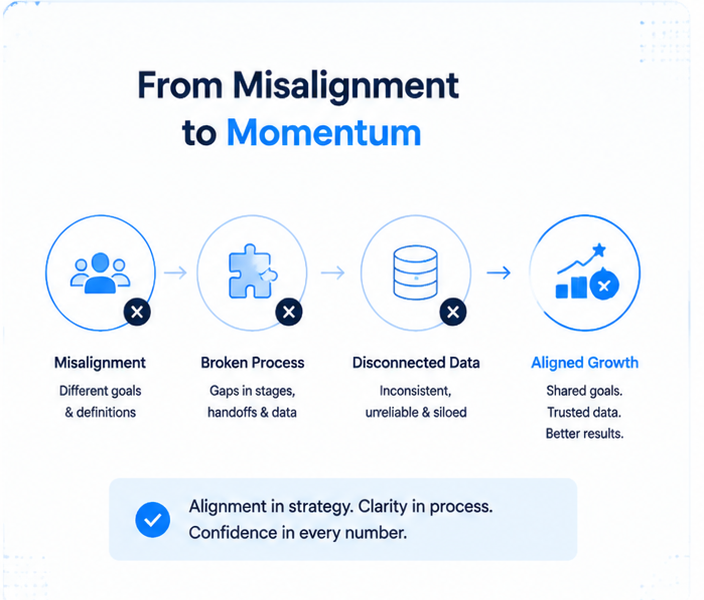
This is why failure rates stay stubbornly high even as the software itself gets better. Research cited by CRM implementation specialist enable.services puts the failure rate at 30% to 70%, driven by poor planning, weak user adoption, and technical missteps rather than product limitations. The pattern repeats across implementation guides: a rushed rollout configures the system around whichever department pushed hardest for the project, and the other department quietly works around it.
Marketing automation makes the misalignment worse when it is layered on top. Roketto's research found that 73% of marketers find marketing automation challenging, and traced most of that friction back to unclear goals rather than the tools themselves. When marketing automates lead scoring using a definition of "qualified" that sales never agreed to, every handoff downstream inherits that gap.
What Process Gaps Cause CRM Implementation to Fail?
Process gaps are where misalignment becomes visible. They show up as specific, fixable breakdowns rather than a vague sense that "the CRM isn't working."
Undefined Deal Stages and Lifecycle Definitions
When sales and marketing define stages differently, forecasting becomes unreliable and reporting stops meaning anything. SyncMatters points to this directly: if a sales team's deal stages don't match what's configured in the CRM, forecasting becomes inaccurate, and if service reps can't easily pull purchase history, issue resolution slows down.
The fix starts before configuration, not during it. Map the full lifecycle, from first marketing touch to closed deal to renewal, and get sales, marketing, and customer success to agree on what each stage means in writing before anyone builds a single field. A stage called "qualified" needs the same definition whether a marketer or a sales rep is looking at it.
Inconsistent Data Entry Standards
A CRM without documented data standards produces inconsistent data almost immediately, because every rep and every marketer fills fields based on their own judgment. Salesflare's research on CRM adoption found that a lack of clear strategy and defined processes leads directly to this outcome: when there is no agreement on how leads should be tracked or what a stage means, everyone uses the system differently, and the resulting data becomes unreliable exactly when leadership needs it most.
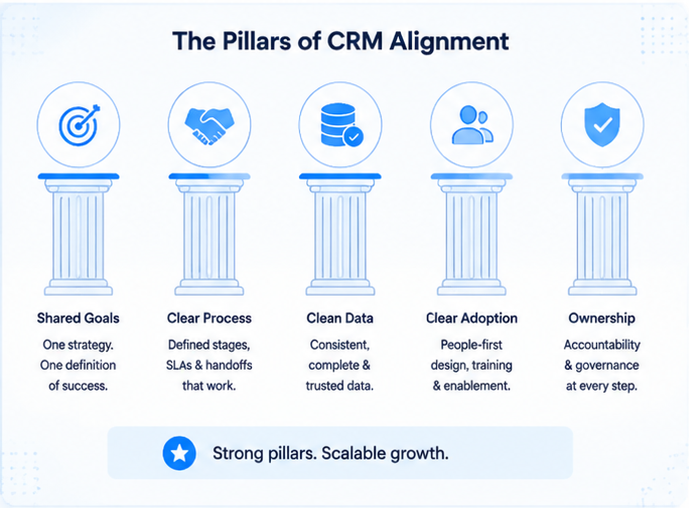
Documented field-level standards, required versus optional fields, and a single owner for data governance solve most of this before it starts. Skipping this step is one of the fastest ways to end up with a CRM full of records nobody trusts.
Missing Handoff Protocols Between Marketing and Sales
Even a well-configured CRM breaks down at the handoff point if there's no explicit rule for when a lead moves from marketing's ownership to sales, or what happens if sales doesn't follow up within a set window. This gap is less about the software and more about the service-level agreement between teams, something that needs to exist as a documented process before implementation, not as an assumption everyone hopes will hold.
How Do You Fix Marketing Automation Integration Issues During CRM Rollout?
Marketing automation only works when the systems feeding it are clean and connected. Roketto's research names poor data quality and integration gaps as one of the most common causes of automation failure: when CRMs, email platforms, and analytics tools don't sync properly, workflows produce misleading insights, and duplicate leads or missing attributes derail campaigns before anyone notices
.
A few fixes address most integration problems at the source:
Run an integration audit before automation goes live, not after. Map every tool that needs to talk to the CRM, from the marketing platform to the support desk to any billing or product-usage system, and confirm the CRM has real, tested connectors rather than a technical possibility that's never been configured.
Build workflows around real-time or near-real-time sync where possible. Batch syncs that run once a day create windows where sales is working from stale data, which is often when a lead goes cold without anyone realizing why.
Use event-based logic instead of rigid, linear automation rules. SyncMatters and Roketto both point to the same failure mode from different angles: automation that assumes every prospect follows the same path breaks the moment someone skips a step, and a contact who's ready to buy gets stuck in a nurture sequence built for someone earlier in the funnel.
For teams building or customizing this connective layer rather than relying entirely on native integrations, webdew's guide to custom CRM development covers how a tailored setup handles integration requirements that off-the-shelf configurations often can't.
What Causes CRM Adoption Barriers, and How Do You Overcome Them?
Low adoption is the most common reason CRM projects fail, and it traces back almost every time to the same root cause: the people expected to use the system daily were not involved in choosing or shaping it.
Salesflare's research is blunt about this: a CRM chosen without input from the actual sales team is often met with resistance, leading to inconsistent data and, eventually, a system that gathers dust. The fix is not more training after the fact. It's involving end users, including the most skeptical ones, in the selection and configuration process from the start, so the CRM reflects how the team actually works rather than how a spreadsheet or a vendor demo assumed they would.
Complexity compounds the adoption problem. SyncMatters found that overcomplicated interfaces, cluttered dashboards, and redundant fields slow users down and increase errors, and when logging a note or updating a deal takes too many clicks, people either disengage or stop using the CRM altogether. Fewer required fields, role-based dashboards that show only relevant information, and a regular audit to strip out unused fields all reduce this friction directly.
Training matters, but ongoing training matters more than the initial onboarding session. A single walkthrough at launch rarely survives contact with a busy sales quarter. Role-specific sessions, easy access to support when someone gets stuck, and refreshers tied to feature updates keep usage from decaying six months after go-live. webdew's CRM software management guide covers this in more detail, including how to structure internal usage guidelines that keep data quality consistent as the team scales.
Who Should Own the CRM: Resolving Cross-Departmental Ownership Conflicts
Ownership conflicts are the quietest process gap and often the most damaging, because they don't surface as a single dramatic failure. They show up as a slow accumulation of unresolved disputes: who can edit a deal stage, who's accountable when a field breaks, who decides whether a new integration gets approved.
A cross-departmental CRM strategy needs a documented decision-maker before implementation starts, not after the first disagreement. This usually takes one of two forms. Either a dedicated RevOps function owns the system with input from sales, marketing, and customer success, or, in the absence of a formal RevOps team, a cross-functional steering group meets on a fixed schedule to approve changes and resolve disputes. What doesn't work is leaving ownership implicit, where whichever department configured the system first ends up making unilateral decisions the other departments live with silently.
enable.services' research on failed implementations names executive buy-in as a related and equally critical piece: without a champion at the leadership level who is accountable for CRM outcomes, individual disputes between departments have no forum for resolution and tend to fester instead of getting settled.
What Does Successful Cross-Departmental CRM Alignment Look Like in Practice?
Three implementations illustrate how these fixes play out when a team gets the process right from the start.
At Obsidian Insurance Holdings, the underlying problem was a set of process gaps: missing data fields for critical deal information, deal stages that weren't clearly visible or consistent across the team, and reports that gave limited insight into actual pipeline health. webdew's approach addressed the root cause rather than the symptoms, building custom deal properties, five structured pipelines with automated stage movement, and 25 tailored reports tied to the client's actual KPIs. The result was a CRM the sales and operations teams could rely on as a single source of truth, delivered in just 10 days, with automation removing the manual date-tracking that had been eating time and introducing errors.
Royal Vending faced a different but related challenge: years of contact, company, and deal data scattered across unorganized spreadsheets, with no consistent process for capturing new leads from the website. Rather than importing the mess as-is, webdew streamlined the data first, then built the automation layer, including workflows for automatic contact assignment and deal creation, on top of clean, structured records. That sequencing, fixing the data before automating around it, is the difference between automation that compounds a data quality problem and automation that actually saves time.
Open Doors Mortgage shows what cross-departmental complexity looks like at its most technical. Moving off a legacy CRM meant preserving not just contact records but the full web of associations between borrowers, lenders, and deals, along with historical emails, notes, and task logs that standard CSV imports simply cannot carry over. webdew's phased migration, standard records first, then a custom association and activity migration built through direct API work, delivered 100% accuracy on core records and a 95%-plus success rate on the notoriously difficult task of migrating full email threads, all without a single workflow disruption for the live sales team.
The common thread across all three: the technical work only succeeded because the underlying process, whether that was deal stage clarity, data hygiene, or record association logic, was addressed before automation was layered on top.
Should You Use In-House Teams or Enterprise CRM Services for Implementation?
This decision depends less on company size and more on whether the implementation involves genuine cross-departmental complexity or a relatively contained technical task.
In-house teams can often handle straightforward configuration: adding fields, building simple workflows, and managing day-to-day CRM administration once the system is live. Where this breaks down is exactly the process work covered above, mapping lifecycle stages across departments, resolving ownership conflicts, and building integrations that need to survive contact with messy real-world data.
Enterprise CRM services earn their cost when the implementation touches multiple departments with competing requirements, involves data migration from a legacy system, or requires custom association logic that off-the-shelf tools can't handle. webdew's CRM management guide walks through the fuller range of what a managed implementation typically covers, from initial process mapping through post-launch data governance, for teams weighing whether to build this capability internally or bring in a specialist partner.
Whichever route a team chooses, the same principle applies: technical execution only pays off when someone owns getting sales and marketing to agree on process before the first workflow gets built.
How Do You Know If Your CRM Implementation Is Actually Aligned?
A few signals separate a genuinely aligned CRM from one that's technically functioning but quietly fracturing along department lines.
Check whether sales and marketing can describe the lead lifecycle the same way, using the same stage names and the same definition of "qualified," without looking anything up. If the two answers diverge, the CRM configuration is downstream of a strategy gap that hasn't been closed.
Look at data entry consistency across reps and campaigns. If some records are rich with detail and others are nearly empty, that's a sign the data standards were never agreed on or never enforced, not a training issue that will resolve on its own.
Track whether disputes over CRM changes get resolved through a defined process or through whichever department escalates loudest. The second pattern means ownership was never actually settled, even if an org chart implies otherwise.
Finally, watch adoption trends over time rather than at launch. A spike in usage during the first month followed by a slow decline almost always means the system was imposed rather than built with the people using it, and that gap tends to widen, not close, without deliberate intervention.
Dive Into our
Client Testimonials
Listen to business owners like you share how we’ve helped them grow. Your story could be next!





.svg)

“Recently we reached out to Webdew for a website inside of HubSpot and they also did some mocking automation for us.”

“Webdew team was quite honest and quite easy to work with in terms of taking feedback implementing it, showing that it doesn’t happen again and things like making sure that it meets our expectations.”

“We worked with webdew to help us build our HubSpot website and they did an amazing job with it. They were very quick.”

“webdew has helped us optimize the sales and marketing processes, and this is automating a lot of processes.”

“Hi everyone my name is Kara and I work as a channel consultant at HubSpot Singapore. I’ve been working closely with webdew agency”

“Hi my name is Christian from OpenDoors Mortgage team and I’m in the mortgage business and just trying to work on new projects and kind of incorporating HubSpot for my operations”

“I’m one of the technology directors for Travelopia. We are the largest experiential travel company in the world. We’ve engaged webdew recently, not recently, it’s been about a couple of quarters now.”
“We worked with Chehak over the past several months to create a series of animated videos for an academic planner that we produce. And from the very beginning, she was absolutely professional and a pleasure to work with.”


6x
We helped clients multiply their website conversion rates through strategic design and UX optimization.
20%
Our marketing campaigns led to a 20% uplift in customer engagement across digital channels.
2K+
Delivered over 2,000 qualified leads through targeted funnels and smart automation.
120+
Our video content has earned 120,000+ views, driving brand awareness and audience retention.
“I recently had the pleasure of working with Chehak on a video demo project, and I was thoroughly impressed with her services.”
.svg)

Additional Resources
Access expert tips, trends, and strategies designed for small businesses. Stay ahead of the curve and make informed decisions with our comprehensive resources!