

 We typically respond the same day

I've spent years helping software companies untangle this, and the pattern is almost always the same. A scrappy startup wins early traffic with a handful of sharp blog posts. Then it grows. The site balloons to thousands of pages, three product lines, a documentation portal, a careers section, and four regional subdomains. Suddenly, the tactics that worked at 50 pages quietly stop working at 5,000, and nobody can point to the exact moment it broke.
That gap is the heart of most B2B SaaS SEO challenges. Enterprise-level SEO isn't "regular SEO, but bigger." It's a different discipline with different failure modes, and the companies that struggle most are usually the ones treating it like the former. Let's get into why that happens and what actually fixes it.
Enterprise SEO Is Not Just SEO at a Larger Volume
Here's the distinction that trips up most marketing teams. On a small site, ranking is mostly a content question: write something useful, earn a few links, climb the results. On an enterprise SaaS site, ranking becomes a systems question. Can search engines even crawl your most important pages? Do your product, comparison, and integration pages cannibalize each other? Will it take six weeks of cross-team approvals to ship a single technical fix?
Enterprise websites are vast, often holding thousands of pages where each one carries the potential to convert a visitor into a paying customer. That scale changes the math entirely. As one enterprise SaaS SEO guide from Growfusely puts it, the fundamentals of SEO aren't different at enterprises, but the processes are, and the complexity of the issues makes obvious fixes far harder than they look.
Three structural traits define an enterprise SaaS site, and each one quietly raises the difficulty:
The site's direct impact on brand reputation and revenue means mistakes are expensive. The level of cross-team collaboration required to change anything means nothing moves fast. And the sheer page volume means you cannot manage SEO manually—automation stops being a nice-to-have and becomes survival.
Miss any one of these, and you get a marketing team applying small-site instincts to a problem that punishes them.
The Technical Blockers Nobody Sees Until Traffic Stalls
Technical issues are where enterprise SaaS SEO most often breaks first, because they're invisible until they aren't. You can publish brilliant content and earn strong links, but a site riddled with technical debt will still get eclipsed by competitors. Search engines reward what they can crawl, render, and trust, and large SaaS sites routinely fail at all three.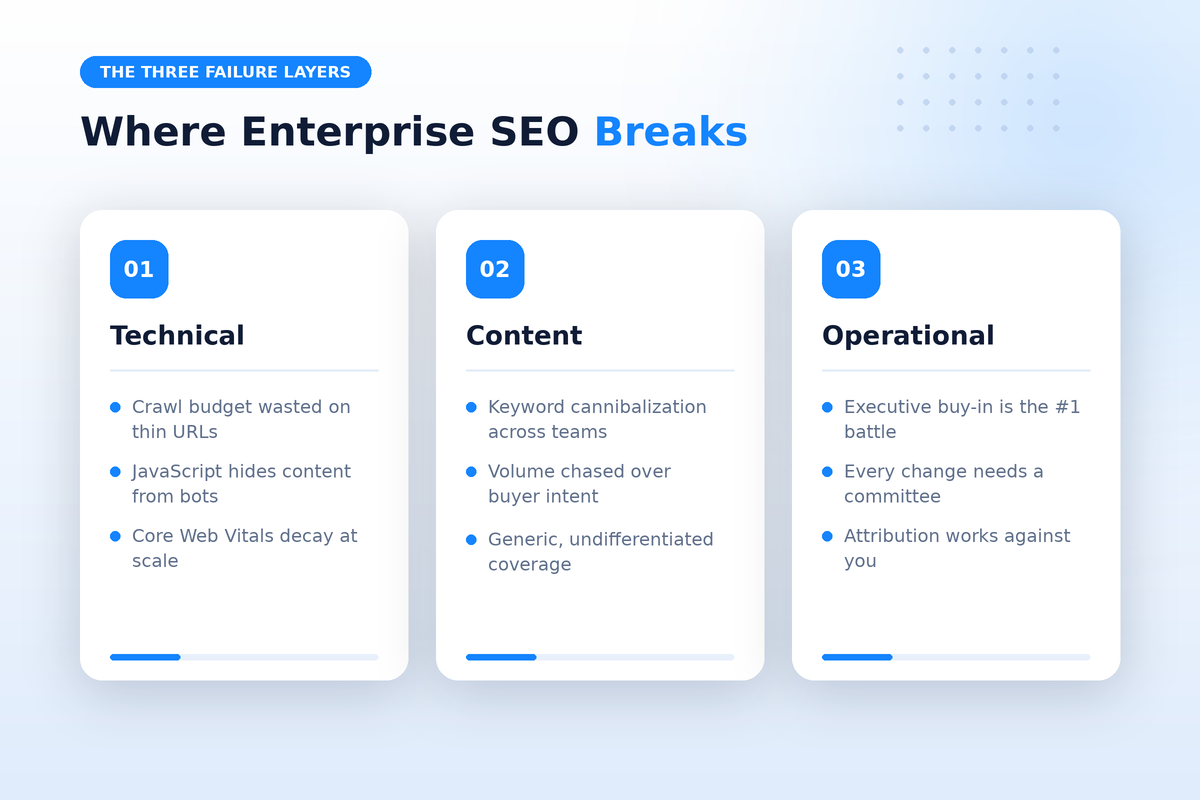
Crawl budget gets wasted on pages that don't matter
Search engines allocate a finite crawl budget to every site. On a 50-page blog, that's irrelevant. On a sprawling SaaS site with faceted navigation, filtered URLs, staging subdomains, and thousands of thin or duplicate pages, it's everything. Google's own guidance has long flagged that URL duplication on larger sites makes it likely to miss new content, meaning your freshly published comparison page may sit undiscovered for weeks while bots crawl junk.
When I audit a struggling SaaS site, wasted crawl budget is almost always near the top of the list. Endless parameter variations, soft 404s, redirect chains, and unconsolidated paginated archives all bleed crawl equity away from the pages that actually drive the pipeline.
JavaScript rendering quietly hides your content
Modern SaaS sites are JavaScript-heavy by nature. The product feels great to users—but if critical content only appears after client-side rendering, search engines may never see it. Dynamic rendering and server-side rendering aren't optional polish for JS-driven SaaS platforms; they're prerequisites for getting indexed at all. Plenty of teams discover this only after a redesign mysteriously tanks their organic traffic.
Core Web Vitals and site health degrade as you scale
Large-scale SaaS sites frequently stumble on page speed, interactivity, and visual stability exactly the signalsGoogle's Core Web Vitals weigh heavily. Add in duplicate title tags, broken internal links, missing canonical tags, and inconsistent hreflang across regions, and you've got a site that's technically working but search-invisible in all the wrong places.
Multiple sites, subdomains, and regions multiply every problem
Most enterprise SaaS companies don't run one website. They run a marketing site, a docs subdomain, a community forum, a status page, a careers portal, and often several regional variants in different languages. Each one is a surface where duplicate content, inconsistent canonicals, and keyword overlap can creep in.
International SEO is its own minefield. Simple translation doesn't work; people in different markets don't search using direct translations of English terms, and an audience that speaks another language often relates to your product through entirely different mental models. Get the hreflang implementation wrong, and you serve the German page to French searchers, or split ranking signals across versions that should be consolidated. For a global SaaS brand, these aren't edge cases; they're daily realities that a small-site SEO playbook never had to account for.
None of this is glamorous. All of it determines whether your content ever gets a chance to rank.
The Content Trap: More Pages, Less Authority
If technical debt is the silent killer, content sprawl is the slow one.
The old playbook said, "Publish more, rank more." So SaaS teams shipped 2,000-word "ultimate guides" by the dozen, chased high-volume keywords, and measured success by raw page count. That logic has quietly collapsed. Generative AI has commoditized average content. If a chatbot can produce your blog post in four seconds, that post has almost no value to a search engine that's now tuned to reward genuine experience, expertise, authoritativeness, and trust.
For B2B SaaS specifically, three content failures show up again and again.
Keyword cannibalization. When you manage multiple product lines, subdomains, and overlapping blog clusters without a holistic plan, your own pages start competing with each other. Two posts targeting the same intent split your authority instead of compounding it. On enterprise sites, this happens constantly because different teams publish without a shared keyword map.
Chasing volume over intent. Ranking number one for a 10,000-search term feels like a win until you realize most of those searches now end without a click, answered directly by an AI overview or siphoned to a review aggregator like G2 or Capterra. The traffic that converts for SaaS sits lower in the funnel: comparison queries, integration searches, and "best [category] for [use case]" terms with real buying intent.
Generic, undifferentiated coverage. This is the trap I see swallowing the most budget. A team produces technically competent content with no proprietary data, no point of view, and no first-hand product experience. It reads fine. It ranks nowhere. Search engines and increasingly, AI answer engines are looking for the source of truth, not the seventh paraphrase of it.
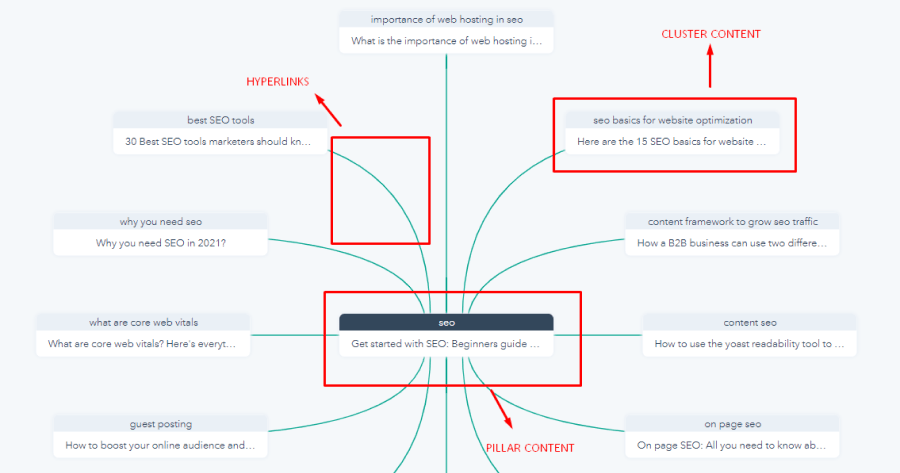
The fix isn't more content. It's structured, intent-mapped content built around a pillar-and-cluster model where a comprehensive pillar page anchors a set of tightly related spoke articles, each owning a distinct keyword cluster and funnel stage. Websites that adopt the topic cluster model have reported meaningful jumps in organic traffic precisely because it concentrates authority instead of scattering it.
To make this concrete: I worked with a SaaS team that had eleven separate blog posts loosely orbiting "customer onboarding." Each ranked on page two or three; none broke through, and several competed directly with one another for the same query. We consolidated them into one authoritative pillar with five distinct spokes, each targeting a specific, non-overlapping sub-intent, and interlinked the whole set deliberately. Within a couple of months, the pillar was holding a top-three position for the head term it had never cracked before. The total word count on the site actually went down. The authority went up. That's the difference between volume and structure.
The Operational Blockers: Where SEO Actually Dies
Here's the uncomfortable truth most guides skip. The biggest B2B SaaS SEO challenges aren't technical or editorial. They're organisational.
You can know exactly what needs to change and still be unable to ship it.
Getting executive buy-in is the number one battle
Survey after survey points to the same culprit: insufficient leadership support is the top challenge SEO teams face when trying to sell a strategy internally. SEO is frequently not viewed as a worthwhile investment, partly because its returns compound slowly and partly because the C-suite can't see a tidy attribution line from a blog post to a closed deal. A Gartner survey found that only around a quarter of marketers feel they have enough budget to actually execute their strategies, and SEO is usually first on the chopping block when leadership isn't convinced.
The result is a vicious loop: SEO gets underfunded, so it underperforms, so it looks unworthy of funding.
Every change requires a committee
On a small site, fixing a technical issue means editing a file. At an enterprise SaaS company, a single content change might need sign-off from product, brand, compliance, legal, and engineering teams, a process that can stretch across weeks. Want to replace legacy pages with new ones? Now you have to account for the impact on inbound links and domain authority, build a business case for the resources, and shepherd it through an approval chain before a single URL changes.
This is why "conventional fixes don't work" at enterprises. The fix is rarely the hard part. The coordination is.
Cross-functional collaboration isn't optional
Enterprise SaaS SEO lives or dies on whether the SEO team can integrate with everyone else. Stakeholders from PR to purchasing may weigh in on a single piece of content. Internal hierarchies have to be navigated, and compromises made. A technical SEO recommendation means nothing until an engineer prioritizes it over the next feature sprint, which means the SEO lead's real job is often half strategy, half diplomacy.
The teams that win here treat SEO as a company-wide discipline, not a marketing silo. They embed an SEO advocate in engineering planning. They demonstrate small, measurable wins to earn the credibility for bigger asks. They translate organic gains into the language each stakeholder cares about: share of voice for executives, pipeline for sales, and efficiency for finance.
Measurement and attribution work against you
There's one more operational blocker that compounds all the others: proving it worked. Enterprise SEO KPIs rarely map cleanly to revenue, which makes the strategy hard to defend in a budget review. Different teams also want different numbers. Executives care about share of voice and market position, paid teams want the split between organic, paid, and zero-click, and product teams want sign-ups and demo requests. Assembling all of that into a coherent story, quarter after quarter, is genuinely time-consuming at enterprise scale.
It's also non-negotiable. Without disciplined reporting, SEO becomes the line item everyone suspects is working but no one can confirm, which is exactly the position from which budgets get cut. The teams that sustain investment are the ones that tie organic performance to demo requests, trials, and closed pipeline through proper CRM integration, so the conversation stops being about traffic and starts being about money.
The 2026 Twist: Search Itself Is Changing Underneath You
Just as B2B SaaS teams were getting a handle on enterprise SEO, the ground shifted again.
Zero-click search is now the norm, not the exception. A large share of searches end without anyone clicking through to an external site, because Google and AI assistants answer the query on the spot. Zero-click searches dominated Google in early 2026, with 68.01% of U.S. searches ending without a website visit.
For SaaS, this guts the top-of-funnel informational traffic—"what is CRM," "benefits of marketing automation"—that used to feed the pipeline. The user gets the value; you get nothing.
At the same time, buyers increasingly arrive with a shortlist already in mind, formed long before they open a search bar. If your brand isn't part of that early consideration set—built through consistent authority, founder-led expertise, and presence in the places buyers actually research you're fighting for the shrinking slice of demand that's still up for grabs.
This is reshaping what enterprise SaaS SEO even means. The smartest teams I work with are adapting in three ways:
They're optimizing to be cited, not just to rank—structuring content with direct, concise answers and robust schema so AI answer engines treat them as the source. They're leaning into proprietary data and genuine expertise, because that's the one thing a language model can't synthesize from thin air. And they're pivoting budget toward bottom-of-funnel, high-intent queries where conversion happens, rather than vanity-volume awareness terms that now resolve inside a chat window.
This doesn't kill traditional SEO for software companies. It raises the bar. The technical and content fundamentals still have to be flawless—they're just table stakes now, not a differentiator.
How to Actually Fix It: A Practical Sequence
If you're a marketing leader staring down these blockers, the worst move is to attack everything at once. Here's the order I'd recommend.
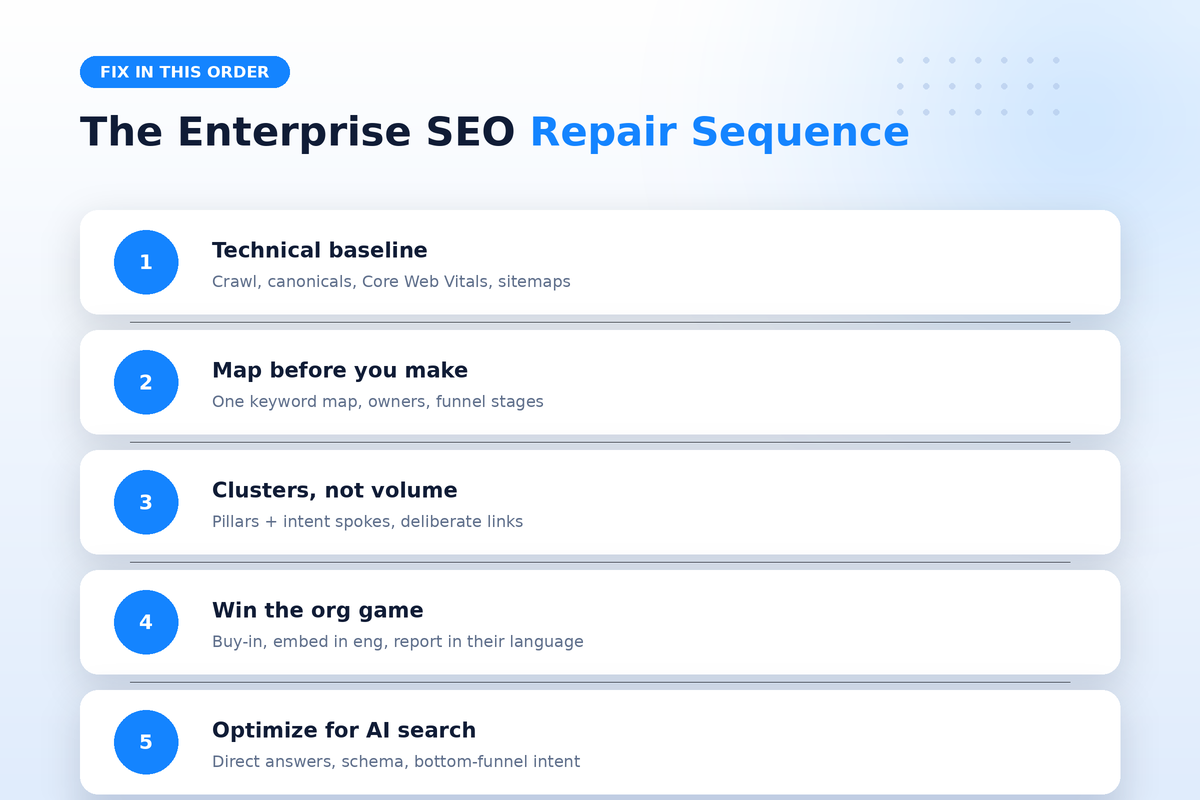
Start with a technical baseline. Run a full crawl. Resolve the binary, pass-fail issues first—HTTPS, mobile optimization, crawlability, canonical tags, XML sitemaps, duplicate content, and Core Web Vitals. These are non-negotiable table stakes for search engine optimization at scale, and they unblock everything downstream. Fix crawl budget waste before you publish another word.
Map your content before you create more. Build a single keyword map that every team works from. Assign each cluster a clear owner, a primary intent, and a funnel stage so new posts reinforce existing ones instead of cannibalizing them. Audit what you already have—prune thin and duplicate pages, refresh underperformers, and consolidate overlapping articles into authoritative pillars.
Build authority through clusters, not volume. Anchor your strategy in pillar pages supported by intent-mapped spokes, woven together with deliberate internal linking. Prioritize content that carries first-hand product experience and proprietary insight—the kind that earns citations and reflects real expertise, which is exactly what both Google and AI answer engines now reward.
Win the operational game in parallel. Secure executive buy-in by demonstrating small, attributable wins and reporting them in each stakeholder's language. Embed SEO into engineering and product planning so fixes don't languish. Invest in the tooling and automation that make managing thousands of pages feasible, because spreadsheets don't scale to an enterprise.
Then look forward. Once the foundation is solid, optimize for the answer-engine era: concise, direct answers, structured data, bottom-funnel intent, and brand-building that puts you on the buyer's shortlist before they ever search.
Sequence matters because each layer depends on the one below it. There's no point building topical authority on a site search engines can't crawl, and no point fixing crawlability if leadership won't fund the content to fill it.
The Bottom Line
B2B SaaS struggles with enterprise SEO not because the work is mysterious but because it's multidimensional in a way smaller sites never have to confront. The technical surface area is larger, the content can quietly turn on itself, and the organizational friction can stall even a perfect strategy. Add the 2026 shift toward zero-click and answer-engine search, and it's no wonder so many capable teams feel stuck.
The companies that break through share one trait: they stop treating enterprise SEO as scaled-up blogging and start treating it as a cross-functional system. They fix the foundation, structure their content for authority instead of volume, and do the unglamorous work of earning buy-in across the org.
Before diving into fixes, it's worth identifying where your organization is struggling most. If new pages take weeks to get indexed, you may have a crawl budget or technical debt problem. If multiple pages compete for the same keywords, content cannibalization is likely holding you back. If SEO recommendations sit in backlogs for months, the bottleneck is probably organizational rather than technical. Understanding which warning signs apply to your business makes it easier to prioritize the right fixes first.
That's the real unlock. Not a clever tactic, but a willingness to address the technical, content, and operational layers together—because at enterprise scale, they were never really separate problems.
If your SaaS site is wrestling with any of these blockers—crawl issues, content cannibalization, or stalled internal buy-in—an enterprise SEO audit is the fastest way to see exactly where the leaks are. Start there, fix in sequence, and let the compounding do its work.
Dive Into our
Client Testimonials
Listen to business owners like you share how we’ve helped them grow. Your story could be next!





.svg)
“Recently we reached out to Webdew for a website inside of HubSpot and they also did some mocking automation for us.”
“Webdew team was quite honest and quite easy to work with in terms of taking feedback implementing it, showing that it doesn’t happen again and things like making sure that it meets our expectations.”

“We worked with webdew to help us build our HubSpot website and they did an amazing job with it. They were very quick.”

“webdew has helped us optimize the sales and marketing processes, and this is automating a lot of processes.”
“Hi everyone my name is Kara and I work as a channel consultant at HubSpot Singapore. I’ve been working closely with webdew agency”

“Hi my name is Christian from OpenDoors Mortgage team and I’m in the mortgage business and just trying to work on new projects and kind of incorporating HubSpot for my operations”
“I’m one of the technology directors for Travelopia. We are the largest experiential travel company in the world. We’ve engaged webdew recently, not recently, it’s been about a couple of quarters now.”
“We worked with Chehak over the past several months to create a series of animated videos for an academic planner that we produce. And from the very beginning, she was absolutely professional and a pleasure to work with.”


6x
We helped clients multiply their website conversion rates through strategic design and UX optimization.
20%
Our marketing campaigns led to a 20% uplift in customer engagement across digital channels.
2K+
Delivered over 2,000 qualified leads through targeted funnels and smart automation.
120+
Our video content has earned 120,000+ views, driving brand awareness and audience retention.
“I recently had the pleasure of working with Chehak on a video demo project, and I was thoroughly impressed with her services.”
.svg)

Additional Resources
Access expert tips, trends, and strategies designed for small businesses. Stay ahead of the curve and make informed decisions with our comprehensive resources!