

 We typically respond the same day

Outsourcing your CRM should help your SaaS business scale faster.
The right partner can improve automation, clean up data, optimize workflows, and create a CRM system your revenue teams actually use.
The wrong partner creates the opposite result: a complicated system, poor adoption, inaccurate reporting, and expensive rebuilding work later.
For B2B SaaS teams, CRM outsourcing decisions matter because the CRM manages critical revenue operations:
- Lead management
- Sales pipelines
- Customer lifecycle tracking
- Revenue forecasting
- Marketing automation
- Customer expansion
The challenge is finding a partner who understands your business process, not just the CRM platform.
This guide covers the top CRM outsourcing red flags SaaS companies should identify before signing a contract.
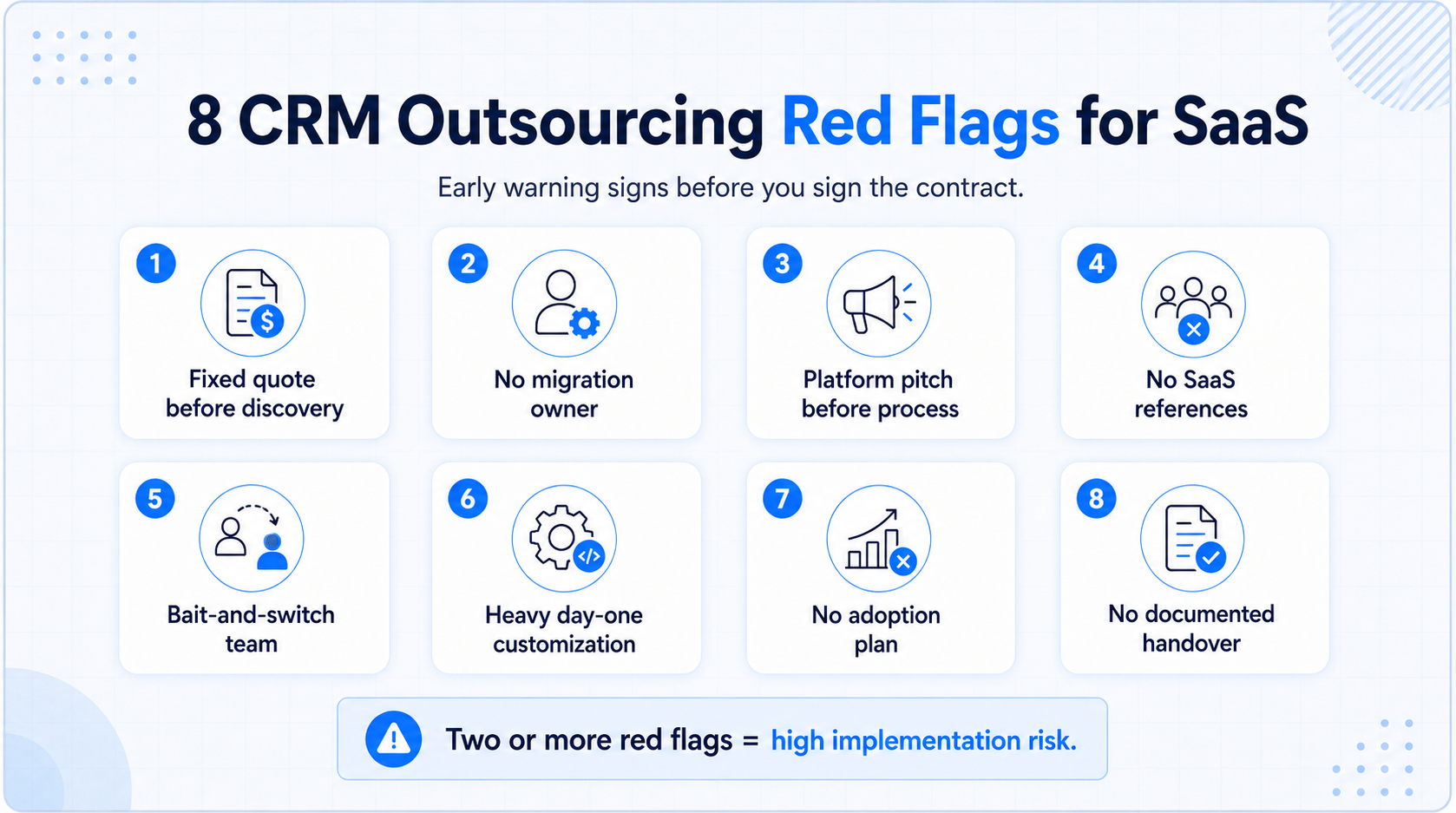
TL;DR: CRM Outsourcing Red Flags to Watch
The biggest warning signs include:
- Fixed pricing before discovery
- No clear data migration ownership
- Selling a platform before understanding your process
- No B2B SaaS experience
- Different delivery team from the sales team
- Excessive customization from day one
- No adoption plan after launch
- No documentation or handover process
Each of these issues can turn a CRM investment into a long-term operational problem.
What Is CRM Outsourcing for B2B SaaS?
CRM outsourcing means working with an external partner to implement, optimize, or manage your CRM instead of handling everything internally.
For SaaS companies, CRM outsourcing can include:
- HubSpot implementation
- CRM migration
- Workflow automation
- Data cleanup
- Reporting setup
- Integration management
- CRM administration
- Revenue operations support
Unlike a simple software setup, SaaS CRM projects require understanding:
- Subscription revenue models
- Multi-stakeholder buying journeys
- Sales-to-customer success handoffs
- Expansion and renewal processes
A CRM partner must understand how your business operates, not just how the software works.
Why CRM Outsourcing Projects Fail
Most CRM failures are not caused by technology.
They happen because of:
- Poor discovery
- Weak process mapping
- Bad data migration
- Lack of adoption planning
- Misaligned expectations
A CRM partner can either improve your processes or simply automate existing problems.
The difference becomes visible during vendor evaluation.
1. They Provide Pricing Before Discovery
A fixed quote after one sales call is a major warning sign.
A CRM partner cannot accurately estimate implementation complexity without understanding:
- Existing CRM structure
- Data quality
- Integrations
- Sales processes
- Reporting needs
- Automation requirements
Without discovery, pricing usually leads to:
- Unexpected change requests
- Reduced project scope
- Poor implementation quality
A reliable partner starts with discovery, process mapping, and technical assessment.
Ask:
“What does your discovery process include before finalizing scope?”
A strong answer should include:
- Stakeholder interviews
- Workflow analysis
- Data audit
- Integration review
- CRM roadmap
2. No Clear Data Migration Owner
Data migration is one of the biggest CRM implementation risks.
Poor migration creates:
- Duplicate contacts
- Missing information
- Broken workflows
- Incorrect reports
A partner should have a clear migration process covering:
- Data cleanup
- Field mapping
- Deduplication
- Import testing
- Validation
Before moving systems, review your existing database using a structured CRM data audit process.
You can also explore Webdew’s guide on [CRM data audits before HubSpot migration](internal link).
Ask:
“Who owns migration, and how do you validate imported data?”
If the answer is unclear, the project is already at risk.
3. They Recommend a Platform Before Understanding Your Process
A CRM should fit your business model.
A SaaS company with a self-service funnel needs a different setup from an enterprise sales organization managing long buying cycles.
A partner should first understand:
- Your customer journey
- Sales cycle
- Marketing process
- Reporting needs
- Team structure
Then recommend the right solution.
Ask:
“How do you decide which CRM approach fits our business?”
The answer should start with questions about your process, not a product demo.
4. They Have Certifications but No SaaS Experience
CRM certifications show platform knowledge.
They do not prove industry experience.
B2B SaaS companies need partners who understand:
- MRR and ARR reporting
- Product-qualified leads
- Customer expansion
- Renewals
- Subscription lifecycle
A partner without SaaS experience may build a CRM designed for one-time sales instead of recurring revenue.
Ask:
“Can you share B2B SaaS CRM projects and the metrics you supported?”
Look for specific examples, not just logos.
5. The Sales Team Is Not the Delivery Team
A common outsourcing issue is a strong sales presentation followed by an inexperienced delivery team.
Problems include:
- Lost context
- Missed expectations
- Poor communication
- Slow problem-solving
You are hiring the implementation team, not the salesperson.
Before signing, meet:
- CRM consultants
- Developers
- Administrators
- Project managers
Ask:
“Who will actually work on our CRM project day to day?”
The answer should include real names and responsibilities.
6. They Recommend Heavy Customization Immediately
More customization does not always mean a better CRM.
Over-customized systems often create:
- Complex workflows
- Low adoption
- Higher maintenance costs
- Difficult reporting
A better approach is:
- Start with standard CRM functionality
- Launch core workflows
- Measure usage
- Improve based on real needs
A good partner knows what not to build.
Ask:
“What would you intentionally leave out of phase one?”
The best partners understand simplicity creates long-term scalability.
7. No Adoption Plan After Launch
Go-live is not the end of CRM implementation.
It is the beginning.
Without adoption support, teams return to old habits.
A strong CRM partner should provide:
- User training
- Documentation
- Workflow adjustments
- Usage tracking
- Continuous improvement
CRM success depends on whether teams use the system daily.
Ask:
“What happens in the first 90 days after launch?”
Look for:
- Adoption metrics
- User feedback
- Data quality checks
- Optimization plans
8. No Documentation or Handover Process
A CRM partner should help your team become self-sufficient.
A warning sign is when a vendor keeps all system knowledge internally.
Your project should include:
- CRM documentation
- Workflow maps
- Property definitions
- Admin training
- Knowledge transfer
Ask:
“If we ended this partnership next year, what would we own?”
A good answer includes complete documentation and internal enablement.
CRM Outsourcing Evaluation Checklist
Before selecting a partner, confirm:
✅ Discovery happens before final pricing
✅ Data migration has a dedicated owner
✅ Process comes before platform recommendations
✅ Partner has SaaS experience
✅ Delivery team is introduced early
✅ Phase one avoids unnecessary complexity
✅ Adoption support continues after launch
✅ Documentation is included
If a vendor fails multiple checks, consider it a major CRM outsourcing warning sign.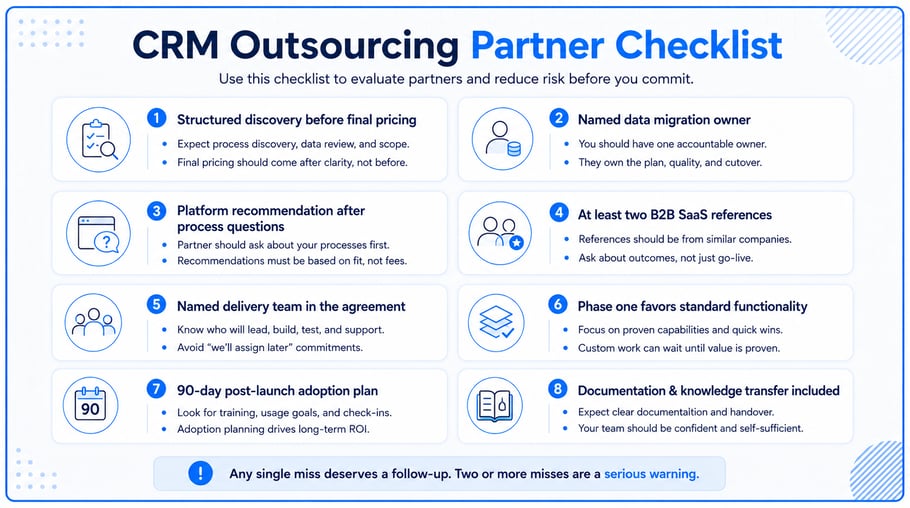
How Webdew Helps SaaS Teams With CRM Implementation
Webdew helps B2B SaaS companies design, implement, and optimize CRM systems that support scalable revenue growth.
Our CRM services include:
- HubSpot CRM implementation
- CRM audits
- Migration support
- Workflow automation
- Reporting dashboards
- CRM optimization
- Revenue operations support
Learn more:
- CRM Management Guide
- CRM Software Management
- Custom CRM Development
- [HubSpot Consulting Services](internal link)
Final Thoughts
Choosing a CRM outsourcing partner is not just a technology decision.
It is a revenue operations decision.
The right partner helps your team build a CRM that improves visibility, automation, and productivity.
The wrong partner creates complexity your team has to fix later.
Before signing a contract, evaluate the partner’s discovery process, SaaS experience, migration approach, adoption strategy, and long-term support.
A successful CRM implementation does not just create a working system.
It creates a system your revenue team can rely on.
Dive Into our
Client Testimonials
Listen to business owners like you share how we’ve helped them grow. Your story could be next!




.svg)
“Recently we reached out to Webdew for a website inside of HubSpot and they also did some mocking automation for us.”
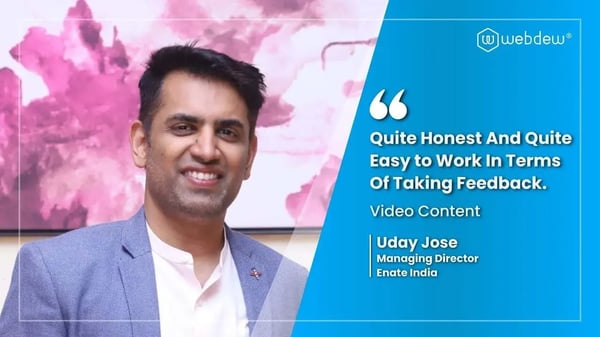
“Webdew team was quite honest and quite easy to work with in terms of taking feedback implementing it, showing that it doesn’t happen again and things like making sure that it meets our expectations.”
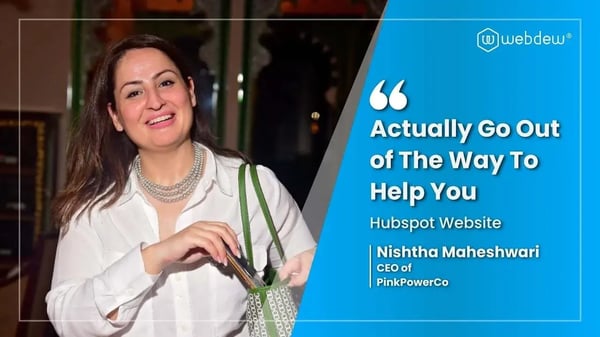
“We worked with webdew to help us build our HubSpot website and they did an amazing job with it. They were very quick.”
“webdew has helped us optimize the sales and marketing processes, and this is automating a lot of processes.”
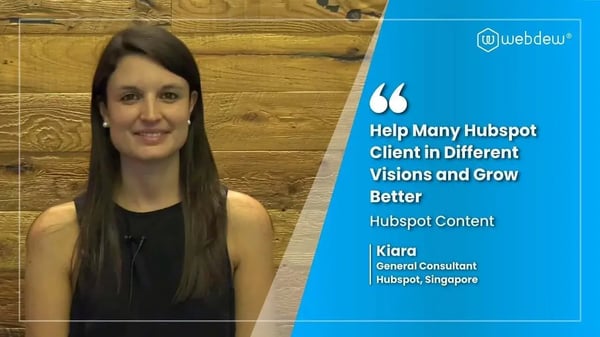
“Hi everyone my name is Kara and I work as a channel consultant at HubSpot Singapore. I’ve been working closely with webdew agency”

“Hi my name is Christian from OpenDoors Mortgage team and I’m in the mortgage business and just trying to work on new projects and kind of incorporating HubSpot for my operations”
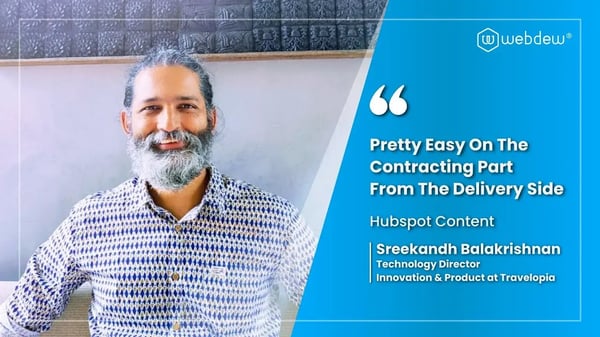
“I’m one of the technology directors for Travelopia. We are the largest experiential travel company in the world. We’ve engaged webdew recently, not recently, it’s been about a couple of quarters now.”
“We worked with Chehak over the past several months to create a series of animated videos for an academic planner that we produce. And from the very beginning, she was absolutely professional and a pleasure to work with.”


6x
We helped clients multiply their website conversion rates through strategic design and UX optimization.
20%
Our marketing campaigns led to a 20% uplift in customer engagement across digital channels.
2K+
Delivered over 2,000 qualified leads through targeted funnels and smart automation.
120+
Our video content has earned 120,000+ views, driving brand awareness and audience retention.
“I recently had the pleasure of working with Chehak on a video demo project, and I was thoroughly impressed with her services.”
.svg)

Additional Resources
Access expert tips, trends, and strategies designed for small businesses. Stay ahead of the curve and make informed decisions with our comprehensive resources!