

 We typically respond the same day

Most B2B SaaS companies discover a churned account after the cancellation email arrives. The account manager says they "seemed fine." The marketing team has no data trail. And the post-mortem reveals that the signals were sitting in the CRM for months: two missed check-ins, a spike in support tickets, a contact who stopped opening emails in Q3.
Customer health scoring exists to close that gap. It turns scattered CRM activity into a single, trackable number for every account, so your team can act before the renewal conversation gets ugly.
This guide breaks down how B2B SaaS marketing and customer success leaders are building health scores from CRM data in 2026, which signals matter most, and how to use those scores to keep more accounts past the 12-month mark.
Why Customer Retention Hinges on CRM Data
B2B SaaS retention is a math problem before it is a relationship problem. According to Bain & Company research, a 5% increase in customer retention lifts profits by 25 to 95%. That range is wide, but the directional truth holds: keeping an existing account is almost always cheaper than acquiring a new one.
The problem is that most retention work runs on instinct. A customer success manager checks in when they remember to. A renewal gets flagged 30 days out. An expansion opportunity surfaces during a quarterly business review, not six months earlier when the account was primed for it.
CRM platforms change that dynamic. They log every touchpoint: email opens, support interactions, deal stage movement, meeting attendance, contact-level engagement. CRM data gives health scoring its raw material. Health scoring gives CRM data its purpose.
- CRM platforms capture behavioral signals across the full account lifecycle.
- Customer health scores convert those signals into risk tiers your team can act on.
- B2B SaaS teams use health scores to prioritize retention effort at scale.
What a Customer Health Score Actually Measures
A customer health score is a composite metric, usually a number between 0 and 100, that reflects how likely an account is to renew, expand, or churn. The score pulls from multiple data sources and weights each signal based on its predictive value for your specific product and customer segment.
The score measures current account behavior, not just historical spend. A customer who paid on time for two years but stopped logging in three months ago is a retention risk, not a safe renewal. Health scoring surfaces that shift while there is still time to respond.
The typical data sources for a B2B SaaS health score include product usage data, CRM engagement signals, support ticket history, payment and billing records, and survey responses like NPS. Not every company weighs these equally. A product-led growth company might weight feature adoption at 40% of the score. A high-touch enterprise SaaS business might weight executive engagement more heavily.
The right model depends on what actually predicts churn in your customer base, which you can only learn by looking backward at accounts that churned and identifying the signals they shared.
The Six CRM Signals That Predict Churn in B2B SaaS
1. Contact Engagement Frequency
CRM platforms log every email sent, opened, replied to, and ignored. When key contacts at an account stop engaging with your team, that drop in response rate correlates with churn more reliably than almost any other signal.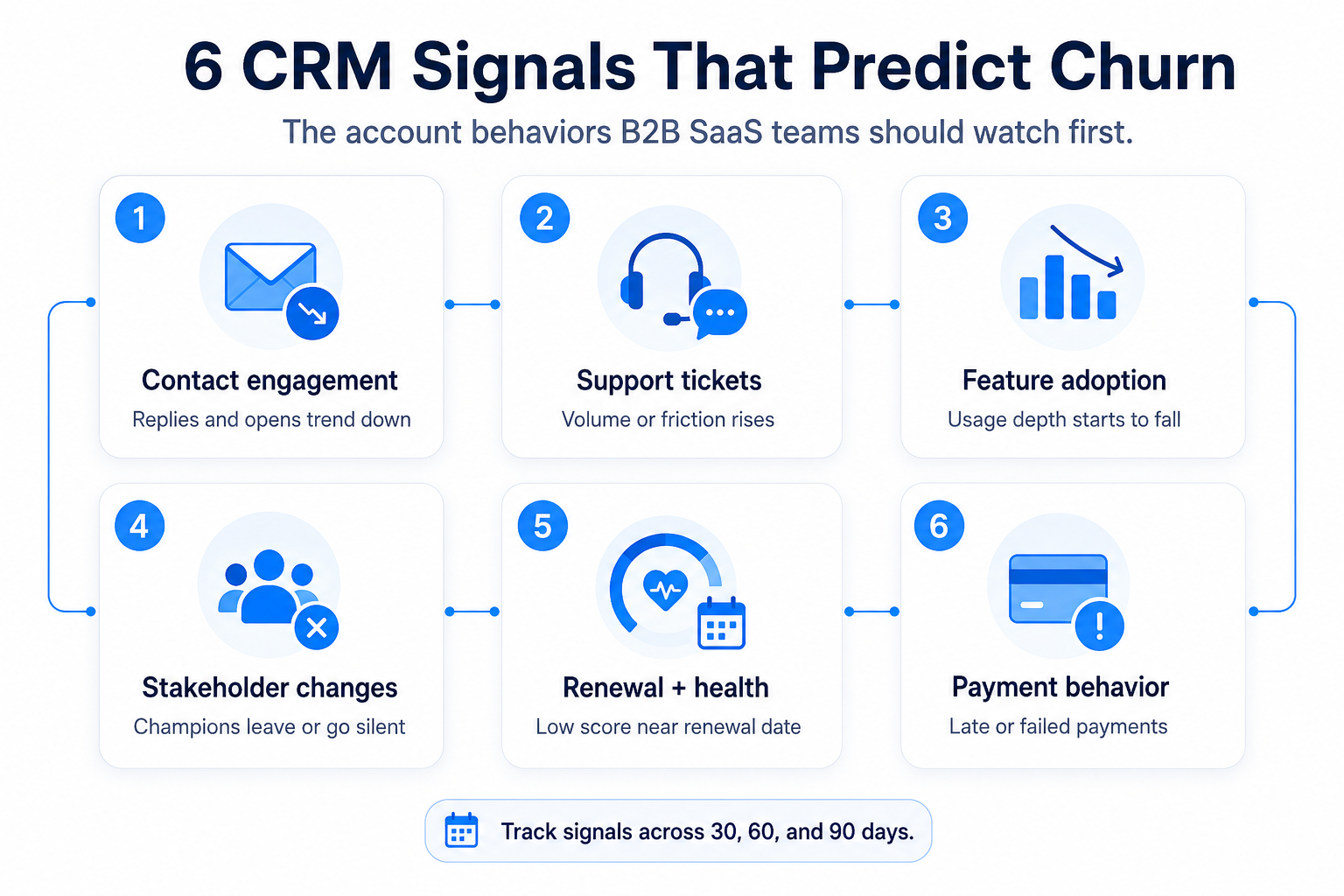
CRM contact engagement tracks email interaction rates at the account level. Teams monitor response rate trends over 30, 60, and 90-day windows. Accounts where key stakeholders go silent for 45 or more days move into the at-risk tier.
Learning how to use your CRM's contact management and lead scoring features gives your team the tracking foundation this signal requires.
2. Support Ticket Volume and Sentiment
A sudden increase in support tickets is a warning sign. So is a pattern of tickets with similar complaints across multiple contacts at the same account. What matters is not just volume but trajectory: an account that went from two tickets per month to eight in six weeks is telling you something.
CRM platforms connect support data to account records. Health scoring models assign negative weight to spikes in ticket volume and positive weight to accounts with consistently low support friction. Teams use this signal to flag accounts where product pain is outpacing value delivery.
3. Product Feature Adoption Rate
Customers who use more of your product cancel less. This is one of the most consistent findings in SaaS retention research. Feature adoption measures which capabilities an account has activated and how frequently they use them.
Product usage data feeds into the CRM through integrations with your product analytics tool. Health scoring models track depth of adoption, breadth across user seats, and trend direction over the past 90 days. An account using three features across two users is more vulnerable than one using eight features across 12 users, even if both are on the same plan.
4. Stakeholder Map Changes
In B2B SaaS, champion turnover is one of the fastest paths to churn. When the person who bought your product leaves, their replacement may not see the same value, may have a competing vendor preference, or may simply deprioritize your tool during their onboarding period.
CRM platforms record contact-level job changes, email bounce patterns, and account-level personnel updates. Health scoring models flag accounts where the primary contact has changed in the past 90 days. Customer success teams use this flag to schedule executive alignment calls before the new contact forms a negative impression.
5. Renewal Date Proximity Combined with Health Score
A healthy account approaching renewal is an expansion opportunity. An at-risk account approaching renewal is a churn risk. The combination of renewal timeline and current health score determines how much attention that account needs and from whom.
CRM data links contract end dates to account records and health scores. Teams configure automated alerts when an account scores below a threshold with fewer than 90 days to renewal. Sales and customer success both receive the alert so coverage is coordinated.
Understanding how to manage these timelines well connects directly to sales pipeline management in your CRM, where renewal deals should live as active opportunities with probability scores tied to the health tier.
6. Invoice Payment Behavior
Late payments and failed transactions are often the last CRM signal before an account churns, not the first. By the time billing issues appear, the account has usually been disengaged for weeks. Still, payment behavior is a reliable lagging indicator that belongs in any health score model.
CRM billing integrations pull payment status, days-to-payment trends, and failed transaction history into account records. Health scoring models assign a significant negative weight to accounts with two or more late payments in a rolling 90-day window. Finance and customer success teams review these accounts weekly together.
How to Build a Health Score Model Using Your CRM
Step 1: Define Your Churn Predictors
Before you build a score, look at accounts that churned in the past 12 to 18 months. Identify the CRM signals they had in common at 90, 60, and 30 days before cancellation. Those shared signals become your weighted inputs.
This retrospective is not a one-time project. Run it quarterly. The signals that predict churn shift as your product evolves and your customer base changes.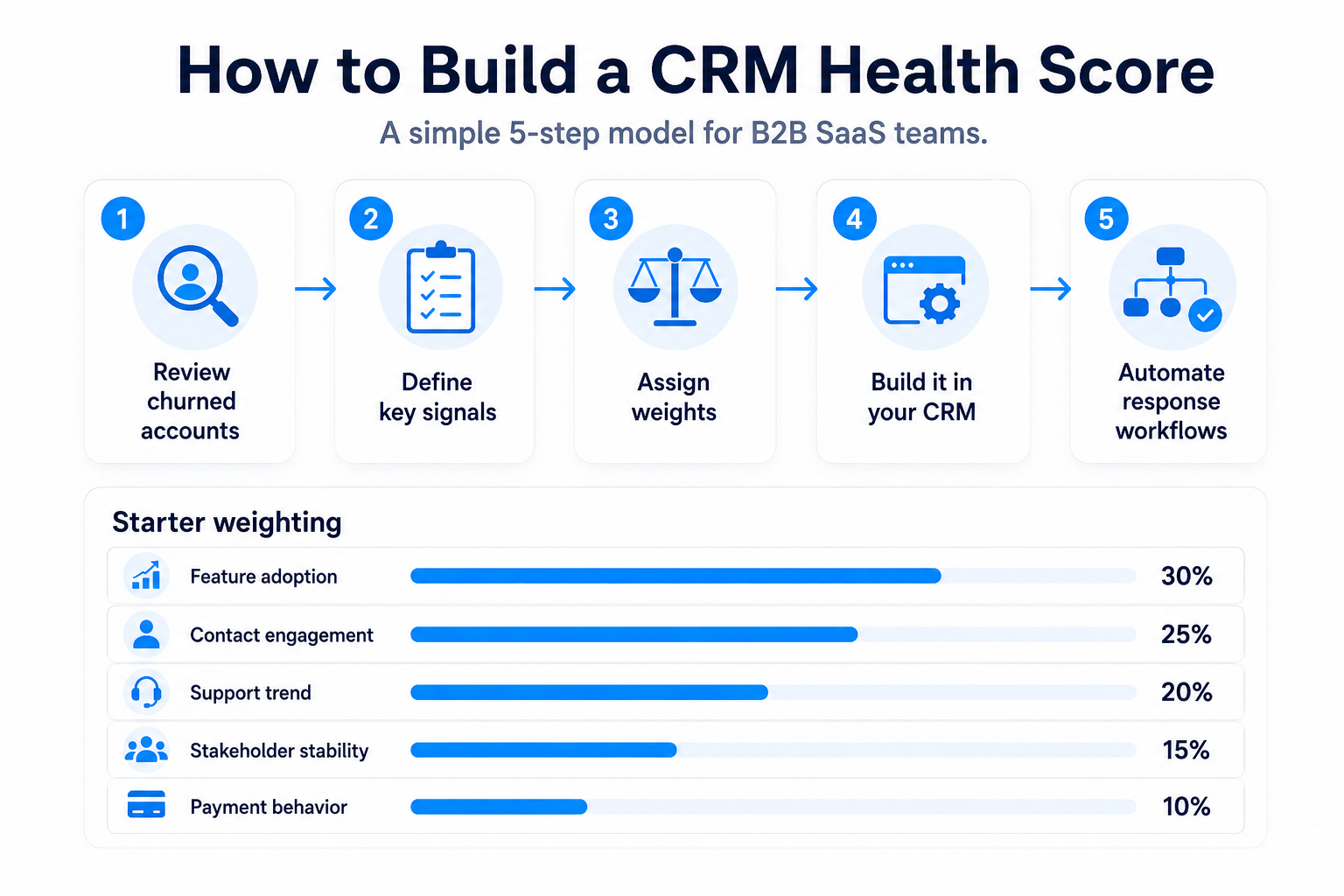
Step 2: Assign Signal Weights
Not all signals carry equal predictive weight. For most B2B SaaS businesses, feature adoption and contact engagement account for the largest share of churn risk, while payment behavior and support volume play a secondary role. A basic starting framework distributes weight like this:
- Feature adoption and active usage: 30%
- Contact engagement rate: 25%
- Support ticket trend: 20%
- Stakeholder map stability: 15%
- Payment behavior: 10%
These percentages are a starting point, not a prescription. Calibrate them against your historical churn data.
Step 3: Build the Score Into Your CRM
Most enterprise CRM platforms support custom scoring fields. HubSpot, for example, lets you create calculated properties that pull from contact activity, deal records, and custom data fields. Salesforce supports health scoring through custom objects and workflow automation.
A well-structured CRM management approach ensures the underlying data quality is high enough for a health score to be meaningful. If your CRM has inconsistent data entry, incomplete contact records, or gaps in activity logging, the score will reflect those gaps.
Step 4: Set Your Health Tiers
Divide accounts into three tiers based on score range. The specific cutoffs depend on your score distribution, but a common setup is:
Green (70 to 100): Healthy accounts. Candidates for expansion conversations, case study requests, and referral programs.
Yellow (40 to 69): At-risk accounts. These need a proactive outreach within 14 days, a value conversation, and a plan to address any identified friction.
Red (0 to 39): Critical accounts. These require immediate attention from a senior customer success manager or account executive. Renewals in this tier need a dedicated save play with executive involvement if needed.
Step 5: Automate the Workflow Response
A health score that lives in a dashboard nobody checks is not a retention tool. It is a reporting metric. The score has to trigger a workflow.
CRM automation sends a task to the assigned customer success manager when an account drops from green to yellow. A separate workflow routes red accounts to a weekly triage call. Renewal opportunity records update automatically when the health score falls below the threshold, moving them to a higher-attention stage in the pipeline.
Where Most B2B SaaS Teams Go Wrong
The most common mistake is building the health score before cleaning the CRM data. A score calculated from incomplete activity logs, duplicate contact records, or missing product usage data will flag the wrong accounts. Teams lose confidence in the model fast.
The second mistake is treating the score as a customer success tool only. Health scores should inform marketing too. Accounts in the yellow tier are not good candidates for upsell email campaigns. Accounts in the green tier are natural candidates for referral asks, community participation, and expansion conversations through both sales and marketing channels.
The third mistake is never updating the model. A scoring model built on 2024 churn data will drift as your product changes and your customer base evolves. Schedule a quarterly calibration. Compare the model's predictions against actual churn outcomes and adjust weights where the model was wrong.
Connecting Health Scores to B2B SaaS Retention Campaigns
Marketing leaders in B2B SaaS are increasingly using health scores to segment retention email campaigns. Instead of sending the same renewal reminder to every account, teams customize the message based on where each account sits in the health tier.
Green accounts get a different email than yellow accounts. The green version focuses on growth and expansion. The yellow version acknowledges the value conversation and offers a business review or training session. Red accounts are removed from automated email sequences entirely, because a poorly timed nurture email can accelerate an exit rather than prevent it.
Health score data also feeds into advertising. Some teams use CRM audiences built from at-risk accounts to run targeted LinkedIn campaigns with content specifically designed to reinforce product value, featuring case studies or outcome data relevant to the account's industry.
Measuring Whether Your Health Score Model Works
A health score model earns trust by predicting churn more accurately over time. Track these metrics to assess model performance:
Churn prediction accuracy: What percentage of accounts that churned were flagged as red in the 90 days before cancellation?
False positive rate: How many accounts scored red but renewed anyway? A high false positive rate wastes customer success capacity.
Yellow-to-green conversion rate: Of accounts that entered the yellow tier, what percentage recovered to green within 60 days? This tells you whether your intervention playbooks are working.
Net revenue retention: Your broadest retention indicator. A working health score model should show up as an improvement in NRR over time
Conclusion
Customer health scoring helps B2B SaaS teams turn everyday CRM activity into an early-warning system for churn. By combining engagement, product usage, support activity, stakeholder changes, renewal timing, and payment behavior, teams can identify risk earlier and take action before accounts reach the cancellation stage.
The most effective models start with clean CRM data, use signals that reflect actual customer behavior, and improve continuously based on real retention outcomes. If your CRM data, automation, or reporting setup is holding your retention strategy back, webdew can help you build a more structured CRM system that supports smarter customer health scoring, automation, and long-term growth.
Dive Into our
Client Testimonials
Listen to business owners like you share how we’ve helped them grow. Your story could be next!





.svg)

“Recently we reached out to Webdew for a website inside of HubSpot and they also did some mocking automation for us.”

“Webdew team was quite honest and quite easy to work with in terms of taking feedback implementing it, showing that it doesn’t happen again and things like making sure that it meets our expectations.”

“We worked with webdew to help us build our HubSpot website and they did an amazing job with it. They were very quick.”

“webdew has helped us optimize the sales and marketing processes, and this is automating a lot of processes.”

“Hi everyone my name is Kara and I work as a channel consultant at HubSpot Singapore. I’ve been working closely with webdew agency”

“Hi my name is Christian from OpenDoors Mortgage team and I’m in the mortgage business and just trying to work on new projects and kind of incorporating HubSpot for my operations”

“I’m one of the technology directors for Travelopia. We are the largest experiential travel company in the world. We’ve engaged webdew recently, not recently, it’s been about a couple of quarters now.”
“We worked with Chehak over the past several months to create a series of animated videos for an academic planner that we produce. And from the very beginning, she was absolutely professional and a pleasure to work with.”


6x
We helped clients multiply their website conversion rates through strategic design and UX optimization.
20%
Our marketing campaigns led to a 20% uplift in customer engagement across digital channels.
2K+
Delivered over 2,000 qualified leads through targeted funnels and smart automation.
120+
Our video content has earned 120,000+ views, driving brand awareness and audience retention.
“I recently had the pleasure of working with Chehak on a video demo project, and I was thoroughly impressed with her services.”
.svg)

Additional Resources
Access expert tips, trends, and strategies designed for small businesses. Stay ahead of the curve and make informed decisions with our comprehensive resources!