

 We typically respond the same day

TL;DR
- A one-time cleanup fixes the database you have; governance keeps the database you will have in eighteen months. B2B SaaS data cleanup only holds when an operating model sits behind it.
- HubSpot governance rests on four pillars: named ownership, written data standards, controls at every entry point, and a monitoring cadence with defined thresholds.
- Most decay enters through the doors nobody guards: forms, imports, integrations, and manual rep entry. Controls belong at those four points.
- Measure data quality with a small standing scorecard rather than ad hoc audits, so drift becomes visible before it reaches reporting.
- HubSpot onboarding is the cheapest moment to install governance, because standards set before go-live cost a fraction of standards retrofitted afterward.
What is legacy data governance in HubSpot?
Legacy data governance is the standing operating model that keeps migrated and newly created records accurate over time: who owns the data model, what the standards are, where the controls sit, and how drift gets caught. It is the difference between a portal that was clean at launch and a portal that is still clean two years later.
The distinction matters because these are separate projects. A pre-migration cleanup is a finite exercise with an end date. Governance is a permanent function with an owner and a cadence. Teams that run the first and skip the second budget for the same cleanup again within two years, usually right before another migration or a reporting crisis. webdew treats governance as part of the onboarding scope for this reason, not as a follow-on project sold later.
If you need the underlying concepts first, our primer on the customer relationship management system covers the fundamentals this framework assumes.
Why does data decay after a clean migration?
Data decays because a CRM is a live system with several unguarded entry points, and every one of them writes records at a different standard. Migration quality is a snapshot; without controls, that snapshot degrades from day one.
Four sources account for most of it:
- Forms. Free-text fields, missing validation, and inconsistent field mapping introduce new format variants faster than anyone cleans them.
- Imports. Lists from events, webinars, and vendors arrive with their own conventions and get uploaded under deadline pressure.
- Integrations. Connected systems write into HubSpot on rules set once and rarely reviewed, and field mappings drift after any property rename.
- Manual entry. Reps working quickly enter what the process requires, in whatever format is fastest, unless the property constrains them.
Natural decay compounds all four. Contacts change jobs, companies get acquired, and email addresses go dead on a predictable curve. Legacy data management is partly about resisting entropy and partly about catching it early.
What are the four pillars of HubSpot data governance?
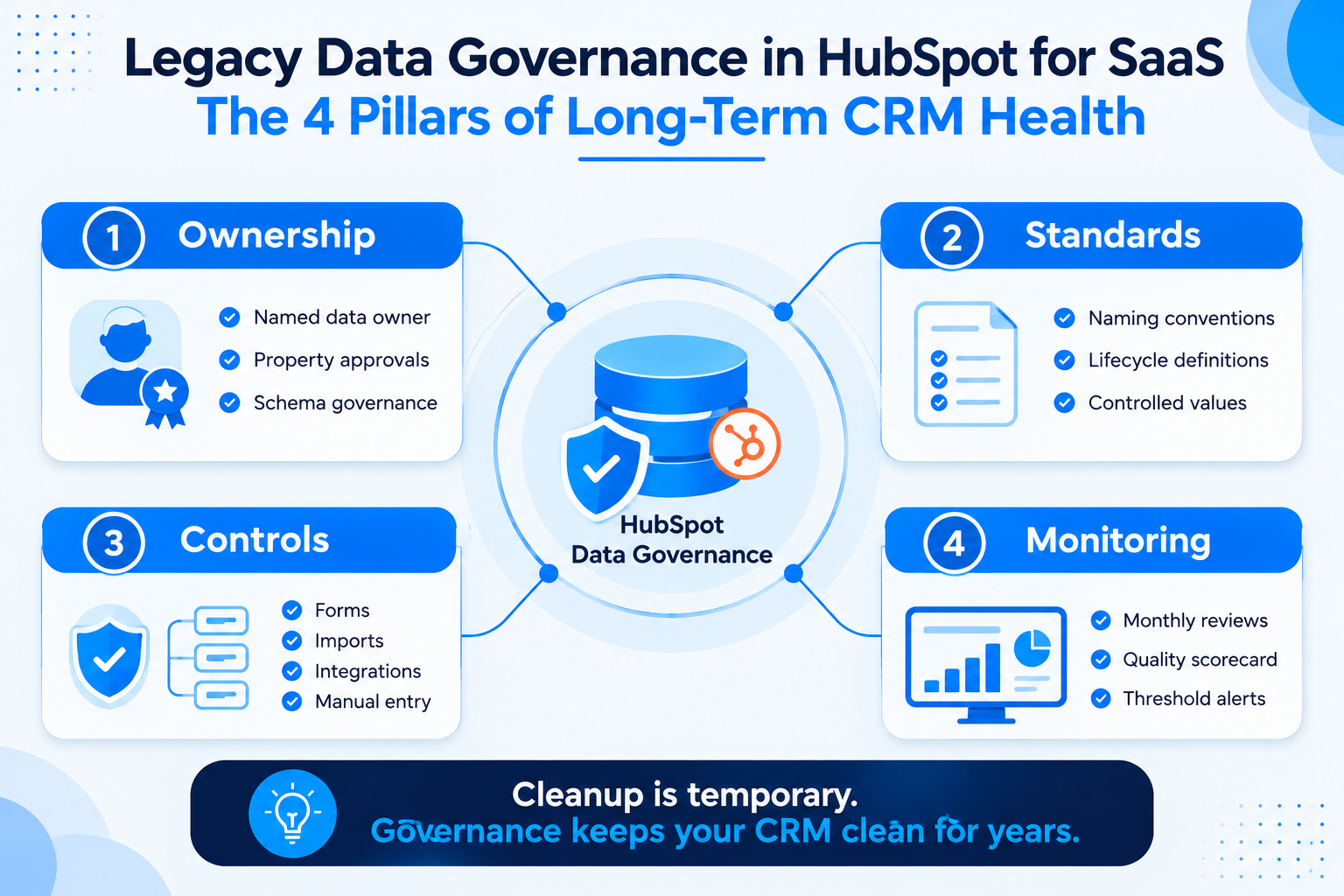
Governance in HubSpot rests on four pillars, and a program missing any one of them will not hold. Each answers a different question about how data stays trustworthy.
1. Ownership
Name one person accountable for the data model, with authority over property creation and schema changes. Not a committee, and not "whoever administers the portal." The owner approves new properties, retires unused ones, and arbitrates when two teams want the same field to mean different things. Portals without this role accumulate duplicate properties within two quarters, and every report inherits the ambiguity.
2. Standards
Write the standards down where every user can read them. A usable standards document covers the format for each key property, the controlled value list for every dropdown, the naming convention for new properties, and the definition of each lifecycle stage. This is dull to produce and it is what makes every other pillar enforceable, because a control cannot enforce a rule nobody wrote.
3. Controls
Put enforcement at the four entry points rather than relying on cleanup afterward:
- Forms: validation rules, dropdowns instead of free text, and progressive profiling instead of long forms that invite junk.
- Imports: a required pre-import mapping check and a staging review before anything touches production.
- Integrations: a documented source of truth per field, so one system wins and the others defer.
- Manual entry: constrained property types, minimal required fields, and automated capture wherever HubSpot can do the logging instead of a rep.
4. Monitoring
Set thresholds and check them on a schedule. Monitoring is the pillar teams skip most often, and it is what turns the other three from documentation into practice.
How should teams measure CRM data quality?
Track a small standing scorecard on a fixed cadence rather than running ad hoc audits when something feels wrong. Five metrics cover most of what matters:
- Duplicate rate, by object. Track contacts and companies separately and set a threshold that triggers a merge cycle rather than waiting for complaints.
- Fill rate on governed properties. Only the fields your process actually depends on. Falling fill rates signal either a broken form or an adoption problem.
- Email deliverability signals. Hard bounce rate is the fastest early warning that list quality is slipping.
- Format compliance. Sample governed dropdown and format-controlled fields for values that arrived outside the standard, which usually means an import or integration bypassed a control.
- Record staleness. The share of records with no activity beyond a defined window, which drives archiving decisions.
Review monthly, with a deeper quarterly pass. Database optimization is not a project you finish; it is a number you watch, and thresholds convert watching into action. Data cleansing tools help at scale, particularly for deduplication and email verification, but they enforce nothing on their own.
How does HubSpot onboarding support governance?
Onboarding is the cheapest moment to install governance, because standards agreed before go-live cost a fraction of standards retrofitted into a live portal. This is the strongest argument for scoping governance into CRM platform services rather than treating it as optional.
A governance-aware onboarding covers five things beyond the migration itself:
- The property model, designed to the standards document rather than inherited from the legacy system's field list.
- Controls configured at all four entry points before the first real record arrives.
- The named owner identified and given authority, in writing, as part of the project.
- The monitoring scorecard built and baselined at go-live, so every later measurement has a comparison point.
- A written handover: standards, decisions, and the review cadence, in a document the team will actually keep.
The same governance layer sits beneath broader revenue operations work, since alignment between teams depends on both trusting the same records. We covered how that fits together in CRM consulting for RevOps alignment, and the data pillar there is what this article details. Teams scoping the work can start with webdew's HubSpot consulting services, where governance is built into the onboarding plan rather than sold as later remediation.
What does a governance review cadence look like?
Run a light monthly check and a substantive quarterly review, with mandatory reviews triggered by structural change. The cadence matters more than the depth; a shallow review that happens beats a thorough one that gets postponed.
- Monthly: scorecard check against thresholds, merge cycle if duplicates exceed the limit, and a scan of new properties created since last month.
- Quarterly: standards document review, integration field-mapping audit, unused property retirement, and a sample check for format compliance.
- Triggered: any pricing change, reorg, new funnel motion, or integration addition forces a review regardless of the calendar.
Two habits keep the cadence alive. Assign the review to a named person with a recurring calendar hold, and report the scorecard somewhere leadership sees it. Governance that lives only in an operations backlog gets deprioritized the first busy quarter, and by the third the drift is expensive again.
Key takeaways
- Cleanup is a project; governance is a function. B2B SaaS data cleanup that ships without an operating model will repeat itself within 2 years.
- The four pillars are ownership, standards, controls, and monitoring. Missing any one collapses the others.
- Guard the four entry points where decay enters: forms, imports, integrations, and manual entry.
- Measure with a five-metric scorecard on a monthly and quarterly cadence, with thresholds that trigger action.
- Install governance during HubSpot onboarding, when it costs least, rather than retrofitting it after the habits have set.
If your portal was clean at launch and is not clean now, the gap is governance rather than cleanup, and another cleanup alone will not close it. Talk to webdew about scoping the ownership model, standards, and monitoring cadence alongside your HubSpot work.
Dive Into our
Client Testimonials
Listen to business owners like you share how we’ve helped them grow. Your story could be next!





.svg)

“Recently we reached out to Webdew for a website inside of HubSpot and they also did some mocking automation for us.”

“Webdew team was quite honest and quite easy to work with in terms of taking feedback implementing it, showing that it doesn’t happen again and things like making sure that it meets our expectations.”

“We worked with webdew to help us build our HubSpot website and they did an amazing job with it. They were very quick.”

“webdew has helped us optimize the sales and marketing processes, and this is automating a lot of processes.”

“Hi everyone my name is Kara and I work as a channel consultant at HubSpot Singapore. I’ve been working closely with webdew agency”

“Hi my name is Christian from OpenDoors Mortgage team and I’m in the mortgage business and just trying to work on new projects and kind of incorporating HubSpot for my operations”

“I’m one of the technology directors for Travelopia. We are the largest experiential travel company in the world. We’ve engaged webdew recently, not recently, it’s been about a couple of quarters now.”
“We worked with Chehak over the past several months to create a series of animated videos for an academic planner that we produce. And from the very beginning, she was absolutely professional and a pleasure to work with.”


6x
We helped clients multiply their website conversion rates through strategic design and UX optimization.
20%
Our marketing campaigns led to a 20% uplift in customer engagement across digital channels.
2K+
Delivered over 2,000 qualified leads through targeted funnels and smart automation.
120+
Our video content has earned 120,000+ views, driving brand awareness and audience retention.
“I recently had the pleasure of working with Chehak on a video demo project, and I was thoroughly impressed with her services.”
.svg)

Additional Resources
Access expert tips, trends, and strategies designed for small businesses. Stay ahead of the curve and make informed decisions with our comprehensive resources!