

 We typically respond the same day

TL;DR
- HubSpot onboarding for mid-market SaaS is a data and lifecycle design project. Configuration comes last.
- A B2B SaaS CRM has to model trials, product usage, expansion, and renewal, not just contacts and deals.
- Three delivery paths exist: HubSpot direct, partner-led, and an in-house build. Migration volume, custom objects, and RevOps capacity decide which fits.
- Define lifecycle stages across marketing, sales, and customer success before any workflow is built. Renaming stages after go-live means rebuilding reports.
- Plan for six to twelve weeks. Data cleanup and integration mapping take longer than the automation build.
What is HubSpot onboarding for a mid market SaaS company?
HubSpot onboarding for a mid-market SaaS company is the structured setup of a B2B SaaS CRM: data migration, object and property design, lifecycle stage definition, integration mapping, automation build, and reporting, handed over so revenue teams can run the system without daily engineering help.
The word onboarding does double duty in SaaS. Customer onboarding is the activation path that moves a new user to first value. CRM onboarding is the internal project that moves a revenue team into HubSpot. This guide covers the second.
Scope separates mid market from small business setups. A twelve person startup can adopt HubSpot with default properties and one pipeline. A mid market SaaS company arrives with several products, a sales motion split across SDRs, account executives, and customer success, years of legacy records, a product database that has to sync, and a board expecting pipeline reporting. webdew works with teams at that stage, where setup decisions made in the first month determine what reporting is possible a year later. Our HubSpot onboarding guide covers the general process.
Why do mid market B2B SaaS funnels break a standard CRM rollout?
Standard rollouts break because they assume one funnel with one conversion point, while mid market B2B SaaS funnels run several entry paths at once: self serve trials, product qualified leads, sales assisted deals, partner referrals, and expansion inside accounts that are already customers.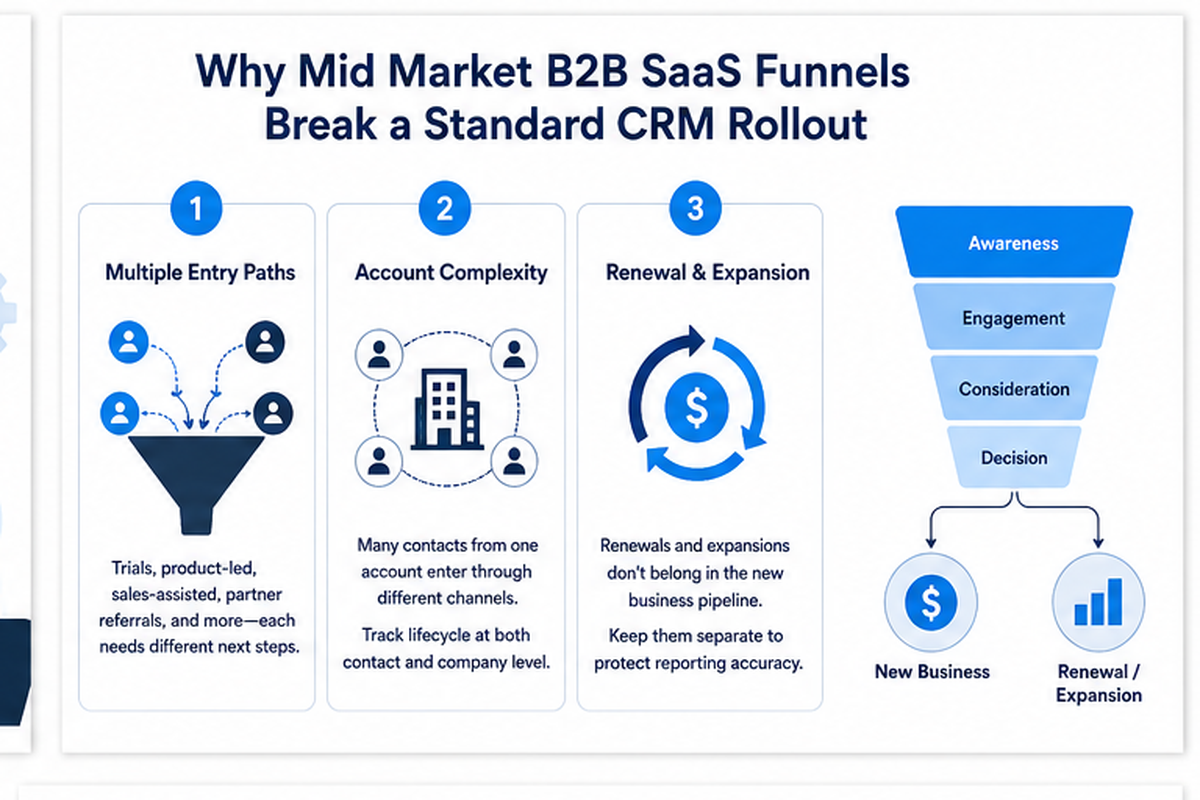
Each path carries its own qualification logic. A trial user who crosses an activation threshold needs a different next action from a contact who booked a demo. Force both into one lead status field and sales loses the signal telling them which conversation to have.
Account structure adds the second problem. In B2B SaaS the buying unit is the company, not the contact. Five people from one account can enter through five channels across three months. Track lifecycle only at contact level and the account view fragments.
Renewal and expansion create the third. Neither fits the new business pipeline, and running them there inflates win rates and hides churn risk. Both need separate pipelines.
Which onboarding path fits: HubSpot direct, partner led, or in house?
Three variables decide the path: how much legacy data has to move, whether custom objects and non standard integrations are required, and how much RevOps capacity exists internally.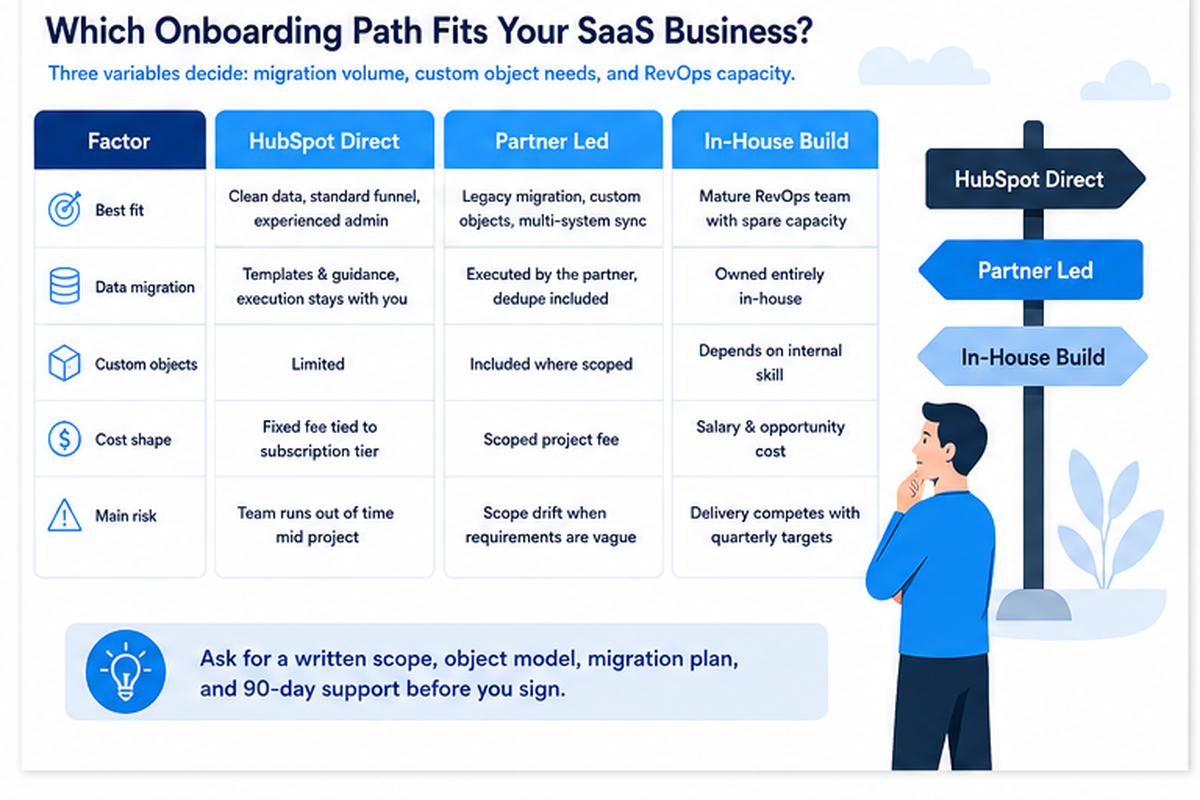
The evaluation questions stay the same on every path. Ask for a written scope naming who owns data migration, how duplicates are resolved, and what the admin handover looks like. Ask to see the proposed object model before signing, not after kickoff. Confirm what support exists in the first ninety days after go live, when the real gaps surface. Our breakdown of HubSpot onboarding services for SaaS covers what a scoped webdew engagement includes.
If a partner is involved, check their HubSpot Solutions Directory listing for tier, certifications, and reviews rather than the claim on their own website.
How should lifecycle automation be mapped before anything is configured?
Lifecycle automation should be mapped on paper first: define each stage, name the single event that moves a record into it, assign an owner, then build workflows against those definitions. Skipping the definition step is the most expensive shortcut in a HubSpot rollout, because every report built afterwards inherits the ambiguity.
A working sequence:
- Write one sentence definitions for every lifecycle stage, in language marketing, sales, and customer success all accept.
- Attach exactly one entry trigger to each stage. When two triggers compete, one belongs to a different stage or property.
- Decide which stages live on the contact record and which on the company record, then set the rule for how one updates the other.
- Map product events into the CRM before automation is built. Trial start, activation, seat count, and usage decline drive a SaaS lifecycle.
- Define what happens the moment a record reaches customer, starting with the handover to customer success. Teams that pair that handoff with SaaS onboarding videos give new accounts a consistent first week.
- Write the reports leadership will ask for, then confirm the properties those reports need already exist.
What should the onboarding scope include for complex funnels?
A scope for a mid market SaaS rollout should cover ten areas: data migration and deduplication, object model design, property governance, integration mapping, pipeline design, routing rules, automation build, reporting, permissions, and documented enablement.
Integration mapping deserves the most attention. Most mid market SaaS tools stacks include a billing system, a product analytics platform, a support desk, and a data warehouse. Each holds fields the CRM needs and fields it should never store. Set the direction of every sync and the system of record for every field before connecting anything, because a two way sync between systems that define a field differently creates errors that are hard to trace.
What goes wrong most often, and how do teams avoid it?
The most common failure is migrating dirty data into a new portal and building automation on top of it. Duplicate companies, inconsistent country values, and free text job titles break routing and segmentation immediately, and the cost of fixing them rises once workflows depend on them. The cleanup belongs before the migration.
Three other patterns repeat. Teams automate too early, wiring dozens of workflows before the lifecycle model is stable. Teams treat reporting as a phase two task, so the properties attribution needs were never collected. And teams finish onboarding without naming an internal owner.
Key takeaways
- Design the data model and lifecycle definitions before configuring anything in HubSpot.
- Track lifecycle at both contact and company level, since the buying unit in B2B SaaS is the account.
- Keep renewal and expansion in pipelines separate from new business.
- Choose the delivery path based on migration volume, custom object needs, and internal capacity.
Where mid market SaaS teams should start
The decisions that shape a B2B SaaS CRM are made before the portal is configured: how lifecycle stages are defined, which objects carry the account relationship, where renewal and expansion live, and which system owns each field. Teams that settle those on paper spend the build phase implementing a plan. Teams that skip them spend the next year rebuilding reports.
If a HubSpot rollout is on the roadmap this year, start with the lifecycle definitions and the reporting requirements, then choose the delivery path that matches the migration ahead. webdew delivers HubSpot onboarding for B2B SaaS teams, from object model design and data migration through lifecycle automation and ongoing CRM management services. Book a scoping call to map your funnel before configuration begins.
Dive Into our
Client Testimonials
Listen to business owners like you share how we’ve helped them grow. Your story could be next!





.svg)
“Recently we reached out to Webdew for a website inside of HubSpot and they also did some mocking automation for us.”
“Webdew team was quite honest and quite easy to work with in terms of taking feedback implementing it, showing that it doesn’t happen again and things like making sure that it meets our expectations.”
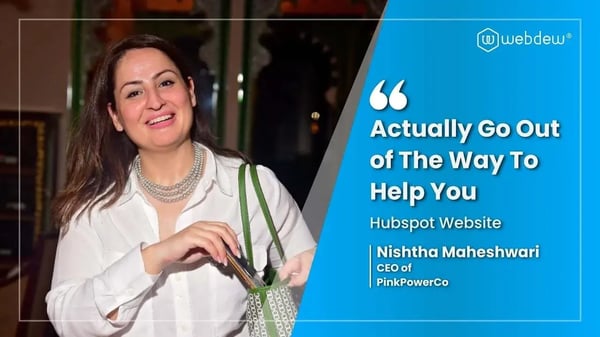
“We worked with webdew to help us build our HubSpot website and they did an amazing job with it. They were very quick.”

“webdew has helped us optimize the sales and marketing processes, and this is automating a lot of processes.”
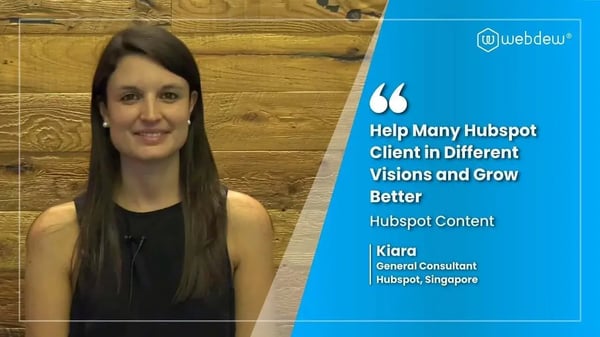
“Hi everyone my name is Kara and I work as a channel consultant at HubSpot Singapore. I’ve been working closely with webdew agency”

“Hi my name is Christian from OpenDoors Mortgage team and I’m in the mortgage business and just trying to work on new projects and kind of incorporating HubSpot for my operations”

“I’m one of the technology directors for Travelopia. We are the largest experiential travel company in the world. We’ve engaged webdew recently, not recently, it’s been about a couple of quarters now.”
“We worked with Chehak over the past several months to create a series of animated videos for an academic planner that we produce. And from the very beginning, she was absolutely professional and a pleasure to work with.”


6x
We helped clients multiply their website conversion rates through strategic design and UX optimization.
20%
Our marketing campaigns led to a 20% uplift in customer engagement across digital channels.
2K+
Delivered over 2,000 qualified leads through targeted funnels and smart automation.
120+
Our video content has earned 120,000+ views, driving brand awareness and audience retention.
“I recently had the pleasure of working with Chehak on a video demo project, and I was thoroughly impressed with her services.”
.svg)

Additional Resources
Access expert tips, trends, and strategies designed for small businesses. Stay ahead of the curve and make informed decisions with our comprehensive resources!