


 We typically respond the same day

TL;DR
- Most HubSpot setup problems are data model problems. Properties, lifecycle stages, and deal stages are defined after the first import, not before.
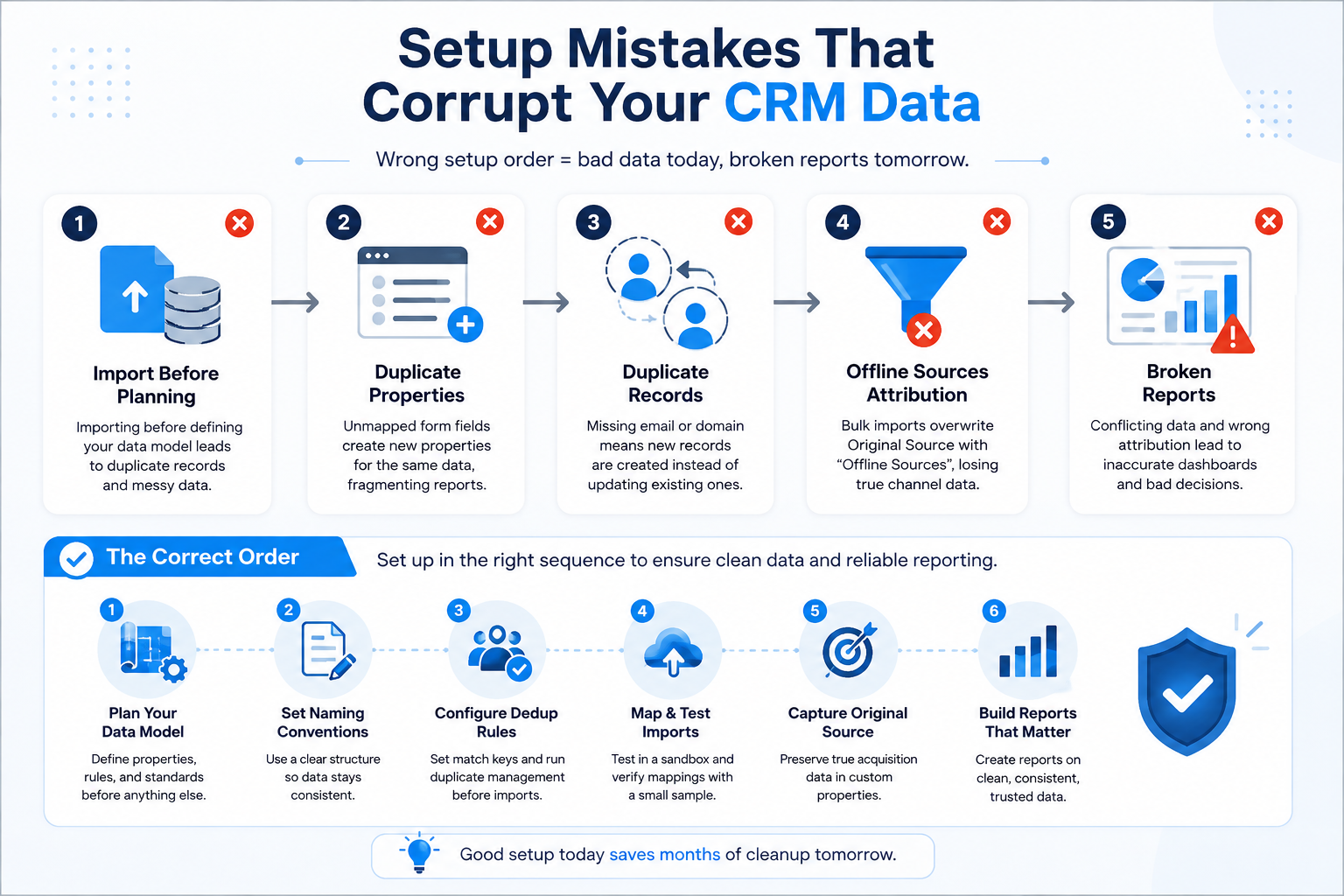
- Bulk-importing contacts stamps Original Source as Offline Sources. HubSpot treats Original Source as read-only after record creation, so the channel that actually produced each lead is gone.
- HubSpot deduplicates contacts on email address and companies on domain name. An import missing those keys creates new records instead of updating existing ones, and a HubSpot merge cannot be undone.
- Deal stages left on HubSpot's default win probabilities produce a forecast that reflects a template sales cycle, not the one the company runs.
- Google and Yahoo have required SPF, DKIM, and DMARC from bulk senders since February 2024, which makes sending domain authentication a go-live blocker rather than a later task.
- Remediation after go-live is usually possible without a rebuild. Trailing history, including attribution and stage timestamps, is rarely recoverable.
What are the most common HubSpot setup mistakes?
The most common HubSpot setup mistakes come from doing the work in the wrong order. Records get imported before the data model exists, lifecycle stage names get agreed on without agreeing on definitions, deal stages get copied from a template, and automation gets switched on before anyone has tested it against real records.
Nine show up repeatedly in B2B SaaS portals:
- Importing contacts and companies before property naming and deduplication rules exist
- Creating duplicate properties through unmapped form fields
- Overwriting Original Source with a bulk import
- Writing lifecycle stages that marketing and sales read differently
- Leaving company-to-contact lifecycle sync on a setting nobody chose
- Mapping deal stages to internal activity rather than buyer-verifiable actions
- Keeping HubSpot's default win probabilities on a custom pipeline
- Enabling workflow re-enrollment across a portal at once
- Sending the first marketing email before the sending domain is authenticated
Webdew sees most of these in portals that were stood up quickly by a small team, then inherited by someone who now has to report on them.
Why do HubSpot setup mistakes only surface months after go-live?
Setup mistakes stay invisible until someone builds a report. A portal with duplicate properties, mixed lifecycle definitions, and template deal probabilities still accepts form submissions, still sends email, and still creates deals. Nothing errors. The cost appears at the first quarterly review, when two dashboards answer the same question differently and nobody can say which one is right.
The mechanism is straightforward. HubSpot records a property value at the moment it changes, and reports read from those stored values. A property that was configured wrong for six months produces six months of wrong history. Fixing the configuration going forward does not repair the trailing data, which is why a setup error found in month seven costs more than the same error found in week two.
What goes wrong when data is imported before the data model is defined?
An import into an undefined data model produces duplicate records, duplicate properties, and attribution that cannot be recovered. HubSpot matches contacts on email address, companies on domain name, and both on Record ID, so a file missing those keys adds records rather than updating them.
How do unmapped form fields create duplicate properties?
When a form field is not mapped to an existing property, HubSpot creates a new one. Three forms asking about company size in three different ways produce three properties, and every dashboard built afterwards uses whichever one its builder happened to find. Some property field types cannot be changed once records hold values, so cleanup becomes a migration rather than an edit.
Set a naming convention before the first form goes live. A source prefix, a plain-language label, and one named owner for property creation prevents most of this.
Which imports create duplicate records instead of updating them?
Any import whose file lacks the matching key for the object being imported: email address for contacts, domain name for companies, or Record ID for either. Without a key HubSpot can match on, every row becomes a new record. Merging duplicates afterwards is manual work, and a merge in HubSpot cannot be reversed. The surviving record absorbs most values and the association history collapses into it, so a wrong merge is permanent.
Run the duplicate management tool before the import rather than after. Where the subscription includes a sandbox, stage the file there first and check what the mapping actually did to 20 records before running it against 20,000.
Original Source overwritten at import
HubSpot sets Original Source when a record is created and treats it as read-only afterwards. A contact imported from a spreadsheet is stamped Offline Sources, which is accurate and useless: the campaign, channel, and referrer that produced the lead are not stored anywhere else. A team that migrates a list and then asks which channel drove last year's pipeline gets one answer for the entire cohort.
Carry original acquisition data into custom properties during migration. Original Source will read Offline Sources, and the custom properties will hold what the reports need.
How should lifecycle stages be configured in HubSpot?
Lifecycle stages should be defined as a handoff agreement between marketing and sales before anyone edits the property, with one written entry criterion and one owner per stage.
HubSpot ships with Subscriber, Lead, Marketing Qualified Lead, Sales Qualified Lead, Opportunity, Customer, Evangelist, and Other. The names are the easy part. The failure is definitional: marketing reads Marketing Qualified Lead as a score threshold, sales reads it as a promise of a real conversation, and both build reports on the same property.
Write entry criteria as observable records rather than adjectives. "Submitted the demo request form" is a criterion. "Shows strong intent" is not.
Lifecycle stage sync between companies and contacts
HubSpot can sync lifecycle stage between a company and its associated contacts. Left on without a deliberate decision, one company moving to Customer pulls every associated contact to Customer, including the ones still in an active nurture sequence. Marketing then reports customers it never acquired and stops emailing people who are still evaluating.
HubSpot's default progression also moves lifecycle stage forward only. A record that should move back after a lost deal needs an explicit workflow action or a manual change, so a portal without that workflow accumulates stale Opportunity records that inflate every funnel report it feeds.
What makes a HubSpot deal pipeline produce an unreliable forecast?
A pipeline forecasts badly when its stages describe what the rep did instead of what the buyer did, and when each stage still carries HubSpot's default win probability. HubSpot assigns a probability to every deal stage and uses it in forecast reporting, so a copied template pipeline forecasts against assumptions about a sales cycle nobody at the company runs.
Two corrections, both cheap before launch and expensive after:
- Rewrite each stage as an event a buyer can be observed completing. "Demo completed" is verifiable. "Interest confirmed" is not.
- Replace default probabilities with the close rate from that stage across the last four complete quarters. Where that history does not exist yet, set numbers the sales lead will defend publicly, then revisit once 30 to 50 deals have closed.
Deal stage timestamps drive velocity reporting, and renaming or reordering stages after deals have already moved through them leaves gaps no report can fill. Pipeline design belongs in setup, not in the first optimization sprint. Teams running HubSpot Sales Hub get stage-level forecast and velocity reporting without custom work, which makes the accuracy of the stage definitions the limiting factor rather than the tooling.
Which HubSpot automation mistakes cause the most damage?
The most damaging automation mistake is enabling re-enrollment on a workflow built for a one-time audience. Re-enrollment is off by default in HubSpot, and switching it on later can enroll every historical record matching the trigger the moment the setting saves.
Four patterns account for most post-launch automation incidents:
- Overlapping enrollment criteria across two nurture workflows, so the same contact enters both and receives two emails an hour apart
- One workflow setting lifecycle stage while another sets it back, which shows up as thousands of property changes on a single record
- No suppression list for customers and open deals, so a paying customer receives an acquisition offer they cannot redeem
- Internal notifications wired to a deactivated user, so nothing routes and nobody notices for weeks
Before publishing a workflow, save it with the action steps unpublished and read the enrollment count. If the number is surprising, the trigger is wrong. Webdew treats that count as a go or no-go check rather than a formality, because a mis-scoped trigger is cheap to catch before publishing and slow to unwind afterwards. Reviewing what HubSpot's marketing automation features can and cannot do at each subscription level is worth doing before the build rather than during it.
What are the most common HubSpot integration mistakes?
Most HubSpot integration mistakes are field-mapping mistakes. Two systems get connected without deciding which one wins when both write the same field, so records either flip back and forth or overwrite each other without an error.
The recurring five:
- Sync direction chosen once at the connector level, with no check of field-level behavior. A two-way sync on a field both systems write is a conflict generator.
- No unique identifier agreed between systems. Email address works until someone changes jobs.
- The connection authenticated by an admin who later leaves, so the sync is tied to a deactivated seat and stops with no obvious symptom.
- Billing or product usage data pushed into free-text properties instead of typed fields, which makes it unreportable.
- No sandbox test, so the first sync writes to production records.
Decide the system of record for every synced field, write it down where the next admin will find it, and confirm what the connector does at field level rather than what the marketplace listing implies. Where a native connector cannot express the rules the business needs, a custom HubSpot integration with explicit conflict handling costs less than two years of reconciling two versions of the same account record.
What do teams skip in the last week before go-live?
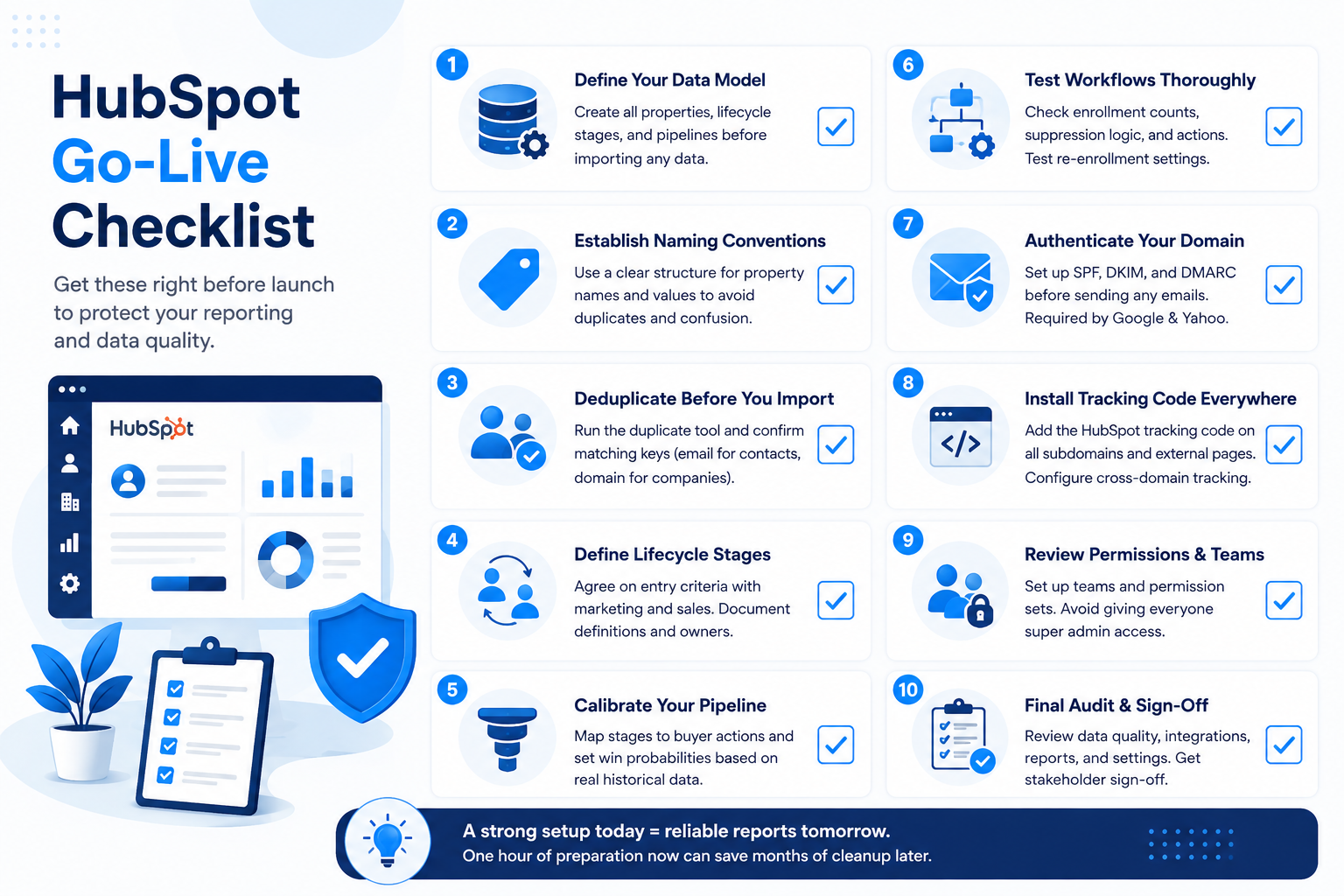
Three items get skipped most often: tracking code coverage, sending domain authentication, and user permissions. All three are cheap to fix before launch and disruptive afterwards.
Where does the HubSpot tracking code need to be installed?
On every subdomain a prospect can touch, including docs, blog, product, and any separately hosted pricing or landing page. HubSpot attributes sessions through its tracking code, so a visitor who converts on a page without the code arrives with no session history attached. Cross-domain tracking has to be configured deliberately. Pages built inside HubSpot carry the code by default, which is one argument for keeping high-intent pages on the CMS. Teams without front-end resource can still build those pages on HubSpot without writing code.
Sending domain authentication
Google and Yahoo have required SPF, DKIM, and DMARC from bulk senders since February 2024, per Google's email sender guidelines. HubSpot requires a connected sending domain for marketing email, and DNS changes take time to propagate. A portal that goes live on Monday and sends its first campaign on Tuesday usually lands in promotions or spam, and the resulting engagement numbers then get read as a content problem.
Permissions and teams
Every user as a super admin means every user can edit properties, delete records, and rewrite workflow logic. Configure teams and permission sets before the first user is invited, not after someone deletes a property that eleven dashboards depend on.
How do you know if your HubSpot setup needs remediation?
Check five things. Two or more failures point to a remediation project rather than incremental fixes.
- Search the property list for "size", "industry", and "budget". More than one property answering the same question is the clearest signal.
- Ask a marketer and a sales rep to define Marketing Qualified Lead separately. If the definitions differ, every funnel report is contested.
- Open the deal pipeline settings. Win probabilities identical to HubSpot's defaults mean the forecast has never been calibrated.
- Open the duplicate management tool. A count nobody has reviewed this quarter means duplicates are still accumulating.
- Group contacts by Original Source. A distribution dominated by Offline Sources means attribution was overwritten at import.
Can you fix a bad HubSpot setup without starting over?
Yes, in most cases. Properties, lifecycle definitions, pipelines, and workflows can all be corrected in place, so a full portal rebuild is rarely the right answer. What cannot be recovered is history: attribution stamped at record creation, stage timestamps that were never captured, and property values overwritten before anyone noticed.
Sequence decides how long it takes. Data model first, then lifecycle and pipeline definitions, then automation, then reporting. Repairing dashboards before the data model produces reports that break again at the next cleanup, which is the most common reason a remediation project runs twice.
Key takeaways
- Setup order matters more than setup speed. Define properties, lifecycle stages, and pipelines before importing anything.
- Original Source is stamped once and read-only afterwards. Preserve acquisition data in custom properties during any migration.
- HubSpot merges cannot be undone, so deduplication belongs before the import.
- Default deal probabilities forecast a template sales cycle. Replace them with observed close rates or defensible estimates.
- Authenticate the sending domain before go-live. Google and Yahoo have required SPF, DKIM, and DMARC from bulk senders since February 2024.
- Remediation works without a rebuild, but trailing history is usually unrecoverable, which makes early detection the whole game
Get the setup audited before the next reporting cycle
Most of the mistakes above take an hour to find and a quarter to unwind. If your portal is producing numbers that two teams read differently, Webdew's HubSpot team can audit the data model, lifecycle definitions, pipeline configuration, and integration field mapping, then sequence the fixes so reporting is rebuilt last rather than first.
.
Dive Into our
Client Testimonials
Listen to business owners like you share how we’ve helped them grow. Your story could be next!





.svg)

“Recently we reached out to Webdew for a website inside of HubSpot and they also did some mocking automation for us.”

“Webdew team was quite honest and quite easy to work with in terms of taking feedback implementing it, showing that it doesn’t happen again and things like making sure that it meets our expectations.”

“We worked with webdew to help us build our HubSpot website and they did an amazing job with it. They were very quick.”

“webdew has helped us optimize the sales and marketing processes, and this is automating a lot of processes.”

“Hi everyone my name is Kara and I work as a channel consultant at HubSpot Singapore. I’ve been working closely with webdew agency”

“Hi my name is Christian from OpenDoors Mortgage team and I’m in the mortgage business and just trying to work on new projects and kind of incorporating HubSpot for my operations”

“I’m one of the technology directors for Travelopia. We are the largest experiential travel company in the world. We’ve engaged webdew recently, not recently, it’s been about a couple of quarters now.”
“We worked with Chehak over the past several months to create a series of animated videos for an academic planner that we produce. And from the very beginning, she was absolutely professional and a pleasure to work with.”


6x
We helped clients multiply their website conversion rates through strategic design and UX optimization.
20%
Our marketing campaigns led to a 20% uplift in customer engagement across digital channels.
2K+
Delivered over 2,000 qualified leads through targeted funnels and smart automation.
120+
Our video content has earned 120,000+ views, driving brand awareness and audience retention.
“I recently had the pleasure of working with Chehak on a video demo project, and I was thoroughly impressed with her services.”
.svg)
